Risk disclosure: Independent research finds 70–84% of Polymarket traders lose money (Sergeenkov, April 2026; Akey et al., SSRN, March 2026). Forex CFDs: 70–85% retail loss rate. Binary options: 80%+ in most jurisdictions. AI agents don't change these baselines. Full disclaimer. Security context: Three critical CVEs disclosed in OpenClaw in Q1 2026 (CVE-2026-25253, CVE-2026-32922) plus the ClawHavoc supply-chain attack (1,184 malicious skills). Always run v2026.4.12 or later. Full security assessment.
Automated trading is often sold as a fix for the emotional mistakes that sink manual traders. It isn't a magic fix — it just moves the difficulty. A bot executes a bad strategy with perfect discipline, which means it loses money consistently instead of erratically. This honest comparison covers what automation actually fixes, what it doesn't, and why the best approach is usually a hybrid.
We compare manual and automated trading on discipline, speed, adaptability, scalability, and the failure modes of each.
TL;DR — The 30-second answer
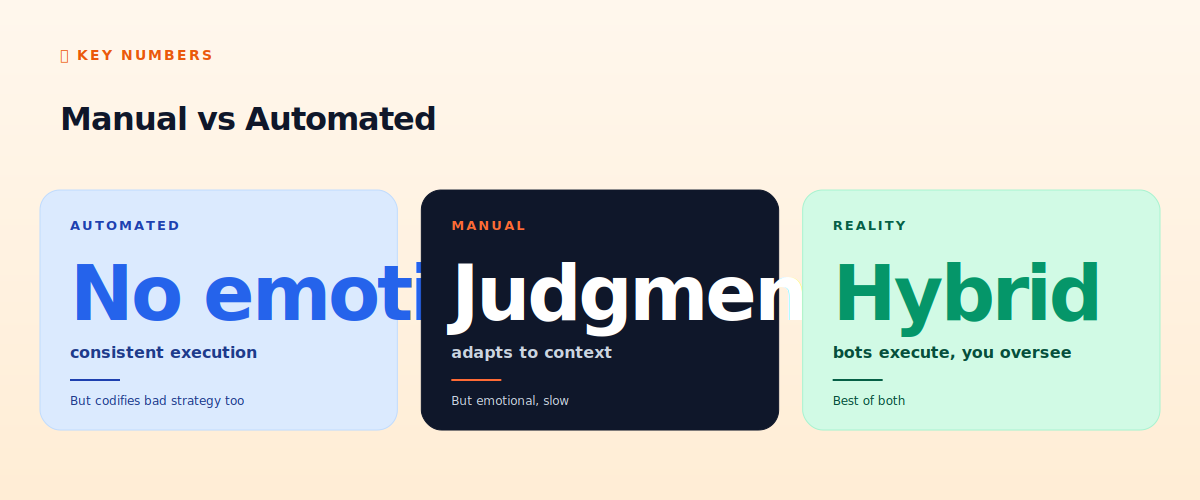
- Automated: consistent execution, no emotion, scales — but codifies bad strategy too.
- Manual: adapts to context, uses judgment — but emotional and slow.
- Automation doesn't fix a bad strategy — it executes it faster and more consistently.
- Bots fail silently; humans fail emotionally. Different failure modes.
- Best approach: hybrid — bots execute, you oversee and adjust.
- Reality: most successful operators combine both.
What each does well
The discipline myth
The pitch for automation is seductive: 'Remove emotion from trading.' And it's true that bots don't panic-sell, don't revenge-trade, don't move stop-losses out of hope. They execute the strategy exactly as coded, every time. For traders whose main problem is emotional discipline, this is genuinely valuable.
But here's the catch the pitch omits: a bot executes a bad strategy with the same perfect discipline as a good one. If your strategy lacks an edge, automating it doesn't create one — it just makes you lose money consistently and efficiently. We've said this throughout the site (see What Is OpenClaw): automation amplifies whatever strategy you give it, good or bad. It's a multiplier, not a fix.
Speed
Automation wins on speed for anything faster than human reaction time. A bot reacts to a price level or a signal in milliseconds (or for OpenClaw, 1.5-3 seconds — still faster than a human reading a chart). For strategies that depend on quick execution, automation is necessary. Manual traders simply can't compete on speed.
Adaptability and judgment
Manual trading wins on judgment. A human can recognize that 'this time is different' — an unprecedented news event, a market regime change, a situation the strategy didn't anticipate. Pure deterministic bots can't; they execute their rules even when the rules no longer fit. (OpenClaw's LLM partially bridges this — it can reason about novel situations — but even it has limits and can hallucinate.) For markets in unusual conditions, human judgment is a real edge.
Failure modes
They fail differently, and understanding this is key:
- Bots fail silently. A bot can run a broken strategy for days, accumulating losses, while you assume it's fine because no alarm fired. Or a bug causes it to place wrong trades systematically. Silent failure is insidious — you don't notice until you check.
- Humans fail emotionally. Manual traders fail in bursts — a revenge-trading spiral after a loss, abandoning the plan during a drawdown, over-sizing after a win. Emotional failure is dramatic but at least you're aware it's happening.
This is why automated trading requires active oversight — daily log review, alerts on every trade, heartbeat monitoring (see the hardening checklist). 'Set and forget' is how bot traders blow up silently.
Scalability
Automation scales; manual doesn't. A bot can monitor 50 markets simultaneously, 24/7, never sleeping. A human can watch a handful of markets during waking hours before fatigue degrades decisions. For strategies requiring breadth or round-the-clock attention, automation is the only practical option.
The hybrid reality
Most successful operators don't choose — they combine. The pattern: bots handle execution (speed, consistency, scale, 24/7 monitoring) while the human handles oversight and high-level judgment (strategy validation, regime-change recognition, intervention when something looks wrong). OpenClaw is well-suited to this hybrid: it automates execution and monitoring while keeping you in the loop via alerts and daily reviews.
The human's job in the hybrid model isn't to execute trades — it's to oversee the system, validate that the strategy still works, and intervene when judgment is needed. This captures automation's consistency and scale while retaining human adaptability where it matters.
The verdict
Don't frame it as manual vs automated. Automate execution (consistency, speed, scale, 24/7 coverage) but retain human oversight (judgment, strategy validation, intervention). Automation is a powerful tool that amplifies your strategy — make sure the strategy is worth amplifying, and never 'set and forget.' The traders who succeed with bots are the ones who treat automation as a supervised tool, not a hands-off money machine.
📧 Get every new tutorial in your inbox
One email per week. Tutorials, CVE disclosures, broker updates. Unsubscribe in one click.
(Connect FluentCRM / ConvertKit / Beehiiv form here)
Frequently asked questions
Does automation remove emotion from trading?
From execution, yes. But it codifies whatever strategy you give it. A bot runs a bad strategy with the same discipline as a good one — it doesn't fix a lack of edge.
Can I just set a bot and forget it?
No. Bots fail silently — running broken strategies for days unnoticed. Active oversight (daily review, alerts, heartbeat) is mandatory.
Is automated trading more profitable?
Only if the underlying strategy has an edge. Automation amplifies your strategy; it doesn't create profitability where none exists.
What's the best approach?
Hybrid: bots execute (speed, consistency, scale), you oversee (judgment, validation, intervention). Most successful operators combine both.
Is OpenClaw manual or automated?
Both, by design. It automates execution and monitoring while keeping you in the loop via alerts and reviews — the hybrid model.
What to read next
- What Is OpenClaw?
- Freqtrade vs OpenClaw
- The 12-Point Hardening Checklist
- Forex Lot Sizing & Risk Management
Sources cited: The Hacker News (CVE-2026-25253 disclosure, Feb 2026); Conscia 2026 OpenClaw Security Crisis advisory; Snyk ToxicSkills study; Cyber Press ClawHavoc reporting; Wall Street Journal Polymarket profitability analysis (May 2026); Andrey Sergeenkov via The Defiant (April 2026); Akey, Grégoire, Harvie & Martineau, SSRN paper (March 2026); openclaw.ai official advisories; Peter Steinberger public statements on X. behavioral finance research on retail trading; OpenClaw operational documentation.