Risk disclosure: Independent research finds 70–84% of Polymarket traders lose money (Sergeenkov, April 2026; Akey et al., SSRN, March 2026). Forex CFDs: 70–85% retail loss rate. Binary options: 80%+ in most jurisdictions. AI agents don't change these baselines. Full disclaimer. Security context: Three critical CVEs disclosed in OpenClaw in Q1 2026 (CVE-2026-25253, CVE-2026-32922) plus the ClawHavoc supply-chain attack (1,184 malicious skills). Always run v2026.4.12 or later. Full security assessment. Affiliate disclosure: Links to brokers (Exness, Deriv, Binance, Bybit, OKX, IQ Option, Pocket Option, Quotex) may earn us a referral commission. Your costs don't change. Our ratings don't either.
If you're a student — in school or university, with limited money and lots of curiosity — OpenClaw is a fascinating thing to learn, but your financial situation demands extra care. You likely don't have money to lose, and the trading-hype ecosystem aggressively targets students with 'get rich while you study' promises. This walkthrough is education-first: how to genuinely learn automated trading while protecting the little capital you have, and how to recognize the schemes aimed at people exactly like you.
The honest truth: the best thing trading can give a student is not income but education — in markets, programming, statistics, and self-discipline. Approached that way, it's genuinely valuable. Approached as a money-maker, it's a trap that has cost many students their savings.
TL;DR — The 30-second answer
- Education first: the real value for a student is learning, not income.
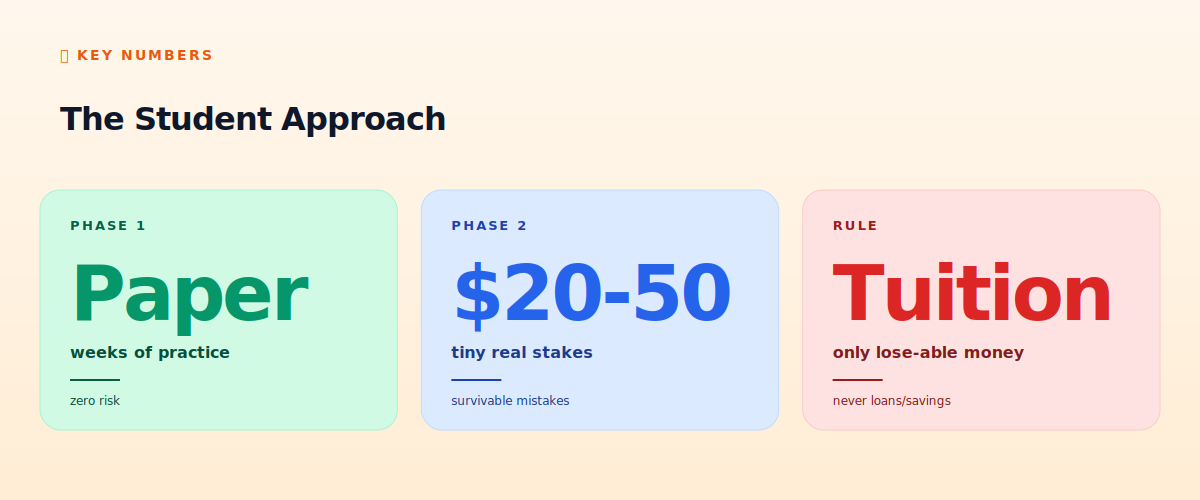
- Phase 1: paper trade for weeks — zero risk, maximum learning.
- Phase 2: tiny real stakes ($20-50) only — survivable mistakes.
- The hard rule: never trade loans, tuition, or savings. Only lose-able money.
- Watch out: 'student trader' schemes specifically target you. They're scams.
- The skills you build (coding, stats, discipline) outvalue any likely trading profit.
The student approach
Why education is the real prize
As a student, you're in an ideal position to learn but a poor position to risk money. Lean into the first. Running OpenClaw teaches you genuinely valuable things: how markets work, programming (building and modifying skills), statistics and probability (understanding edge, variance, risk of ruin), and self-discipline (the hardest and most transferable skill). These compound over a lifetime. A student who spends a year learning trading deeply — even while making no money — gains skills worth far more than the small profits a tiny account could generate. Frame your trading as a learning project, and it becomes one of the best uses of your time. Frame it as income, and it becomes a dangerous distraction.
The education-first plan
- Phase 1 — Paper trading (weeks, $0 risked). This is where most of your learning happens, at zero financial risk. Install OpenClaw (guide), build simple bots, watch them trade fake money, study why they win and lose. Read the beginner series alongside. Spend real time here.
- Phase 2 — Tiny real stakes ($20-50 maximum). Only after substantial paper practice, and only with money you could lose without any impact on your life. The point is feeling real execution and the psychology of real (tiny) money — not profit.
- Phase 3 — Build skills, not just an account. Learn to code skills (if you're technical), understand the statistics, study the strategies. These are the lasting takeaways. The account is secondary to the education.
The hard financial rules for students
These are non-negotiable given a student's situation:
- Never trade student loans. Borrowed money for education is not risk capital. Trading it is a catastrophic mistake that has ruined students. Don't.
- Never trade tuition, rent, or food money. If you need it, don't risk it.
- Never trade savings you'd miss. Only genuinely disposable money — the equivalent of what you'd spend on entertainment.
- No leverage. A student account with leverage is liquidation waiting to happen (see leverage guide).
- Apply the 1% rule strictly (see risk of ruin) — survival discipline matters most when you have little to lose.
The schemes that target students
Be aware: the trading-hype ecosystem specifically targets students, because students are young, optimistic, financially stretched, and active on the social platforms where this content spreads. The pitches — 'I made $10K trading between classes,' 'student forex mentorship,' 'turn your loan into wealth,' 'join my signals group' — are designed to exploit exactly your situation. They're almost universally scams or affiliate traps (see our hype vs reality and scam recognition guides). The 'student trader' flexing wealth on social media is usually either lying, selling a course, or earning affiliate commissions on your losses. Treat every such pitch as a warning sign. Real trading education doesn't come from someone trying to sell you the dream.
Honest expectations for a student
What a student can realistically gain: deep, valuable learning in markets, code, statistics, and discipline; hands-on experience with a cutting-edge tool; and an honest understanding of why most retail trading fails (which itself protects you for life). What a student should not expect: meaningful income, a way to cover expenses, or anything resembling the social-media fantasy. If you finish your studies having learned trading deeply and kept your money, you've won — and the skills you built may matter for your career in ways trading profits never could. Many successful people in finance and tech started by tinkering exactly this way, learning the systems without betting their future on early profits.
The honest verdict
For a student, OpenClaw is a superb learning opportunity and a poor money-making scheme — treat it accordingly. Paper trade extensively, use only trivial real stakes ($20-50) of genuinely disposable money, never touch loans or savings, and be ruthlessly skeptical of the 'student trader' schemes aimed directly at you. The real return is education — in markets, programming, statistics, and discipline — which compounds over a lifetime far beyond what a small account could earn. Learn deeply, risk almost nothing, and let the skills be the profit. That's how a student wins at this.
📧 Get every new tutorial in your inbox
One email per week. Tutorials, CVE disclosures, broker updates. Unsubscribe in one click.
(Connect FluentCRM / ConvertKit / Beehiiv form here)
Frequently asked questions
Should students trade with OpenClaw?
As a learning project, yes — it teaches markets, coding, statistics, and discipline. As a money-maker, no. The real value is education, not income.
How much real money should a student risk?
Very little — $20-50 maximum, and only genuinely disposable money (entertainment-budget equivalent), after extensive paper trading. Never loans, tuition, rent, or savings.
Can I make money trading as a student?
Realistically, no meaningful amount — and chasing it is dangerous. The 70-84% retail loss rate applies. The skills you build are worth far more than likely profits.
Are 'student trader' mentors and signal groups legit?
Almost never. They specifically target students because you're young, optimistic, and stretched. They're usually scams, course sellers, or affiliate traps. Treat every pitch as a warning sign.
What's the real benefit of trading for a student?
Education — in markets, programming, statistics, and self-discipline — which compounds over a lifetime and may matter for your career far beyond any trading profit.
What to read next
- Risk of Ruin: The Math Every Trader Must Know
- AI Trading Hype vs Reality
- OpenClaw for the $100 Beginner
- Binary Options Scams: Recognition Guide
Sources cited: The Hacker News (CVE-2026-25253 disclosure, Feb 2026); Conscia 2026 OpenClaw Security Crisis advisory; Snyk ToxicSkills study; Cyber Press ClawHavoc reporting; Wall Street Journal Polymarket profitability analysis (May 2026); Andrey Sergeenkov via The Defiant (April 2026); Akey, Grégoire, Harvie & Martineau, SSRN paper (March 2026); openclaw.ai official advisories; Peter Steinberger public statements on X. retail loss-rate disclosures; analysis of trading-scheme targeting.