Risk disclosure: Independent research finds 70–84% of Polymarket traders lose money (Sergeenkov, April 2026; Akey et al., SSRN, March 2026). Forex CFDs: 70–85% retail loss rate. Binary options: 80%+ in most jurisdictions. AI agents don't change these baselines. Full disclaimer. Affiliate disclosure: Links to brokers (Exness, Deriv, Binance, Bybit, OKX, IQ Option, Pocket Option, Quotex) may earn us a referral commission. Your costs don't change. Our ratings don't either.
Not everyone wants to be a trader. If your goal is to accumulate assets over the long term with minimal effort — the investor mindset rather than the trader mindset — OpenClaw has a genuinely good fit: automated dollar-cost averaging. This walkthrough is for the passive investor who wants disciplined, hands-off accumulation, not active trading. It's the lowest-effort, lowest-risk use of OpenClaw, and for many people, it's the most sensible one.
There's no shame in passive — quite the opposite. The data consistently shows that most active traders underperform a simple buy-and-hold or DCA approach. If passive accumulation is your goal, you're choosing the strategy that beats most of the people trying to be clever.
TL;DR — The 30-second answer
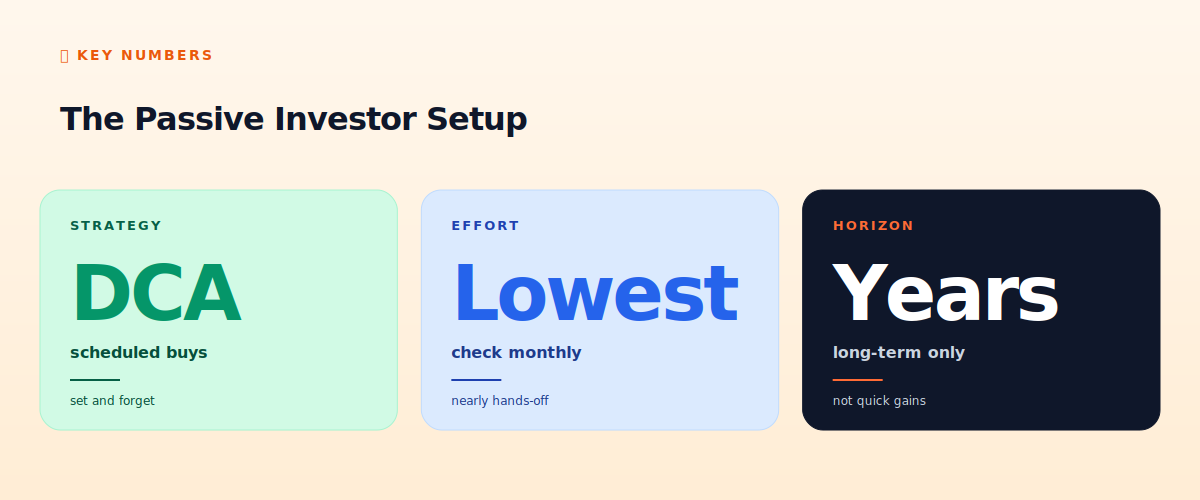
- The fit: automated DCA — scheduled buys, hands-off accumulation.
- Effort: the lowest of any use case. Set it up, check monthly.
- Why it's smart: most active traders underperform simple accumulation.
- Horizon: years. This is long-term building, not quick gains.
- Best for: assets you have long-term conviction in, not speculation.
- The discipline a bot provides: buying consistently regardless of emotion.
The passive investor setup
The investor mindset vs the trader mindset
There's a fundamental fork: the trader tries to profit from price movements through active decisions; the investor accumulates assets over the long term and lets time and growth do the work. These are different games with different skills, and — importantly — the investor's game is easier to win. The data is clear and repeated: most active traders, retail especially, underperform a simple passive approach (the 70-84% loss rates we cite throughout). If your temperament and goals fit the investor mindset, embrace it. You're not settling for less — you're choosing the approach that beats most of the people working much harder.
Why DCA is the passive fit
Dollar-cost averaging — buying a fixed amount at regular intervals regardless of price — is the quintessential passive strategy, and OpenClaw automates it perfectly (see our DCA bot guide). It removes the two hardest things: timing the market (you don't try) and emotional discipline (the bot buys regardless of fear or greed). For a passive investor, a DCA bot is almost the entire toolkit — it accumulates your chosen asset steadily, automatically, without requiring you to make decisions or watch markets. Set the schedule and amount, and let it run.
The setup
- Choose your asset(s) carefully. DCA works for assets you have long-term conviction in — it assumes the asset rises over your long horizon. Choose established assets you believe in, not speculative tokens. DCA into something that goes to zero just loses money steadily.
- Set a sustainable amount and schedule. An amount you can comfortably commit indefinitely (weekly or monthly), through good times and bad. Sustainability matters more than size — a small consistent buy beats a large one you abandon.
- Build a simple DCA bot (or use a community DCA skill you've audited). It checks the schedule, places the buy, logs it, and alerts you. That's the whole machine.
- Fund a dedicated wallet/account with what the bot needs, using trade-only API keys (see wallets guide). Keep the bulk of holdings in cold storage.
- Set a monthly check-in — confirm it's running, review accumulation, ensure funding. That's your entire ongoing effort.
What makes this low-risk
DCA is the lowest-risk OpenClaw use for several reasons: no leverage (no liquidation risk), no timing bets (you're not trying to predict anything), no complex logic that can malfunction expensively, and a long horizon that absorbs short-term volatility. The main risks are the asset itself declining long-term (mitigated by choosing wisely) and security (mitigated by limited bot funds and cold storage for the bulk). Compared to active trading's many failure modes, passive DCA has few — which is exactly why it suits the hands-off investor.
Realistic expectations
Passive DCA is emphatically not get-rich-quick. It's get-rich-slowly-and-boringly, working over years, not weeks or months. In any given month it might be up or down — that's normal and not a reason to stop (stopping DCA during dips defeats its purpose). The realistic expectation: steady accumulation of an asset you believe in, with your average cost smoothed over time, building a position over years. If your chosen asset appreciates over your horizon, you'll have accumulated it sensibly without the stress and losses of active trading. That's the win — modest, patient, and more reliable than most active strategies.
When passive is the right choice
Passive DCA is the right fit if: you don't have time or desire to actively trade, you have long-term conviction in certain assets, you value low stress and low effort, and you're honest that you probably can't beat the market actively (almost no one can). For most people reading this site, passive accumulation is genuinely the most sensible approach — even though it's the least exciting. The active strategies in our strategy guides are there for those who want them, but there's deep wisdom in choosing the boring approach that the evidence supports.
The honest verdict
For the passive investor, OpenClaw's best use is automated DCA — the lowest-effort, lowest-risk way to accumulate assets you believe in over the long term. It removes timing and emotion, requires minimal attention (a monthly check-in), and aligns with the evidence that most active traders underperform simple accumulation. Choose your assets wisely, set a sustainable schedule, secure it sensibly, and let boring compound over years. It won't make for exciting stories, but it's the approach most likely to actually work for most people — and choosing it over active trading you'd probably lose at is a sign of wisdom, not timidity.
📧 Get every new tutorial in your inbox
One email per week. Tutorials, CVE disclosures, broker updates. Unsubscribe in one click.
(Connect FluentCRM / ConvertKit / Beehiiv form here)
Frequently asked questions
What's the best OpenClaw use for a passive investor?
Automated DCA — scheduled buys accumulating an asset you believe in, hands-off. The lowest-effort, lowest-risk use, and the most sensible one for most people.
Why is passive smarter than active trading?
The data: most active traders (70-84% retail) underperform simple accumulation. The investor's game is easier to win than the trader's. Choosing passive beats most people working harder.
How much effort does DCA require?
The least of any use case. Set the asset, amount, and schedule, secure it, then check in monthly. That's the entire ongoing effort.
What's the time horizon for DCA?
Years, not weeks. It's long-term accumulation. Any given month may be up or down — that's normal, and stopping during dips defeats the purpose.
What should I DCA into?
Established assets you have long-term conviction in — DCA assumes the asset rises over your horizon. Not speculative tokens; DCA into something that goes to zero just loses money steadily.
What to read next
- DCA Bots: Automating Dollar-Cost Averaging
- DCA vs Lump Sum: What the Data Says
- Crypto Wallets Explained
- OpenClaw for the Busy Professional
Sources cited: The Hacker News (CVE-2026-25253 disclosure, Feb 2026); Conscia 2026 OpenClaw Security Crisis advisory; Snyk ToxicSkills study; Cyber Press ClawHavoc reporting; Wall Street Journal Polymarket profitability analysis (May 2026); Andrey Sergeenkov via The Defiant (April 2026); Akey, Grégoire, Harvie & Martineau, SSRN paper (March 2026); openclaw.ai official advisories; Peter Steinberger public statements on X. dollar-cost averaging and passive investing research; retail loss-rate disclosures.