Risk disclosure: Independent research finds 70–84% of Polymarket traders lose money (Sergeenkov, April 2026; Akey et al., SSRN, March 2026). Forex CFDs: 70–85% retail loss rate. Binary options: 80%+ in most jurisdictions. AI agents don't change these baselines. Full disclaimer. Security context: Three critical CVEs disclosed in OpenClaw in Q1 2026 (CVE-2026-25253, CVE-2026-32922) plus the ClawHavoc supply-chain attack (1,184 malicious skills). Always run v2026.4.12 or later. Full security assessment.
Before you risk a single real dollar, there's a checklist to complete. This is the definitive pre-live checklist — the consolidated set of everything that should be true before you switch your OpenClaw bot from paper to live capital. Going live prematurely is one of the most common and expensive beginner mistakes; this checklist exists to prevent it. If you can't tick every box, you're not ready.
Treat this as a hard gate, not a suggestion. Every item here exists because skipping it has cost real traders real money. The discipline of completing the checklist before going live is itself a sign you have the temperament to trade.
TL;DR — The 30-second answer
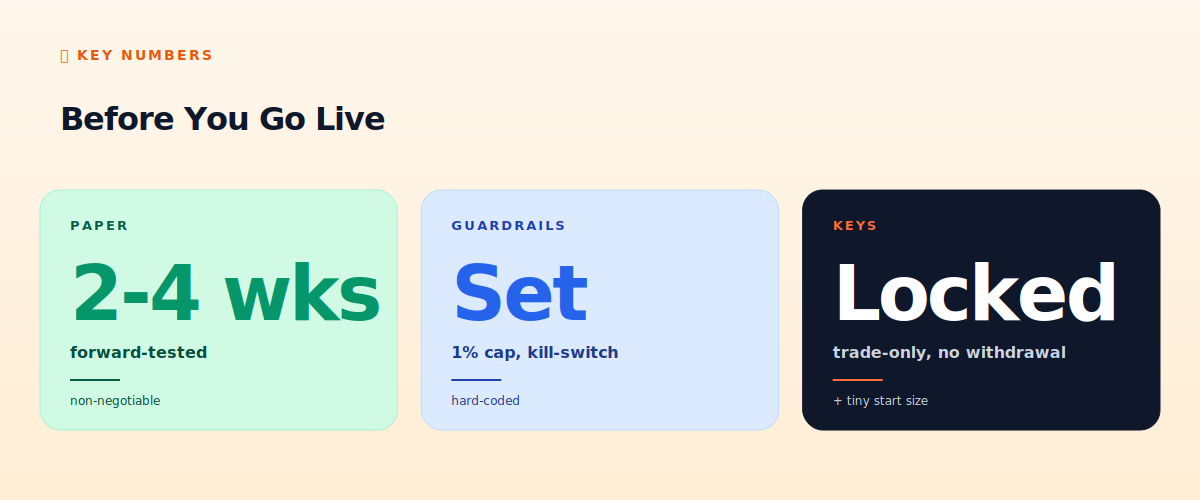
- Paper-tested 2-4 weeks: the full system, forward-tested. Non-negotiable.
- Guardrails hard-coded: 1% risk cap, daily-loss kill-switch, position limits.
- API keys locked: trade-only, never withdrawal; IP-whitelisted; in the keyring.
- Monitoring live: Telegram alerts + heartbeat + a tested kill-switch.
- Start tiny: the smallest real size, with only lose-able capital.
- If you can't tick every box, you're not ready. Go back to paper.
Before you go live
1. Strategy validation
- Paper traded for 2-4 weeks minimum. The complete system (LLM judgment included), forward-tested in real conditions. This is the single most-skipped and most-important item.
- Systematic core backtested (if applicable) with walk-forward analysis, not overfit (see our backtesting guide).
- You understand why it works — you can articulate the edge, not just hope it has one.
- It survived different conditions in paper — not just one favorable stretch.
- Benchmarked against buy-and-hold — does it actually beat the simple alternative? (see our skeptic's trial).
2. Risk management
- The 1% rule is hard-coded — no trade can risk more than 1% of the account (see our risk of ruin guide).
- Position-size caps that no signal can override.
- A daily-loss kill-switch that halts trading after a defined drawdown.
- Stop-losses on every position (see our guide), placed automatically with each entry.
- Leverage minimized or eliminated — especially for beginners (see our leverage guide).
- Capital is genuinely lose-able — not rent, savings, or borrowed money.
3. Security
- API keys are trade-only, never withdrawal-enabled. A compromised key can't drain you (see our wallet hygiene guide).
- Keys stored in the OS keyring, not plain config files.
- IP whitelisting enabled where the exchange supports it.
- The bot runs isolated — ideally a dedicated VPS, not your daily-use machine.
- Every installed skill audited for malicious code (see our skill audit guide) — remember ClawHavoc.
- Bulk holdings in cold storage, only the bot's working capital exposed.
4. Monitoring
- Telegram alerts configured for every trade, error, and daily summary (see our guide).
- A heartbeat so you know immediately if the bot stops — its silence is your alarm.
- A kill-switch tested — a 'close all' command you've confirmed works from your phone, before you need it.
- Comprehensive logging so you can debug issues (see our troubleshooting guide).
- Billing alerts on your LLM provider to catch runaway costs.
5. Operational readiness
- The bot auto-restarts on VPS reboot or crash — it shouldn't stay down silently.
- API error handling (retries with backoff, graceful degradation — see our API errors guide).
- You know how to stop it fast — the kill-switch, and how to halt it manually.
- Configs are version-controlled (Git) so you can roll back changes.
- You've planned your start size — the smallest amount that's still real.
6. Mindset
- Realistic expectations: you understand 70-84% of retail loses and AI confers no alpha (see our hype vs reality). You're not expecting riches.
- You can accept losses without revenge-trading or abandoning your rules.
- You're starting small to prove the live system, not to get rich fast.
- You have a plan to scale only after proven live performance — not before.
The gate
Here's the rule: if you cannot honestly tick every box above, you are not ready to go live. Go back to paper, fix what's missing, and check again. There's no urgency that justifies skipping items — the market will still be there next week. The traders who blow up almost always skipped part of this checklist (usually the paper testing or the risk management). The discipline to complete it fully before risking real money is itself evidence you have the temperament to survive. Rushing past it is evidence you don't — and the market will charge you tuition for the lesson.
The honest verdict
This checklist is a hard gate between paper and live, and every item exists because skipping it has cost real traders real money. Validate the strategy (paper test, benchmark), lock down risk management (1% rule, kill-switch, stops), secure everything (trade-only keys, audited skills, cold storage), set up monitoring (alerts, heartbeat, tested kill-switch), ensure operational resilience, and confirm your mindset is realistic. If every box is ticked, start tiny with lose-able capital. If any box isn't, you're not ready — and recognizing that is wisdom, not failure. The patience to go live only when genuinely prepared is one of the strongest predictors of survival. Tick every box, or stay on paper.
📧 Get every new tutorial in your inbox
One email per week. Tutorials, CVE disclosures, broker updates. Unsubscribe in one click.
(Connect FluentCRM / ConvertKit / Beehiiv form here)
Frequently asked questions
How long should I paper trade before going live?
2-4 weeks minimum, forward-testing the complete system in real conditions across different market situations. It's the single most-skipped and most-important item on the checklist.
What risk management must be in place before going live?
The 1% rule hard-coded, position-size caps no signal can override, a daily-loss kill-switch, automatic stop-losses on every position, minimal/no leverage, and genuinely lose-able capital.
What security is required before going live?
Trade-only API keys (never withdrawal-enabled), keys in the OS keyring, IP whitelisting, an isolated VPS, every skill audited (ClawHavoc!), and bulk holdings in cold storage.
What monitoring should I have?
Telegram alerts for trades/errors/summaries, a heartbeat (its silence is your alarm), a tested 'close all' kill-switch you've confirmed works, comprehensive logging, and LLM billing alerts.
How do I know if I'm ready to go live?
If you can honestly tick every box on the checklist. If you can't, you're not ready — go back to paper and fix what's missing. Recognizing this is wisdom, not failure.
What to read next
- The 12-Point Hardening Checklist
- Risk of Ruin: The Math Every Trader Must Know
- How to Choose Your First Strategy
- Common OpenClaw Mistakes
Sources cited: The Hacker News (CVE-2026-25253 disclosure, Feb 2026); Conscia 2026 OpenClaw Security Crisis advisory; Snyk ToxicSkills study; Cyber Press ClawHavoc reporting; Wall Street Journal Polymarket profitability analysis (May 2026); Andrey Sergeenkov via The Defiant (April 2026); Akey, Grégoire, Harvie & Martineau, SSRN paper (March 2026); openclaw.ai official advisories; Peter Steinberger public statements on X. trading operations and risk management best practices; OpenClaw security guidance.