Risk disclosure: Independent research finds 70–84% of Polymarket traders lose money (Sergeenkov, April 2026; Akey et al., SSRN, March 2026). Forex CFDs: 70–85% retail loss rate. Binary options: 80%+ in most jurisdictions. AI agents don't change these baselines. Full disclaimer. Security context: Three critical CVEs disclosed in OpenClaw in Q1 2026 (CVE-2026-25253, CVE-2026-32922) plus the ClawHavoc supply-chain attack (1,184 malicious skills). Always run v2026.4.12 or later. Full security assessment.
You've learned the concepts, read about the strategies, and now face the practical question: which strategy should you actually start with? This decision guide cuts through the options by matching strategies to you — your available time, capital, risk tolerance, and goals — rather than chasing whatever sounds most exciting. The honest answer for most beginners is simpler and less thrilling than they expect, and that's exactly the point.
There's no universally 'best' strategy — only the best fit for your situation. We'll walk through a decision framework that points you to a sensible starting choice, and steers you away from the strategies that destroy beginners.
TL;DR — The 30-second answer
- No universal best strategy — only the best fit for your situation.
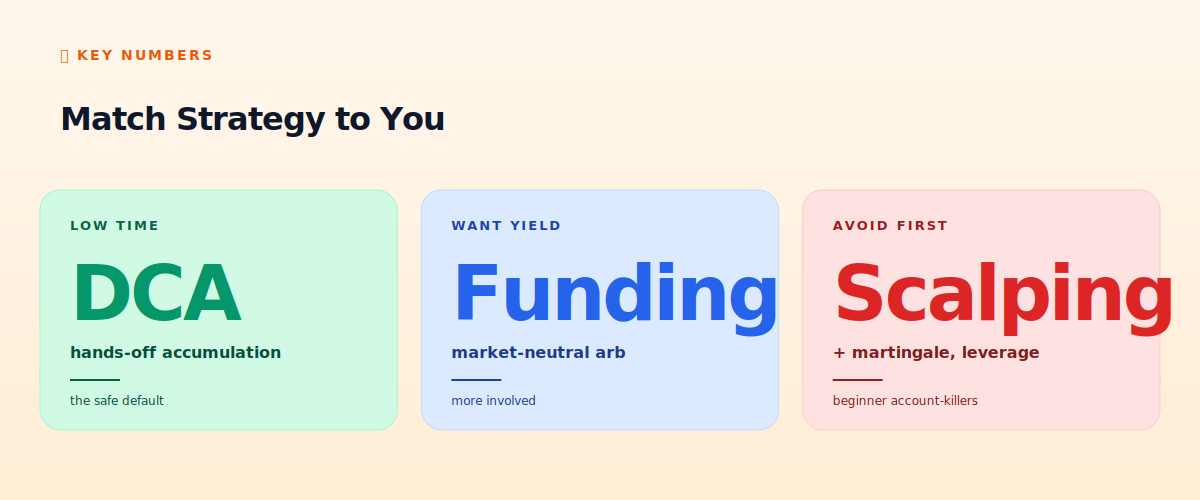
- Low time + low risk tolerance: DCA. The safe default for most beginners.
- Want market-neutral yield: funding rate arbitrage (more involved).
- Comfortable with directional + regime awareness: momentum or mean reversion.
- Avoid first: scalping, martingale, high leverage, market making — beginner-killers.
- Start simpler than you think — you can always add complexity later.
Match strategy to you
The questions that determine your fit
Before picking a strategy, answer these honestly — they determine what fits:
- How much time can you give it? An hour a week, or daily attention? Time constraints rule out active strategies.
- How much capital? Small accounts can't make some strategies economical (fees, minimums).
- What's your risk tolerance? Be honest — can you stomach drawdowns, or will you panic?
- What's your goal? Long-term accumulation? Market-neutral yield? Active trading for its own sake?
- What's your experience? Complete beginner, or do you understand the mechanics?
Your answers point to a fit. There's no shame in the answer being 'the simplest strategy' — that's usually correct.
If you have low time and want low risk: DCA
For most beginners — limited time, modest risk tolerance, long-term goals — the answer is DCA (see our DCA guide). It's the simplest, lowest-risk, lowest-effort strategy: scheduled buys accumulating an asset you believe in. It removes timing and emotion, requires almost no attention, and is nearly impossible to get catastrophically wrong. It won't excite you, but it aligns with the evidence that most active traders underperform simple accumulation. If you're unsure, start here. It's the safe default, and there's deep wisdom in choosing it (see our passive investor guide).
If you want yield without directional bets: funding arbitrage
If you have some capital, want a market-neutral return, and are willing to handle more complexity, funding rate arbitrage (see our guide) is the genuine retail edge on this site. It earns yield while hedged against price direction. It's more involved than DCA (margin management, monitoring, real liquidation risk if careless), so it's not a first-day strategy — but for someone past the beginner stage wanting yield, it's the soundest active option. The HODLer use case (see our guide) is built around it.
If you're comfortable with directional trading: momentum or mean reversion
If you understand the mechanics, can handle drawdowns, and want to trade directionally, the regime-aware pair is momentum (for trends) and mean reversion (for ranges) — see our guides on momentum and mean reversion. The crucial skill is regime detection (knowing which market you're in), since each fails in the other's regime. These require more attention and discipline than DCA or funding arb, and a real risk-management framework (the 1% rule, stops). They're for traders past the beginner stage with the discipline to execute them properly.
What to avoid as a beginner
Some strategies are beginner-killers — avoid these until you're experienced (and some entirely):
- Scalping: OpenClaw can't do it (latency), and it's brutally hard regardless (see our scalping guide).
- Martingale / 'recovery' systems: mathematically guaranteed ruin (see our martingale trap). Never.
- High leverage: the fastest way to liquidation (see our leverage guide).
- Market making: you can't compete with HFT (see our market making guide).
- Triangular arbitrage: too fast and contested for retail (see our guide).
- Binary options: the asymmetric payouts and 80%+ loss rates make them the worst starting point (see why 80% lose).
The decision, simplified
- Complete beginner, unsure? → DCA. Full stop. Start here, learn, expand later.
- Past beginner, want yield, market-neutral? → Funding rate arbitrage.
- Experienced, want directional, disciplined? → Momentum + mean reversion with regime detection.
- Tempted by scalping/martingale/leverage/binaries? → Don't. These are how beginners blow up.
- Whatever you choose: paper trade first, start tiny, follow the pre-live checklist.
The honest verdict
Choosing your first strategy is about matching it to your situation, not chasing excitement. For most beginners, the honest answer is DCA — simple, safe, and aligned with the evidence — and there's wisdom, not weakness, in starting there. As you gain experience, funding arbitrage offers genuine market-neutral yield, and regime-aware directional trading opens up if you have the discipline. But the strategies that sound most exciting — scalping, martingale, high leverage, binaries — are precisely the ones that destroy beginners, so avoid them. The meta-principle: start simpler than you think you need to, prove you can execute with discipline, and add complexity only as you earn it. The trader who starts with humble DCA and survives beats the one who starts with leveraged scalping and blows up — every time.
📧 Get every new tutorial in your inbox
One email per week. Tutorials, CVE disclosures, broker updates. Unsubscribe in one click.
(Connect FluentCRM / ConvertKit / Beehiiv form here)
Frequently asked questions
What strategy should a complete beginner start with?
DCA — simple, lowest-risk, lowest-effort, and aligned with the evidence that most active traders underperform simple accumulation. If you're unsure, start here. There's wisdom in it, not weakness.
What if I want yield without betting on direction?
Funding rate arbitrage — the genuine market-neutral retail edge. More involved than DCA (margin management, monitoring, liquidation risk if careless), so not a first-day strategy, but the soundest active option.
When should I try directional strategies?
Once you're past the beginner stage, understand the mechanics, can handle drawdowns, and have a real risk-management framework. Momentum and mean reversion (regime-aware) are the pair — regime detection is the key skill.
What strategies should beginners avoid?
Scalping (OpenClaw can't, and it's brutal), martingale (guaranteed ruin), high leverage (fast liquidation), market making (can't beat HFT), triangular arbitrage (too contested), and binary options (worst starting point).
How do I decide between strategies?
Match to your situation: time available, capital, risk tolerance, goals, and experience. There's no universal best — only the best fit. And start simpler than you think; you can add complexity later.
What to read next
- DCA Bots: Automating Dollar-Cost Averaging
- Funding Rate Arbitrage
- Building a Multi-Strategy Portfolio
- The Definitive Pre-Live Checklist
Sources cited: The Hacker News (CVE-2026-25253 disclosure, Feb 2026); Conscia 2026 OpenClaw Security Crisis advisory; Snyk ToxicSkills study; Cyber Press ClawHavoc reporting; Wall Street Journal Polymarket profitability analysis (May 2026); Andrey Sergeenkov via The Defiant (April 2026); Akey, Grégoire, Harvie & Martineau, SSRN paper (March 2026); openclaw.ai official advisories; Peter Steinberger public statements on X. strategy selection and risk management literature.