Risk disclosure: Independent research finds 70–84% of Polymarket traders lose money (Sergeenkov, April 2026; Akey et al., SSRN, March 2026). Forex CFDs: 70–85% retail loss rate. Binary options: 80%+ in most jurisdictions. AI agents don't change these baselines. Full disclaimer. Security context: Three critical CVEs disclosed in OpenClaw in Q1 2026 (CVE-2026-25253, CVE-2026-32922) plus the ClawHavoc supply-chain attack (1,184 malicious skills). Always run v2026.4.12 or later. Full security assessment.
You hold crypto for the long term — you're a HODLer — but you wonder if there's a way to earn something on your stack without selling it or taking on directional risk. There is, with care: market-neutral strategies like funding rate arbitrage can generate yield while you remain effectively long, and you can do it without ever touching your cold-stored core holdings. This walkthrough is for the HODLer who wants to make their crypto work a little harder without becoming a trader or risking the stack.
The crucial discipline here is separation: your long-term holdings stay in cold storage, untouched and unrisked, while only a deliberately allocated slice goes toward yield strategies. Get that separation right and you protect what matters while earning on the margin.
TL;DR — The 30-second answer
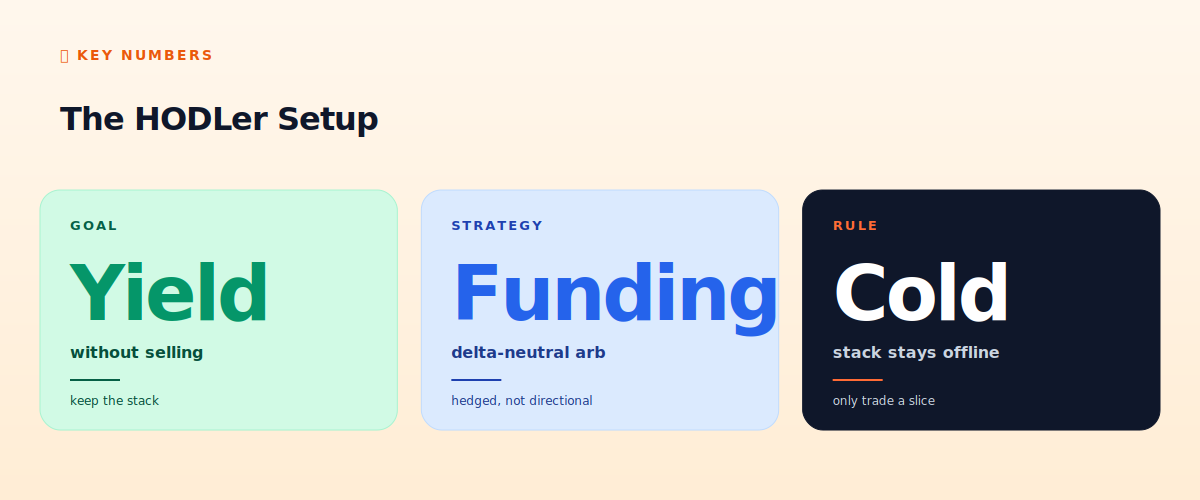
- The goal: earn yield on crypto without selling or taking directional bets.
- The fit: funding rate arbitrage — market-neutral, hedged, real yield.
- The hard rule: core stack stays in cold storage, untouched. Trade only a slice.
- Why not just trade the stack: directional trading risks the holdings you believe in.
- Realistic yield: 5-15% annualized on the allocated slice, with execution risk.
- Never: put your whole stack at risk chasing yield. Separation is everything.
The HODLer setup
The HODLer's dilemma
You believe in your crypto long-term, so you hold rather than trade — sensible, given that most active traders underperform holding. But your stack sits there doing nothing, and you wonder if it could earn something. The temptation is to start trading it — but that's a trap: directional trading puts the holdings you believe in at risk, and if you were good at directional trading you wouldn't be a HODLer. The resolution: market-neutral yield on a separated slice. You earn a return that doesn't depend on price direction (so it doesn't conflict with your long conviction), using only capital you've deliberately set aside — never the core stack.
Why funding rate arbitrage fits
Funding rate arbitrage (see our detailed guide) is the natural fit for a HODLer because it's market-neutral: you hold spot and an offsetting perpetual short, collecting funding payments while hedged against price movement. Your exposure to crypto's price is roughly zero on the arbitrage position — which means it doesn't conflict with your long-term bullish view on your separately-held stack. You're earning a yield (the funding payments) that's largely independent of whether crypto goes up or down. For someone who wants their crypto to earn without betting on direction, it's almost purpose-built.
The realistic yield is 5-15% annualized on the capital deployed in the strategy (not your whole holdings) — modest but real, and market-neutral. It's not free money (there's liquidation risk if margin is mismanaged), but done carefully it generates yield without directional risk.
The separation discipline — the heart of this
This is the most important part. Your setup must rigidly separate two pools:
- The core stack (the bulk): stays in cold storage (see our wallets guide), untouched, unrisked, doing what HODLers do — sitting safely for the long term. Nothing the bot does can touch this.
- The yield slice (a deliberate, limited portion): the only capital allocated to funding arbitrage. Sized so that even a worst-case loss on it (liquidation, execution error) is a tolerable fraction of your total holdings.
The discipline: decide in advance what fraction you're willing to deploy for yield (a conservative HODLer might allocate 5-15% of holdings, keeping 85-95% in cold storage), and never let the yield strategy reach beyond that slice. This separation is what lets you earn yield without endangering the stack you actually care about. Violating it — risking the core to chase more yield — defeats the entire purpose of being a HODLer.
The setup steps
- Keep the core stack in cold storage. Hardware wallet, offline, untouched. This is sacrosanct.
- Allocate a deliberate yield slice to an exchange account — the only capital at risk in the strategy.
- Set up funding rate arbitrage per our guide: spot + offsetting perpetual short, conservative margin (liquidation is the main risk).
- Use trade-only API keys on the exchange account (never withdrawal-enabled), and follow the hardening checklist.
- Monitor margin health via Telegram alerts (guide) — the bot manages the funding position, you supervise the margin.
What to avoid
- Don't trade the core stack directionally. If you wanted to trade, you wouldn't be a HODLer. Keep conviction holdings as holdings.
- Don't over-allocate to the yield slice. Chasing more yield by deploying more of your stack reintroduces the risk you're trying to avoid.
- Don't mismanage margin on the funding arbitrage — liquidation of the short leg is the main way this loses money (see the funding guide).
- Don't chase high-yield 'crypto earn' products promising 20%+ — those usually carry hidden risks (counterparty, lockups) reminiscent of past blowups. Market-neutral arbitrage you control is safer than opaque yield products.
The honest verdict
For the crypto HODLer, OpenClaw enables earning modest, market-neutral yield via funding rate arbitrage — without selling your stack or betting on direction. The entire approach hinges on separation: the core holdings stay in cold storage, untouched, while only a deliberately limited slice is deployed for yield, sized so its worst case is tolerable. Done with discipline — conservative slice, conservative margin, trade-only keys, careful monitoring — you make your crypto work a little harder while protecting what matters. Done carelessly — risking the core, over-allocating, mismanaging margin — you endanger the holdings you set out to protect. Keep the separation sacred, and the HODLer's yield strategy works as intended: a little extra, without the gamble.
📧 Get every new tutorial in your inbox
One email per week. Tutorials, CVE disclosures, broker updates. Unsubscribe in one click.
(Connect FluentCRM / ConvertKit / Beehiiv form here)
Frequently asked questions
Can I earn yield on crypto without selling?
Yes — market-neutral strategies like funding rate arbitrage generate yield while you stay effectively hedged, not directional. You earn without selling or betting on price direction.
Why not just trade my stack?
Directional trading risks the holdings you believe in — and if you were good at it, you wouldn't be a HODLer. Market-neutral yield on a separated slice doesn't conflict with your long conviction.
What yield is realistic?
5-15% annualized on the capital deployed in the strategy (not your whole stack), market-neutral. Modest but real, with liquidation risk if margin is mismanaged.
How much of my stack should I deploy?
A conservative HODLer might allocate 5-15%, keeping 85-95% in cold storage untouched. Size the yield slice so its worst-case loss is a tolerable fraction of total holdings.
What's the key discipline?
Separation. Core stack stays in cold storage, sacrosanct; only a deliberate, limited slice goes to yield. Never let the strategy reach the core — that defeats the purpose of HODLing.
What to read next
- Funding Rate Arbitrage
- Crypto Wallets Explained
- Hot Wallet Hygiene for Bots
- OpenClaw for the Passive Investor
Sources cited: The Hacker News (CVE-2026-25253 disclosure, Feb 2026); Conscia 2026 OpenClaw Security Crisis advisory; Snyk ToxicSkills study; Cyber Press ClawHavoc reporting; Wall Street Journal Polymarket profitability analysis (May 2026); Andrey Sergeenkov via The Defiant (April 2026); Akey, Grégoire, Harvie & Martineau, SSRN paper (March 2026); openclaw.ai official advisories; Peter Steinberger public statements on X. funding rate arbitrage mechanics; crypto custody best practices.