Risk disclosure: Independent research finds 70–84% of Polymarket traders lose money (Sergeenkov, April 2026; Akey et al., SSRN, March 2026). Forex CFDs: 70–85% retail loss rate. Binary options: 80%+ in most jurisdictions. AI agents don't change these baselines. Full disclaimer. Security context: Three critical CVEs disclosed in OpenClaw in Q1 2026 (CVE-2026-25253, CVE-2026-32922) plus the ClawHavoc supply-chain attack (1,184 malicious skills). Always run v2026.4.12 or later. Full security assessment.
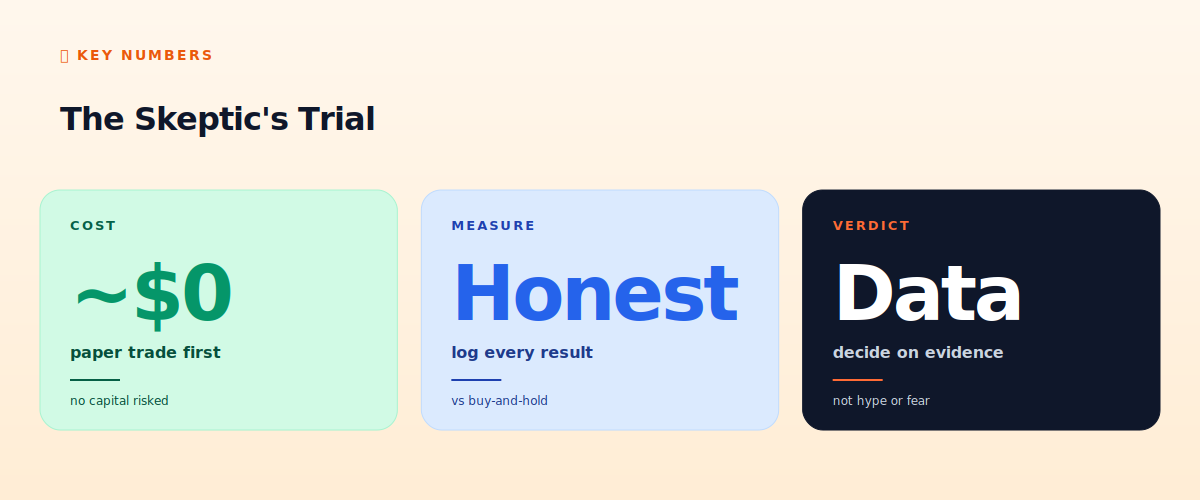
You're skeptical of AI trading — and honestly, you should be. The space is full of hype, scams, and unrealistic promises, and a healthy skepticism is the right starting position. This walkthrough is for the skeptic who's curious despite the doubts and wants a low-commitment, evidence-based way to test whether OpenClaw is worth anything — without taking anyone's word for it, including ours. The plan: paper trade first, measure honestly against a benchmark, and decide based on data rather than hype or fear.
We'll say this plainly: we'd rather you test skeptically and reach your own evidence-based conclusion than believe marketing (ours or anyone's). A skeptic who runs an honest trial will end up better informed than either a true believer or a reflexive dismisser. Let's design that trial.
TL;DR — The 30-second answer
- Healthy skepticism is correct — the AI trading space is full of hype and scams.
- The trial costs ~$0: paper trade first, risking no capital.
- Measure honestly: log every result, compare against just buying and holding.
- The benchmark: did the bot beat simply holding? Usually the honest answer is no.
- Decide on data, not hype or fear. Let the evidence settle it.
- Our honest expectation: you'll find it useful for execution, not for beating the market.
The skeptic's trial
Your skepticism is correct
Let's start by affirming your doubt: the AI trading space genuinely deserves skepticism. It's saturated with '95% win rate bot' scams, course sellers, affiliate traps, and promises that contradict the basic statistics (70-84% of retail loses — see our hype vs reality). A reflexive skeptic who dismisses all of it avoids most of the scams. So your starting position is sound. But skepticism done well isn't reflexive dismissal — it's demanding evidence. The scientific skeptic doesn't say 'this is fake'; they say 'show me the data, gathered honestly.' That's the trial we'll design: a way to test OpenClaw's actual value with evidence you gather yourself, trusting no one's claims.
What we're actually testing
Be precise about the question. We're not testing 'can AI beat the market?' — we'll tell you upfront the honest answer is no (AI confers no alpha — see state of AI agents), and our whole site argues this. What's worth testing is narrower and more honest: is OpenClaw useful for execution, monitoring, and disciplined automation? Does it execute a strategy consistently? Does it remove emotional mistakes? Does it free your time? Is it reliable? These are the real, modest value propositions — not market-beating magic. Test those, not the fantasy, and you'll get a useful answer.
The trial design
- Phase 1 — Paper trade ($0 risked). Set up OpenClaw and run it entirely in paper mode. This costs you nothing but time and validates the basic claims: does it install, run, execute trades, and behave as described? A skeptic risks no capital to answer these.
- Phase 2 — Define a benchmark. The key to an honest trial: compare against an alternative. The obvious benchmark is buy and hold — if you'd just bought the asset and held it over the trial period, how would you have done? Any active strategy must beat this simple baseline to justify its complexity and risk.
- Phase 3 — Log everything honestly. Record every trade, every result, the bot's total performance, and the benchmark's performance over the same period. No cherry-picking, no ignoring the bad days. The whole point of a skeptic's trial is honest data.
- Phase 4 — Run long enough. A week proves nothing (variance dominates). Run the paper trial for at least a month, ideally several, across different market conditions. Short trials lie; longer ones reveal.
How to measure honestly
The honest measurement is where most 'tests' fail — people remember wins, forget losses, and compare against nothing. Avoid these traps:
- Compare against the benchmark, not against zero. 'I made 3%' means nothing if buy-and-hold made 8%. Beating the alternative is the test.
- Count everything, including fees and slippage (paper mode should simulate these; if it doesn't, mentally add them).
- Don't cherry-pick the period. Report the whole trial, including the bad stretches. A strategy that looks great in one month and terrible the next is not a winner.
- Separate luck from skill. A short profitable run might be variance, not edge. This is why the trial must run long enough to distinguish them.
What you'll probably find (our honest prediction)
Here's our genuine expectation, stated upfront so you can hold us to it: you'll likely find that OpenClaw is useful for execution and automation but doesn't beat a simple benchmark. The bot will execute consistently, remove emotional mistakes, and run reliably — real value. But its trading results probably won't beat buy-and-hold, because AI doesn't confer market-beating alpha. If your trial shows OpenClaw dramatically beating the market, be more skeptical, not less — that's likely luck or a too-short period, and it won't persist. The honest, useful conclusion most skeptics will reach: 'this is a capable automation tool, not a money-printing machine' — which is exactly what we've argued throughout the site.
Deciding on data
After an honest, long-enough paper trial with proper benchmarking, you'll have evidence to decide — not hype, not fear, just your own data. Maybe you conclude OpenClaw is worth using for disciplined automation of a strategy you believe in (a reasonable conclusion). Maybe you conclude it's not worth the effort and cost for your situation (also reasonable). Maybe you decide passive DCA (see our passive guide) fits you better than active automation. All of these are legitimate, evidence-based conclusions. The skeptic's victory isn't proving OpenClaw good or bad — it's reaching a conclusion grounded in honest data you gathered yourself, immune to anyone's marketing.
The honest verdict
For the skeptic, the right approach to OpenClaw is exactly your instinct: trust no claims, demand evidence, and test it yourself at near-zero cost. Paper trade extensively, benchmark honestly against buy-and-hold, log everything without cherry-picking, run long enough to separate luck from signal, and decide on data. Our honest prediction — which your trial can confirm or refute — is that you'll find OpenClaw genuinely useful for execution and automation but not for beating the market, because nothing reliably beats the market. A skeptic who runs this trial ends up better informed than believers and dismissers alike. That informed, evidence-based judgment is the goal — and it's the most valuable thing skepticism, done well, produces.
📧 Get every new tutorial in your inbox
One email per week. Tutorials, CVE disclosures, broker updates. Unsubscribe in one click.
(Connect FluentCRM / ConvertKit / Beehiiv form here)
Frequently asked questions
Is skepticism about AI trading justified?
Yes — the space is full of hype, scams, and promises that contradict the statistics (70-84% of retail loses). Healthy skepticism avoids most scams. But skepticism done well demands evidence rather than reflexively dismissing.
How can I test OpenClaw without risking money?
Paper trade. Run it entirely in simulation mode for weeks to months, risking no capital, and measure the results honestly against a benchmark.
What should I compare against?
Buy and hold. If you'd simply bought the asset and held it over the trial period, how would you have done? Any active strategy must beat this baseline to justify its complexity and risk.
What will I probably find?
That OpenClaw is useful for execution and automation but doesn't beat a simple benchmark — because AI confers no market-beating alpha. If it seems to dramatically beat the market, be more skeptical: that's likely luck or too short a period.
How long should the trial run?
At least a month, ideally several, across different market conditions. A week proves nothing — variance dominates short periods. Longer trials separate luck from genuine signal.
What to read next
- AI Trading Hype vs Reality
- The State of AI Trading Agents in 2026
- Backtesting with OpenClaw: Tools & Limits
- OpenClaw for the Passive Investor
Sources cited: The Hacker News (CVE-2026-25253 disclosure, Feb 2026); Conscia 2026 OpenClaw Security Crisis advisory; Snyk ToxicSkills study; Cyber Press ClawHavoc reporting; Wall Street Journal Polymarket profitability analysis (May 2026); Andrey Sergeenkov via The Defiant (April 2026); Akey, Grégoire, Harvie & Martineau, SSRN paper (March 2026); openclaw.ai official advisories; Peter Steinberger public statements on X. retail loss-rate disclosures; performance benchmarking methodology.