Risk disclosure: Independent research finds 70–84% of Polymarket traders lose money (Sergeenkov, April 2026; Akey et al., SSRN, March 2026). Forex CFDs: 70–85% retail loss rate. Binary options: 80%+ in most jurisdictions. AI agents don't change these baselines. Full disclaimer. If trading is affecting your mental health, finances, or relationships, please reach out to a trusted person or professional. This guide is written with care for your wellbeing.
Almost every trading resource tells you how to start, keep going, and improve. Very few tell you when to stop — yet for many people, stopping is the wisest, healthiest, and most profitable decision they can make. This guide is the honest, caring counterweight: how to recognize when trading isn't for you, why quitting can be a smart choice rather than a failure, and the better alternatives that exist. We write this with genuine care for your wellbeing, not to keep you trading.
There's no shame in walking away. The trading industry profits from keeping you in the game; we'd rather you make the decision that's actually best for you, even if — especially if — that's to stop.
TL;DR — The 30-second answer
- Stopping can be the smartest decision — not a failure, but wisdom.
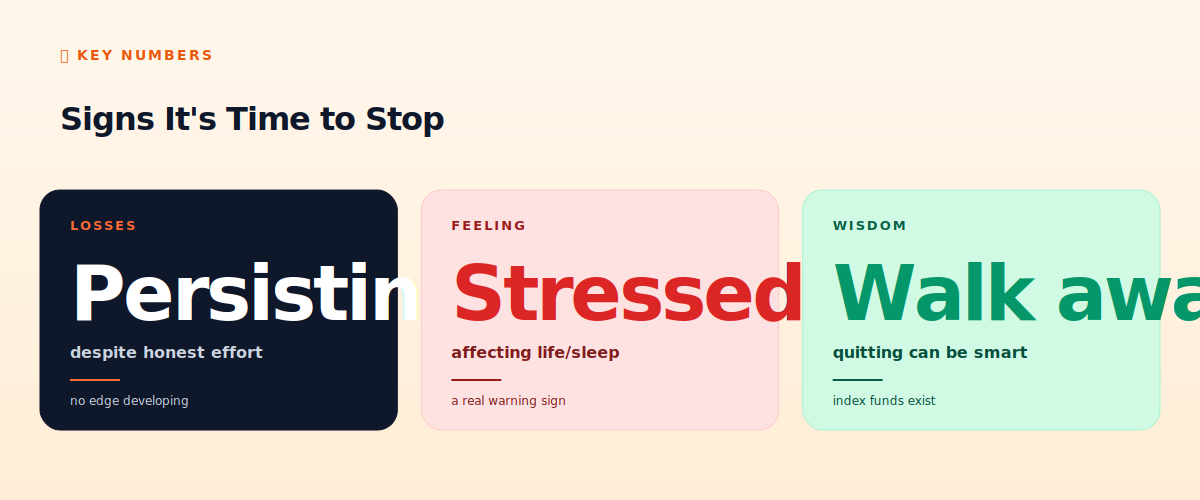
- Signs to stop: persistent losses despite honest effort, no edge developing.
- Bigger warning signs: trading affecting your sleep, stress, finances, relationships.
- The honest math: 70-84% of retail loses; quitting protects the majority.
- Better alternatives exist: index funds, DCA, simply not trading.
- Written with care: your wellbeing matters more than any trading dream.
Signs it's time to stop
Why this guide exists
The trading industry — brokers, course sellers, signal groups, content creators — profits from you continuing to trade, regardless of whether it's good for you. Almost no one in that ecosystem will tell you to stop, because stopping doesn't make them money. So this guide exists to say the thing few will: for many people, the best decision is to stop trading, and that's not a failure — it's clear-eyed wisdom. We have no incentive to keep you trading (this site isn't selling you a course or taking a cut of your losses), so we can say this honestly: if trading isn't working for you, walking away is often the smartest move you can make.
Signs that trading isn't for you
Some honest signals that it may be time to stop:
- Persistent losses despite genuine effort. If you've traded seriously, tracked honestly, and consistently lost over a meaningful period, the evidence is telling you something. Most people don't develop a trading edge — that's not a character flaw, just the reality (70-84% lose).
- No edge developing. If your honest results don't beat simply holding an index or buying-and-holding (see our skeptic's trial), you don't have an edge — and trading without one is a losing game.
- You can't follow your own rules. If you repeatedly break your risk management, revenge trade, or can't stick to a plan, trading may not suit your temperament — and that's okay.
- You're not enjoying the learning. If even the educational value (which we championed for students and beginners) isn't there — if it's just stress and loss — the main justification for continuing is gone.
The more serious warning signs
Beyond 'it's not working financially,' there are signs that trading is actively harming you, and these matter more than any potential profit:
- It's affecting your sleep or stress levels. If you're losing sleep, feeling constant anxiety, or checking prices compulsively, the cost to your wellbeing exceeds any likely financial benefit.
- It's affecting your finances. If you're trading money you need, chasing losses, or it's threatening your financial stability, stop — this is serious.
- It's affecting your relationships. If trading is causing conflict, secrecy, or withdrawal from people you care about, that's a profound warning.
- It feels compulsive. If you can't stop even when you want to, if it has the quality of a compulsion rather than a choice, please treat that seriously — and reach out to a trusted person or professional.
If any of these resonate, please know: your wellbeing matters far more than any trading outcome. Trading is not worth your mental health, your financial security, or your relationships. If it's harming any of these, stopping isn't giving up — it's protecting what actually matters. And if it feels beyond your control, reaching out for support is a sign of strength, not weakness.
Why stopping is often the smart choice
Reframe stopping not as failure but as a rational decision the data supports. The majority of retail traders lose money — so the majority would be financially better off not trading. If you're in that majority (most people are), stopping improves your financial outcome. There's no virtue in persisting at something the evidence shows isn't working for you. The sunk-cost fallacy — 'I've put in so much time/money, I can't quit now' — keeps people trading long past when they should stop. But sunk costs are sunk; the rational question is whether continuing from here is positive, and for most people, honestly assessed, it isn't. Quitting a losing game is winning.
The better alternatives
Stopping active trading doesn't mean doing nothing with your money or giving up on building wealth. The alternatives are often better:
- Index funds: broad, low-cost index investing has historically outperformed the vast majority of active traders, with far less effort and stress. This is what most financial advisors recommend for good reason.
- Simple DCA: if you want crypto exposure, automated dollar-cost averaging (see our DCA guide) captures it without the stress of active trading.
- Just not trading: keeping your money safe and focusing your energy elsewhere is a completely valid choice. Not everyone needs to trade.
- Channeling the interest differently: if you enjoyed the learning, the skills (coding, statistics, markets understanding) transfer to other pursuits without risking your capital.
The honest verdict
This is the guide the trading industry won't write, because we have no stake in keeping you trading. The honest truth: for many people — most, by the numbers — stopping is the smartest, healthiest, and most financially sound decision. If you're losing persistently despite honest effort, if no edge is developing, and especially if trading is harming your sleep, finances, or relationships, walking away isn't failure — it's wisdom. Better alternatives exist (index funds, simple DCA, or simply not trading), and they serve most people better than active trading ever will. We've spent this entire site teaching how to trade as carefully as possible; this guide completes the honesty by acknowledging that the best move, for many, is not to. Your wellbeing comes first. If trading isn't serving it, let it go — and if it ever feels beyond your control, please reach out to someone you trust.
📧 Get every new tutorial in your inbox
One email per week. Tutorials, CVE disclosures, broker updates. Unsubscribe in one click.
(Connect FluentCRM / ConvertKit / Beehiiv form here)
Frequently asked questions
Is quitting trading a failure?
No — it's often wisdom. The majority of retail traders lose money, so the majority would be financially better off not trading. Quitting a losing game is winning, not failing.
What are the signs I should stop trading?
Persistent losses despite honest effort, no edge developing (you don't beat buy-and-hold), repeatedly breaking your own rules, or no longer getting even educational value — just stress and loss.
When is it urgent to stop?
When trading affects your sleep, stress, finances, or relationships, or feels compulsive. Your wellbeing matters far more than any trading outcome. If it feels beyond your control, reach out to a trusted person or professional.
What should I do instead of trading?
Index funds (historically outperform most active traders with less stress), simple automated DCA for crypto exposure, or simply not trading and focusing your energy elsewhere. All are valid, often better, choices.
Why doesn't other trading content say this?
Because the industry profits from keeping you trading — brokers, courses, signals all earn whether you win or lose. This site has no stake in keeping you trading, so we can honestly say: for many, stopping is best.
What to read next
- AI Trading Hype vs Reality
- OpenClaw for the Passive Investor
- Risk of Ruin: The Math Every Trader Must Know
- DCA vs Lump Sum: What the Data Says
Sources cited: The Hacker News (CVE-2026-25253 disclosure, Feb 2026); Conscia 2026 OpenClaw Security Crisis advisory; Snyk ToxicSkills study; Cyber Press ClawHavoc reporting; Wall Street Journal Polymarket profitability analysis (May 2026); Andrey Sergeenkov via The Defiant (April 2026); Akey, Grégoire, Harvie & Martineau, SSRN paper (March 2026); openclaw.ai official advisories; Peter Steinberger public statements on X. retail loss-rate disclosures; behavioral finance on sunk-cost fallacy; index investing research.