Risk disclosure: Independent research finds 70–84% of Polymarket traders lose money (Sergeenkov, April 2026; Akey et al., SSRN, March 2026). Forex CFDs: 70–85% retail loss rate. Binary options: 80%+ in most jurisdictions. AI agents don't change these baselines. Full disclaimer. Security context: Three critical CVEs disclosed in OpenClaw in Q1 2026 (CVE-2026-25253, CVE-2026-32922) plus the ClawHavoc supply-chain attack (1,184 malicious skills). Always run v2026.4.12 or later. Full security assessment. Affiliate disclosure: Links to brokers (Exness, Deriv, Binance, Bybit, OKX, IQ Option, Pocket Option, Quotex) may earn us a referral commission. Your costs don't change. Our ratings don't either.
Trading is marketed relentlessly as the perfect side hustle: passive income, work from your phone, be your own boss, escape the 9-to-5. This walkthrough is the honest counterweight. If you're considering OpenClaw trading as a side income, you deserve the real math on time, money, and realistic outcomes — not the fantasy. The short version: it's not passive, most people don't have an edge, and the better 'side hustle' is building skills that capital can later follow. Let's go through it honestly.
This isn't meant to discourage you from learning — it's meant to set expectations that protect you from the disappointment and losses that come from believing the side-hustle marketing. Going in clear-eyed is the difference between a worthwhile experiment and an expensive lesson.
TL;DR — The 30-second answer
- The marketing: 'passive income side hustle, trade from your phone.'
- The reality: it's not passive — it needs real attention and skill.
- The hard truth: most people don't have a trading edge, at least at first.
- The math: small capital + no edge = small losses, not side income.
- The better bet: build skills first; capital and returns follow skill.
- Honest framing: a learning project that might become income, not instant income.
The side-hustle reality
The marketing vs the math
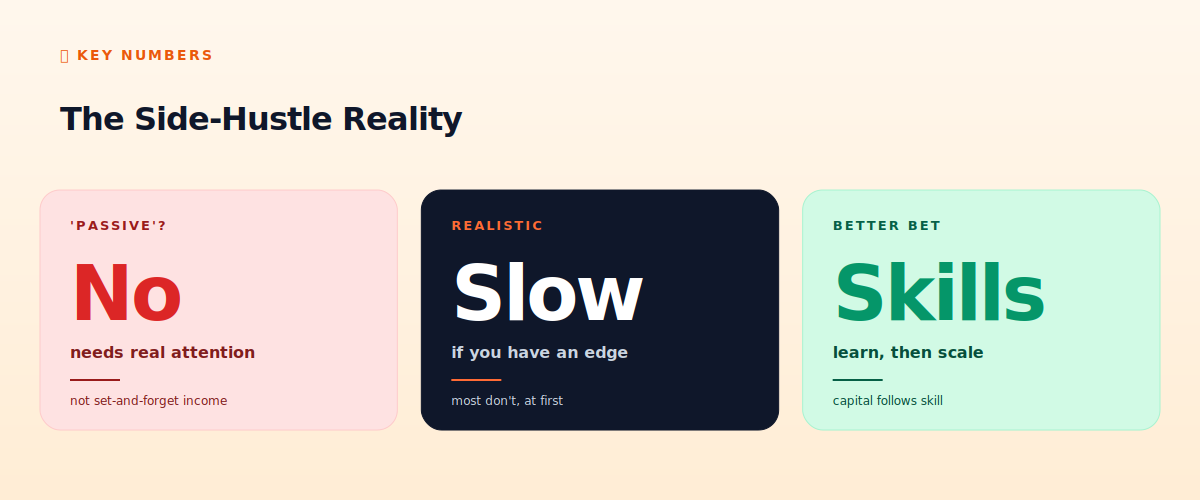
The 'trading as a side hustle' pitch is everywhere: passive income while you sleep, financial freedom from your phone, quit your job by trading part-time. It's compelling and almost entirely false. Here's the math the marketing skips: a side hustle implies meaningful income for modest effort. Trading delivers neither reliably. The 70-84% of retail traders who lose money (see hype vs reality) didn't get a side income — they got a side expense. And the minority who profit mostly did so through significant skill, time, and capital, not casual part-time effort. The 'passive side income' framing collides with the actual statistics.
Why it's not passive
Even well-automated trading is not truly passive. A bot needs setup, monitoring, maintenance, and judgment about changing conditions. Markets shift — a strategy that worked stops working, requiring you to notice and adapt. Things break — APIs change, connections drop, bugs surface. Risk must be managed continuously. 'Passive' implies money arriving with no ongoing effort; real automated trading requires ongoing attention, even if less than active trading. The closest thing to passive is DCA (see our passive investor guide), but that's accumulation, not 'side income' — it builds wealth over years, it doesn't pay you monthly. Anyone selling 'passive trading income' is selling a contradiction.
The edge problem
Here's the crux: profitable trading requires an edge — some genuine reason your trades are positive-expectancy over time. Most people, especially starting out, don't have one. Without an edge, trading is a negative-sum game (after fees and spreads) — you lose money on average no matter how much effort you put in. Automation doesn't create an edge (AI confers none — see state of AI agents); it just executes whatever you have. So the honest side-hustle math is: small capital + no edge + fees = steady small losses. Not income. The few who eventually develop an edge did so through extensive learning and practice — the opposite of a casual side hustle.
The better 'side hustle': build skills first
If you reframe from 'make side income now' to 'build valuable skills that income can follow,' trading becomes genuinely worthwhile:
- Learn deeply — markets, the strategies in our strategy guides, risk management, and (if technical) building skills. These compound.
- Develop and validate an edge over months of paper trading and tiny stakes. Most won't find one; if you do, it's real and earned.
- Let capital follow skill. If you genuinely develop an edge and the discipline to execute it, then deploying more capital makes sense. Skill first, capital second — never the reverse.
This is how the rare successful part-time traders actually got there: years of skill-building before meaningful income, not a quick side hustle. The framing 'I'll learn this properly, and if I develop a real edge, scale it' is honest and can work. The framing 'I'll trade part-time for passive income starting now' is the fantasy that produces the loss statistics.
A realistic plan if you proceed
- Treat year one as education, not income. Paper trade, learn, make tiny real trades. Expect to lose a little; aim to learn a lot.
- Track honestly whether you're developing an edge — log every trade, compare to just holding. Be brutally honest; most don't have an edge, and pretending otherwise is expensive.
- Keep your day job. Never quit reliable income for unproven trading. The 'quit your job to trade' advice has ruined people.
- Scale only on proven edge. If after honest evaluation you have a real, validated edge and the discipline to run it, consider more capital — cautiously, with the risk-of-ruin discipline from our guide.
The honest verdict
As a side hustle, trading is mostly a myth — it's not passive, most people lack an edge, and small capital without an edge produces small losses, not income. The honest reframe is powerful: treat it as a learning project that might, with genuine skill development, become income later. Keep your day job, treat year one as education, track your results brutally honestly, and scale only if you prove a real edge. Approached this way, trading can be a worthwhile long-term skill-building endeavor. Approached as the marketed 'passive side income,' it's a reliable way to donate to the markets while waiting for income that never comes. Build the skill first; let any income follow honestly.
📧 Get every new tutorial in your inbox
One email per week. Tutorials, CVE disclosures, broker updates. Unsubscribe in one click.
(Connect FluentCRM / ConvertKit / Beehiiv form here)
Frequently asked questions
Is trading a good side hustle?
Mostly no. It's not passive, most people lack an edge, and small capital without an edge produces small losses, not income. The 70-84% retail loss rate is the reality behind the marketing.
Why isn't automated trading passive?
It needs setup, monitoring, maintenance, and adaptation as markets change and things break. 'Passive income' implies money with no ongoing effort — real automated trading requires continuous attention.
What's an 'edge' and why does it matter?
A genuine reason your trades are positive-expectancy over time. Without one, trading is negative-sum after fees — you lose on average regardless of effort. Most people don't have an edge, especially at first.
What's the better approach?
Reframe from 'income now' to 'build skills, let capital follow.' Learn deeply, develop and validate an edge over months, and scale only if you genuinely find one. Skill first, capital second.
Should I quit my job to trade?
No. Never quit reliable income for unproven trading — that advice has ruined people. Keep your day job, treat trading as a learning project, and scale only on a proven edge.
What to read next
- AI Trading Hype vs Reality
- Risk of Ruin: The Math Every Trader Must Know
- OpenClaw for the Passive Investor
- The State of AI Trading Agents in 2026
Sources cited: The Hacker News (CVE-2026-25253 disclosure, Feb 2026); Conscia 2026 OpenClaw Security Crisis advisory; Snyk ToxicSkills study; Cyber Press ClawHavoc reporting; Wall Street Journal Polymarket profitability analysis (May 2026); Andrey Sergeenkov via The Defiant (April 2026); Akey, Grégoire, Harvie & Martineau, SSRN paper (March 2026); openclaw.ai official advisories; Peter Steinberger public statements on X. retail loss-rate disclosures; analysis of trading-as-income claims.