Not legal or tax advice. Regulations and tax rules vary and change frequently. Consult a qualified local professional before acting. Risk disclosure: Independent research finds 70–84% of Polymarket traders lose money (Sergeenkov, April 2026; Akey et al., SSRN, March 2026). Forex CFDs: 70–85% retail loss rate. Binary options: 80%+ in most jurisdictions. AI agents don't change these baselines. Full disclaimer. Affiliate disclosure: Links to brokers (Exness, Deriv, Binance, Bybit, OKX, IQ Option, Pocket Option, Quotex) may earn us a referral commission. Your costs don't change. Our ratings don't either.
Nigeria has one of the largest crypto-adopting populations in the world, and a fast-growing community of traders experimenting with AI tools like OpenClaw. This hub covers what Nigerian traders specifically need: how to fund accounts despite banking friction, which brokers and exchanges work well, the regulatory picture after the SEC's 2024 framework, and the practical realities of running a bot from Lagos, Abuja, or anywhere in the country.
We focus on the local specifics — on-ramps, payment methods, naira handling, latency — rather than repeating the general OpenClaw setup, which you'll find in our install guide.
TL;DR — The 30-second answer
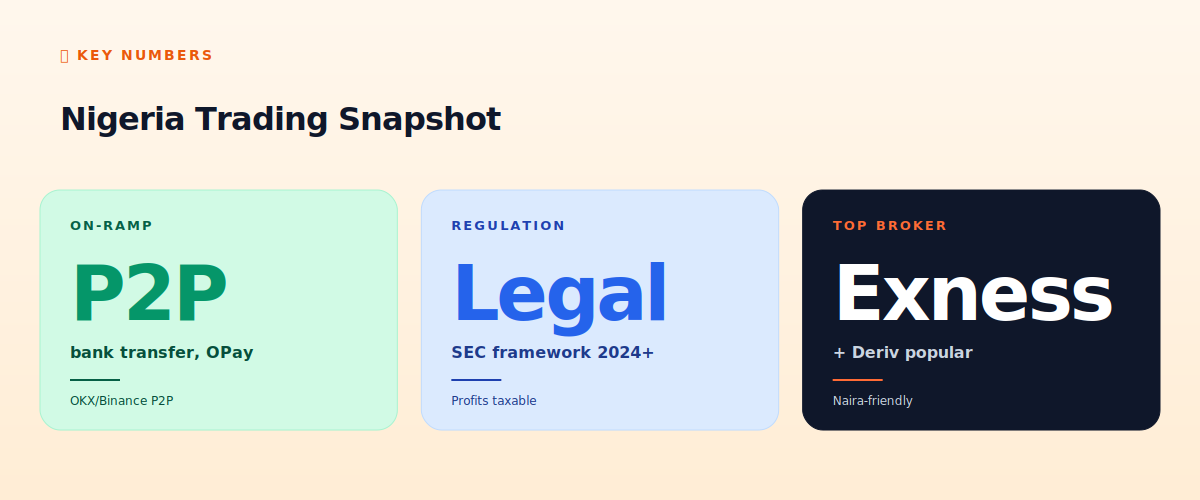
- On-ramp: P2P is king — bank transfer, OPay, PalmPay via OKX/Binance P2P.
- Regulation: legal under the SEC's 2024+ digital asset framework. Profits taxable.
- Best brokers: Exness (naira-friendly, instant withdrawals), Deriv (synthetics popular).
- Crypto exchanges: OKX and Binance P2P for deepest naira liquidity.
- Latency: route bots through EU or a nearby datacenter; local hosting is limited.
- Watch out for: banking restrictions on crypto can cause friction — P2P sidesteps most.
Nigeria trading snapshot
Funding your account — P2P is the answer
Nigeria's banking system has had a complicated relationship with crypto — periods of restrictions on bank-to-exchange transfers have made direct funding unreliable. The practical workaround the entire Nigerian crypto community uses is P2P (peer-to-peer): you buy USDT directly from other users via the P2P marketplaces on OKX or Binance, paying through local methods (bank transfer, OPay, PalmPay, Moniepoint), with the exchange holding the crypto in escrow until payment confirms.
OKX's P2P liquidity for naira is particularly deep (see our OKX review), and Binance P2P remains widely used. This sidesteps the banking friction entirely — you're transacting with individuals, not triggering bank-level crypto flags. Once you hold USDT, you can fund forex brokers or trade crypto directly.
The regulatory picture
After years of ambiguity, Nigeria's SEC introduced a framework (from 2024 onward) that recognizes and regulates digital assets. Crypto trading is legal, and the direction has been toward formalizing the market rather than banning it. Profits are taxable — track your transactions with tax software (see our comparison; Koinly handles Nigerian users well). For the broader regional context, see our crypto regulation guide. As always: this isn't legal advice, and you should verify your specific situation locally.
Best brokers for Nigerian traders
Exness is the standout for Nigerian forex traders — it accepts naira-friendly funding, processes withdrawals instantly, and supports the local payment methods that matter (full review). Deriv is hugely popular for its synthetic indices, low minimums ($5), and local on-ramps (review). For crypto bots, OKX and Binance are the venues (comparison).
Running an OpenClaw bot from Nigeria
Local VPS options in Nigeria are limited, so most Nigerian bot operators run on a VPS in Europe (lower latency to forex brokers) or use DigitalOcean's nearest datacenters. For crypto and Polymarket, the venue's servers (not yours) matter most; a stable EU or South Africa VPS works fine. Follow our VPS comparison for selection. The key local concern is a stable internet connection for initial setup — once the bot runs on a VPS, your home connection doesn't affect it.
The honest reality for Nigerian traders
Nigeria's combination of high crypto adoption, currency volatility, and a young tech-savvy population makes it fertile ground for AI trading interest. But the same caution applies as everywhere: 70-84% of retail traders lose money, AI doesn't change that (see hype vs reality), and the 'forex/crypto will make you rich' narratives common in Nigerian social media are mostly selling courses or affiliate signups. Use OpenClaw as a serious tool with realistic expectations, start small, and never trade money you can't afford to lose.
📧 Get every new tutorial in your inbox
One email per week. Tutorials, CVE disclosures, broker updates. Unsubscribe in one click.
(Connect FluentCRM / ConvertKit / Beehiiv form here)
Frequently asked questions
How do I fund a trading account in Nigeria?
P2P is the practical method — buy USDT from other users via OKX or Binance P2P using bank transfer, OPay, or PalmPay. This sidesteps banking restrictions on direct crypto transfers.
Is crypto trading legal in Nigeria?
Yes, under the SEC's 2024+ digital asset framework. Profits are taxable. Verify your specific situation with a local professional.
Which broker is best for Nigerians?
Exness for forex (naira-friendly, instant withdrawals) and Deriv for synthetic indices. OKX/Binance for crypto.
Can I run an OpenClaw bot from Nigeria?
Yes. Run it on a VPS (EU or nearest datacenter) rather than locally. Once on the VPS, your home internet doesn't affect it.
Do I pay tax on trading profits in Nigeria?
Generally yes — profits are taxable under the current framework. Track transactions with tax software and consult a local professional.
What to read next
- Exness Review 2026
- OKX Review 2026
- Crypto Regulation 2026: SEA, Africa, LATAM
- OpenClaw Trading in Kenya
Sources cited: The Hacker News (CVE-2026-25253 disclosure, Feb 2026); Conscia 2026 OpenClaw Security Crisis advisory; Snyk ToxicSkills study; Cyber Press ClawHavoc reporting; Wall Street Journal Polymarket profitability analysis (May 2026); Andrey Sergeenkov via The Defiant (April 2026); Akey, Grégoire, Harvie & Martineau, SSRN paper (March 2026); openclaw.ai official advisories; Peter Steinberger public statements on X. Nigerian SEC digital asset framework; OKX/Binance P2P data; not current legal authority.