Affiliate disclosure: Links to brokers (Exness, Deriv, Binance, Bybit, OKX, IQ Option, Pocket Option, Quotex) may earn us a referral commission. Your costs don't change. Our ratings don't either. Risk disclosure: Independent research finds 70–84% of Polymarket traders lose money (Sergeenkov, April 2026; Akey et al., SSRN, March 2026). Forex CFDs: 70–85% retail loss rate. Binary options: 80%+ in most jurisdictions. AI agents don't change these baselines. Full disclaimer. Security context: Three critical CVEs disclosed in OpenClaw in Q1 2026 (CVE-2026-25253, CVE-2026-32922) plus the ClawHavoc supply-chain attack (1,184 malicious skills). Always run v2026.4.12 or later. Full security assessment.
OKX is the third major crypto exchange in the OpenClaw bot ecosystem, and arguably the most underrated for our specific audience. Its standout feature is the best P2P fiat on-ramp for Southeast Asia and Africa — local payment methods, deep peer-to-peer liquidity, and acceptance in markets where Binance and Bybit have friction. Combined with slightly lower fees and a solid API, OKX deserves more attention than it usually gets.
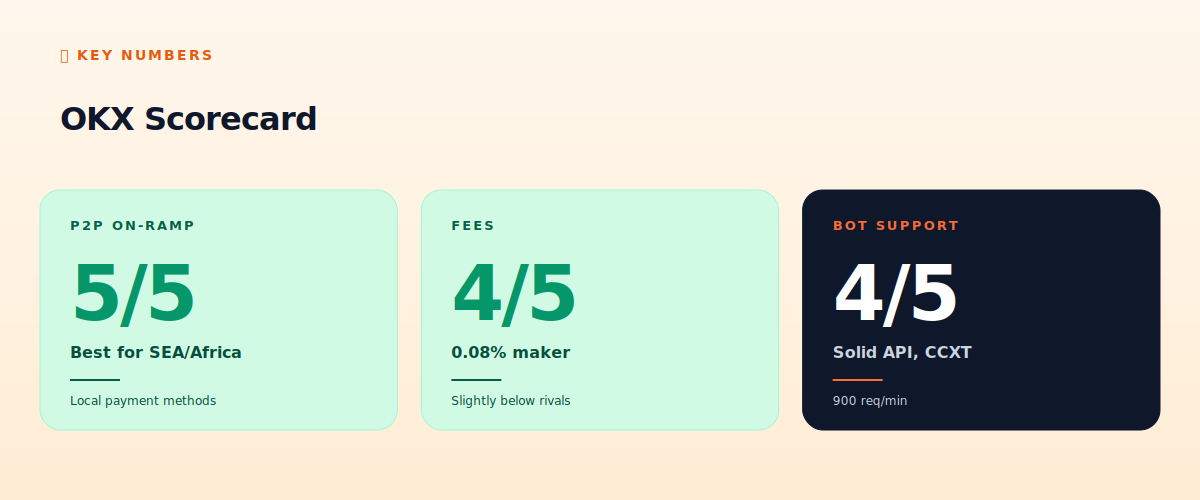
We tested OKX with OpenClaw bots for 30 days. This review covers the P2P on-ramp, fees, regulation, API/bot support, and the verdict. Overall: 4.0/5 — excellent for our regions, slightly behind on liquidity and ecosystem.
TL;DR — The 30-second answer
- Rating: 4.0/5. Underrated. Best P2P on-ramp for SEA/Africa.
- Regulation: offshore + some regional licenses. US restricted.
- Standout: P2P fiat access with local payment methods.
- Watch out for: liquidity slightly below Binance/Bybit on some pairs.
- OpenClaw fit: good — CCXT support, 900 req/min.
- Best for: SEA/Africa traders who need clean local fiat access.
Scorecard
The P2P on-ramp advantage
For traders in Nigeria, Vietnam, Indonesia, the Philippines, and similar markets, getting fiat into a crypto exchange is often the hardest part. Bank transfers get blocked, cards get declined, and international wires are expensive. OKX's P2P marketplace solves this elegantly: you buy USDT directly from other users using local payment methods (mobile money, local bank transfers, regional e-wallets), with OKX acting as escrow.
In our experience, OKX's P2P liquidity is deeper and the local payment method coverage broader than Binance's P2P (which has narrowed in some regions due to regulatory pressure). For our core audience, this is often the deciding factor — OKX is simply easier to fund.
Fees
Spot: 0.08% maker, 0.10% taker at the base tier — marginally cheaper than Binance and Bybit on the maker side. OKB token holders get further discounts. Futures: 0.02% maker, 0.05% taker. The fee advantage is small but real; over high volume it adds up.
Regulation
OKX operates offshore with some regional licenses (Dubai VARA, Bahamas, others). It's restricted in the US. Its regulatory profile is broadly similar to Binance and Bybit — legitimate operation in many markets, offshore structure, regional restrictions. OKX has had less regulatory drama than Binance, partly due to lower profile.
API and OpenClaw compatibility
OKX's API is solid: REST + WebSocket, CCXT support, 900 req/min rate limits (between Binance's 1200 and Bybit's 600). Documentation is good. We ran a statistical-arbitrage bot on OKX for 30 days — reliable execution, accurate data, no significant issues. CCXT integration is mature.
Pros and cons
Pros: best P2P fiat on-ramp for SEA/Africa; marginally lower fees; solid API (900 req/min); good liquidity on major pairs; less regulatory drama than Binance.
Cons: liquidity below Binance/Bybit on some pairs; smaller ecosystem; US restricted; less name recognition (which matters less for bots).
The verdict
OKX earns 4.0/5 and is genuinely underrated for our audience. If you're in SEA or Africa and struggle with funding other exchanges, OKX's P2P on-ramp may be the single most valuable feature of any exchange we review. The slightly lower fees and solid API are bonuses. For pure liquidity, Binance still leads, but the funding advantage often outweighs that for our readers.
Use OKX if: you're in SEA/Africa and need clean local fiat access, you want marginally lower fees. Consider Binance if: maximum liquidity is your priority and funding isn't a problem for you.
📧 Get every new tutorial in your inbox
One email per week. Tutorials, CVE disclosures, broker updates. Unsubscribe in one click.
(Connect FluentCRM / ConvertKit / Beehiiv form here)
Frequently asked questions
Why is OKX good for SEA and Africa?
Its P2P marketplace has deep local-payment-method liquidity, making it easier to fund than Binance or Bybit in many of these markets.
Is OKX safe?
Comparable to Binance and Bybit — legitimate operation, offshore structure, regional restrictions. Standard precautions apply: don't keep more on the exchange than you trade.
Are OKX fees lower?
Marginally. 0.08% maker vs 0.10% on Binance/Bybit. OKB token holders get further discounts.
Does OKX support OpenClaw?
Yes, via CCXT. 900 req/min. Reliable in our 30-day test.
Can US residents use OKX?
No, OKX is restricted in the US.
What to read next
Sources cited: The Hacker News (CVE-2026-25253 disclosure, Feb 2026); Conscia 2026 OpenClaw Security Crisis advisory; Snyk ToxicSkills study; Cyber Press ClawHavoc reporting; Wall Street Journal Polymarket profitability analysis (May 2026); Andrey Sergeenkov via The Defiant (April 2026); Akey, Grégoire, Harvie & Martineau, SSRN paper (March 2026); openclaw.ai official advisories; Peter Steinberger public statements on X. OKX API documentation; regional licensing records; our 30-day live bot test.