Affiliate disclosure: Links to brokers (Exness, Deriv, Binance, Bybit, OKX, IQ Option, Pocket Option, Quotex) may earn us a referral commission. Your costs don't change. Our ratings don't either. Risk disclosure: Independent research finds 70–84% of Polymarket traders lose money (Sergeenkov, April 2026; Akey et al., SSRN, March 2026). Forex CFDs: 70–85% retail loss rate. Binary options: 80%+ in most jurisdictions. AI agents don't change these baselines. Full disclaimer. Security context: Three critical CVEs disclosed in OpenClaw in Q1 2026 (CVE-2026-25253, CVE-2026-32922) plus the ClawHavoc supply-chain attack (1,184 malicious skills). Always run v2026.4.12 or later. Full security assessment.
Bybit is the second-largest crypto derivatives exchange and the preferred venue for many futures-focused OpenClaw bots. Its calling card is the cleanest derivatives trading interface in the business — genuinely better than Binance's for perpetual futures — combined with a solid API and competitive fees.
We tested Bybit with OpenClaw perpetual-futures bots for 30 days. This review covers the futures experience, regulation, fees, API/bot support, and the verdict. Overall: 4.1/5 — excellent for futures, slightly behind Binance on liquidity and API maturity.
TL;DR — The 30-second answer
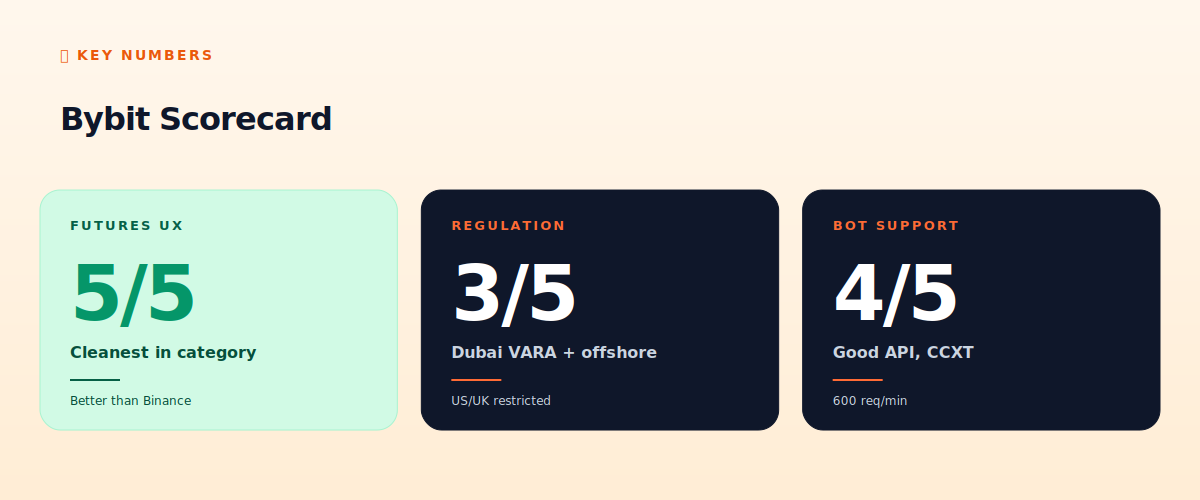
- Rating: 4.1/5. Best futures UX outside Binance. Strong number two.
- Regulation: Dubai VARA license + offshore. US/UK restricted.
- Standout: cleanest perpetual futures interface in crypto.
- Watch out for: thinner liquidity than Binance on less-popular pairs.
- OpenClaw fit: good — CCXT support, 600 req/min.
- Best for: futures-focused bot traders who want clean execution.
Scorecard
The futures experience
Bybit built its reputation on derivatives, and it shows. The perpetual futures interface is cleaner, more intuitive, and better-organized than Binance's — position management, liquidation prices, funding rates, and margin modes are all clearly presented. For traders running futures strategies, the reduced cognitive load matters, even when bots handle execution (you still need to monitor).
Bybit supports USDT-margined and coin-margined perpetuals, inverse contracts, and options. Our Bybit futures tutorial walks through bot setup. We ran a funding-rate strategy for 30 days — clean execution, accurate liquidation calculations, reliable settlement.
Regulation
Bybit holds a Dubai VARA (Virtual Assets Regulatory Authority) license, which gives it a regulated base, plus offshore operations for international clients. It's restricted in the US and the UK. For SEA, Africa, and LATAM, Bybit generally operates, though as with all crypto exchanges, local conditions vary.
Bybit's regulatory profile is similar to Binance's — some legitimate oversight, significant offshore operation, regional restrictions. Slightly less regulatory drama than Binance historically, but also less scrutiny because it's smaller.
Fees
Spot: 0.10% maker/taker base tier. Futures: 0.01% maker, 0.06% taker — notably, the maker fee is lower than Binance (0.02%), making Bybit attractive for maker-heavy strategies, while the taker fee is higher. If your bot primarily provides liquidity (limit orders that rest on the book), Bybit's maker rebate structure can be cheaper than Binance.
API and OpenClaw compatibility
Bybit's API is solid — comprehensive REST + WebSocket, CCXT support, decent documentation. Rate limits are tighter than Binance (600 req/min vs 1200), which rarely matters for OpenClaw bots running at LLM speed but could constrain multi-strategy setups on a single key. We found the API reliable over 30 days, with occasional documentation gaps that required testing to resolve.
Pros and cons
Pros: best futures interface in crypto; lower maker fees than Binance; Dubai VARA regulation; strong for derivatives strategies; good API and CCXT support.
Cons: thinner liquidity than Binance on less-popular pairs; tighter API rate limits; US/UK restricted; slightly less mature documentation than Binance.
The verdict
Bybit earns 4.1/5 as the strongest number two in crypto. For futures-focused bot traders, its clean interface and maker-friendly fees make it genuinely competitive with Binance. For spot trading or maximum liquidity, Binance still leads. Many serious traders run both — Binance for liquidity, Bybit for futures clarity and maker rebates.
Use Bybit if: you focus on futures, your strategy is maker-heavy, you want the cleanest derivatives UX. Consider Binance if: you need maximum liquidity or trade many low-cap pairs.
📧 Get every new tutorial in your inbox
One email per week. Tutorials, CVE disclosures, broker updates. Unsubscribe in one click.
(Connect FluentCRM / ConvertKit / Beehiiv form here)
Frequently asked questions
Is Bybit better than Binance for futures?
The interface is better and maker fees are lower. Binance still has deeper liquidity. Many traders use both.
Is Bybit regulated?
Holds a Dubai VARA license plus offshore operations. US and UK restricted. Regional availability varies.
What are Bybit's fees?
Spot 0.10%. Futures: 0.01% maker (lower than Binance), 0.06% taker (higher). Maker-heavy strategies benefit.
Does Bybit support OpenClaw?
Yes, via CCXT. 600 req/min rate limit. Reliable in our 30-day test.
Can US residents use Bybit?
No, Bybit is restricted in the US and UK.
What to read next
- Binance Review 2026
- OKX Review 2026
- OpenClaw + Bybit Futures Tutorial
- Binance vs Bybit vs OKX for Bots
Sources cited: The Hacker News (CVE-2026-25253 disclosure, Feb 2026); Conscia 2026 OpenClaw Security Crisis advisory; Snyk ToxicSkills study; Cyber Press ClawHavoc reporting; Wall Street Journal Polymarket profitability analysis (May 2026); Andrey Sergeenkov via The Defiant (April 2026); Akey, Grégoire, Harvie & Martineau, SSRN paper (March 2026); openclaw.ai official advisories; Peter Steinberger public statements on X. Bybit API documentation; Dubai VARA licensing records; our 30-day live bot test.