Not legal or tax advice. Regulations and tax rules vary and change frequently. Consult a qualified local professional before acting. Risk disclosure: Independent research finds 70–84% of Polymarket traders lose money (Sergeenkov, April 2026; Akey et al., SSRN, March 2026). Forex CFDs: 70–85% retail loss rate. Binary options: 80%+ in most jurisdictions. AI agents don't change these baselines. Full disclaimer. Affiliate disclosure: Links to brokers (Exness, Deriv, Binance, Bybit, OKX, IQ Option, Pocket Option, Quotex) may earn us a referral commission. Your costs don't change. Our ratings don't either.
Vietnam has one of the world's highest rates of crypto ownership and a young, tech-enthusiastic trading population. Its regulatory framework has historically been ambiguous, though it's been developing. This hub covers what Vietnamese traders need: funding via local banks and Momo, the brokers that work, the evolving regulatory situation, and running OpenClaw from Hanoi, Ho Chi Minh City, or anywhere in the country.
Vietnam's regulatory ambiguity means extra caution is warranted — we flag where the situation is unsettled and recommend verifying current status before committing capital.
TL;DR — The 30-second answer
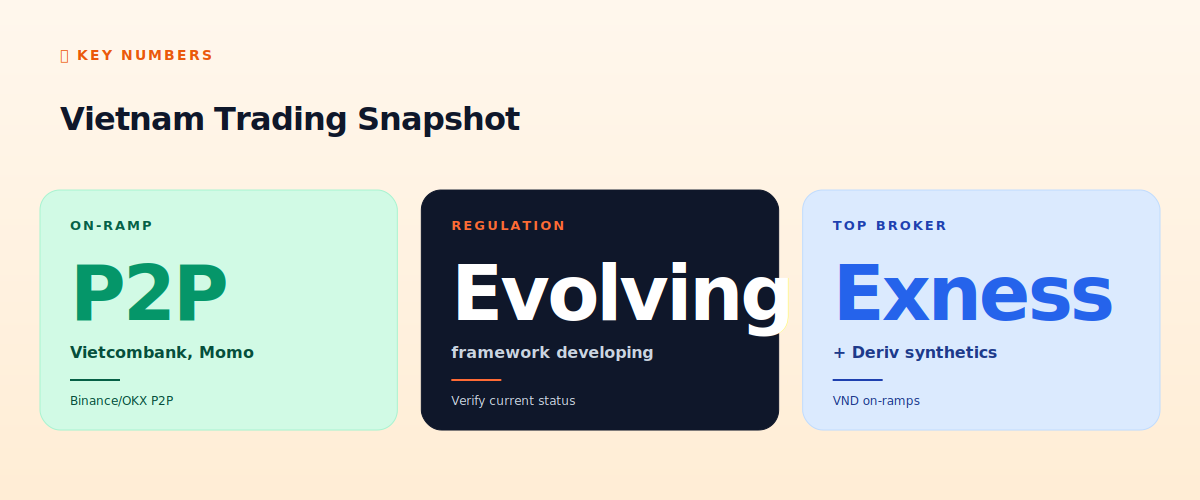
- On-ramp: P2P via Vietcombank, Techcombank, Momo; Binance/OKX P2P strong.
- Regulation: historically ambiguous; framework developing. Verify current status.
- Best brokers: Exness, Deriv (synthetics very popular here).
- Latency: Singapore datacenters close (~40-60ms). DigitalOcean SG.
- Advantage: very high adoption, deep P2P liquidity.
- Watch out for: regulatory uncertainty — the rules are unsettled and evolving.
Vietnam trading snapshot
Funding your account
Vietnam has deep P2P liquidity driven by its very high crypto adoption. You fund through P2P marketplaces (Binance, OKX) paying via local bank transfer (Vietcombank, Techcombank, BIDV) or e-wallets like Momo. The volume of Vietnamese P2P activity means good liquidity and competitive rates. Once you hold USDT, you can fund forex brokers or trade crypto directly.
The regulatory picture — proceed with extra caution
This is where Vietnamese traders need to be careful. Historically, Vietnam did not recognize crypto as legal tender or a regulated asset, creating a gray area — crypto trading wasn't clearly legal or clearly banned. The government has been developing a clearer framework, but the situation has been one of the more unsettled in Southeast Asia. Verify the current status before committing significant capital. See our regional regulation guide, and — more than in clearer jurisdictions — consult a local professional. This isn't legal advice, and Vietnam's ambiguity makes that caveat especially important.
Best brokers for Vietnamese traders
Exness is widely used with VND-friendly on-ramps and instant withdrawals (review). Deriv is extremely popular in Vietnam — the synthetic indices (Volatility 75, Boom/Crash) have a large Vietnamese following, low minimums make them accessible, and the official API suits bot traders (review, plus our synthetics guide). For crypto, Binance and OKX dominate.
Running an OpenClaw bot from Vietnam
Singapore datacenters are close (~40-60ms from Vietnam), so DigitalOcean Singapore is the natural host (VPS comparison). The latency is good for crypto and synthetic-index strategies. Follow our standard install guide for setup.
The honest reality for Vietnamese traders
Vietnam's enormous crypto enthusiasm is matched by enormous exposure to trading hype — Deriv synthetic-index 'strategies' and 'signal groups' are heavily promoted on Vietnamese social media, and most are the survival-bias and affiliate traps we describe in scam recognition. Combined with regulatory ambiguity, Vietnamese traders face two risks: losing to the market (71% lose on Deriv synthetics) and the unsettled legal status. Use OpenClaw as a serious tool, verify the legal situation, be deeply skeptical of signal sellers, and never risk money you can't lose.
📧 Get every new tutorial in your inbox
One email per week. Tutorials, CVE disclosures, broker updates. Unsubscribe in one click.
(Connect FluentCRM / ConvertKit / Beehiiv form here)
Frequently asked questions
Is crypto trading legal in Vietnam?
The situation has been ambiguous — historically not recognized as legal tender or a regulated asset, with a framework developing. Verify the current status with a local professional before committing capital.
How do I fund a trading account in Vietnam?
P2P via Binance/OKX, paying with local bank transfer (Vietcombank, Techcombank) or Momo. Deep liquidity due to high adoption.
Why is Deriv so popular in Vietnam?
Its synthetic indices (Vol 75, Boom/Crash) have a large following, low minimums make them accessible, and the official API suits bots. But 71% of Deriv traders lose — be realistic.
Can I run an OpenClaw bot from Vietnam?
Yes. DigitalOcean Singapore (~40-60ms) is a good host for crypto and synthetic strategies.
Are Vietnamese trading signal groups legit?
Mostly not. Heavily promoted Deriv 'signal groups' are usually survival-bias or affiliate traps. Be deeply skeptical.
What to read next
- Deriv Synthetic Indices Explained
- Deriv Review 2026
- Crypto Regulation 2026: SEA, Africa, LATAM
- OpenClaw Trading in Thailand
Sources cited: The Hacker News (CVE-2026-25253 disclosure, Feb 2026); Conscia 2026 OpenClaw Security Crisis advisory; Snyk ToxicSkills study; Cyber Press ClawHavoc reporting; Wall Street Journal Polymarket profitability analysis (May 2026); Andrey Sergeenkov via The Defiant (April 2026); Akey, Grégoire, Harvie & Martineau, SSRN paper (March 2026); openclaw.ai official advisories; Peter Steinberger public statements on X. Vietnamese regulatory developments; P2P marketplace data; not current legal authority — status is unsettled.