Risk disclosure: Independent research finds 70–84% of Polymarket traders lose money (Sergeenkov, April 2026; Akey et al., SSRN, March 2026). Forex CFDs: 70–85% retail loss rate. Binary options: 80%+ in most jurisdictions. AI agents don't change these baselines. Full disclaimer. Binary options disclosure: CySEC, FCA, and ASIC have restricted or banned binary options for retail due to 80%+ loss rates. Affiliate disclosure: Links to brokers (Exness, Deriv, Binance, Bybit, OKX, IQ Option, Pocket Option, Quotex) may earn us a referral commission. Your costs don't change. Our ratings don't either.
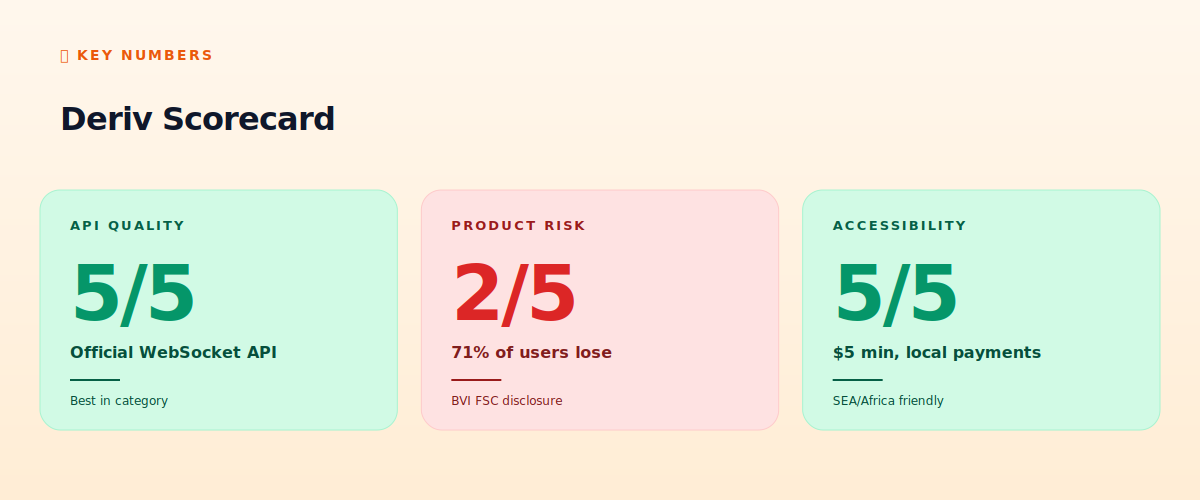
Deriv (formerly Binary.com) is the most bot-friendly platform in the binary/synthetic category, and the only one we'd point an OpenClaw trader toward. Its defining features: an official WebSocket API, the unique synthetic indices (algorithmically generated 24/7 markets), low minimums ($5), and acceptance of local payment methods across our core regions. The retail loss rate is 71% — high, but the best in the category.
We tested Deriv with OpenClaw bots on synthetic indices for 30 days. This review covers the synthetics, the API, regulation, accessibility, and the verdict. Overall: 3.6/5 — the best of the binary-style brokers for bot traders, with the category's inherent caveats.
TL;DR — The 30-second answer
- Rating: 3.6/5. Best binary-style broker for bots. Official API.
- Regulation: BVI FSC, Labuan, Vanuatu, MFSA (Malta). Mixed.
- Standout: official WebSocket API + unique 24/7 synthetic indices.
- Watch out for: 71% retail loss rate; synthetics are pure random walks.
- OpenClaw fit: best in category — official, sanctioned API.
- Best for: bot traders wanting 24/7 algorithmic markets with low minimums.
Scorecard
The synthetic indices — what makes Deriv unique
Deriv's signature offering is synthetic indices: algorithmically generated price feeds (Volatility 75, Boom 1000, Crash 500, Jump indices, and more) that trade 24/7 and aren't tied to any real-world asset. We cover them in depth in our synthetic indices guide. For bot traders, they have a unique property: because the generators are mathematically defined and audited, strategies can be backtested with perfect fidelity.
The flip side: synthetics are pure random walks with known statistical properties. There's no information edge (no news moves them), so any edge must come from exploiting the mathematical structure of the generators. This is a narrow but real opportunity for disciplined statistical bots.
The API — best in category
Deriv's official WebSocket API (documented at developers.deriv.com) is the single biggest reason to choose Deriv over IQ Option, Pocket Option, or Quotex. It's sanctioned (no account-suspension risk for using it), well-documented, stable, and there's a maintained deriv-api OpenClaw skill. Our Deriv bot setup guide walks through it.
We ran a mean-reversion bot on Volatility 75 for 30 days via the official API. Reliable connection (with auto-reconnect handling), accurate tick data, clean settlement. For a binary-style platform, this is a genuinely good developer experience.
Regulation and accessibility
Deriv operates under several entities: BVI FSC, Labuan FSA (Malaysia), Vanuatu FSC, and MFSA (Malta, for EU). The regulation is mixed — the Malta entity is properly EU-regulated, the others are lighter offshore oversight. Restricted in the US.
Accessibility is a strength: $5 minimum deposit, position sizes from $0.35, and acceptance of local payment methods (mobile money, local banks, crypto) across SEA, Africa, and LATAM. For our audience, Deriv is easy to fund and start with — which is both a benefit and a risk (low barrier to losing money).
The product risk
Deriv's BVI FSC disclosure shows 71% of retail accounts lose money. This is better than IQ Option's 83% — possibly because synthetics' mathematical predictability gives disciplined traders a marginally better shot, possibly because Deriv's lower minimums attract smaller, more cautious positions. But 71% losing is still grim. The category's structural disadvantages apply.
Pros and cons
Pros: official sanctioned API (unique in category); 24/7 synthetic indices with backtestable math; low minimums ($5); local payment support; demo with $10K; best bot-trading experience among binary-style brokers.
Cons: 71% retail loss rate; synthetics are random walks (no information edge); mixed regulation; the binary-style product category remains structurally hard.
The verdict
Deriv earns 3.6/5 — the highest in the binary/synthetic category, primarily because of the official API and the genuinely interesting (and backtestable) synthetic indices. For OpenClaw bot traders who want to experiment with 24/7 algorithmic markets, Deriv is the right venue. Just go in with realistic expectations: 71% lose, the synthetics are random walks, and discipline matters more than cleverness.
Use Deriv if: you want to bot-trade synthetic indices with an official API. Be cautious: start in demo, read the loss-rate analysis first, never use martingale on Boom/Crash.
📧 Get every new tutorial in your inbox
One email per week. Tutorials, CVE disclosures, broker updates. Unsubscribe in one click.
(Connect FluentCRM / ConvertKit / Beehiiv form here)
Frequently asked questions
Is Deriv better than IQ Option for bots?
Much better. Deriv has an official, sanctioned API; IQ Option only has an unofficial one that risks account suspension.
What are synthetic indices?
Algorithmically generated 24/7 markets (Vol 75, Boom, Crash, etc.) not tied to real assets. Their math is audited, so strategies backtest with perfect fidelity.
Is Deriv regulated?
Mixed. The Malta (MFSA) entity is EU-regulated; BVI, Labuan, Vanuatu entities have lighter oversight. US restricted.
What's the minimum to start?
$5 deposit, positions from $0.35. Very low barrier — good for learning, risky for impulsive trading.
Do most Deriv traders profit?
No. 71% lose per BVI FSC disclosure. Better than IQ Option's 83% but still a losing majority.
What to read next
- IQ Option Review 2026
- Deriv Synthetic Indices Explained
- OpenClaw + Deriv Bot Setup
- Why 80% of Binary Options Traders Lose
Sources cited: The Hacker News (CVE-2026-25253 disclosure, Feb 2026); Conscia 2026 OpenClaw Security Crisis advisory; Snyk ToxicSkills study; Cyber Press ClawHavoc reporting; Wall Street Journal Polymarket profitability analysis (May 2026); Andrey Sergeenkov via The Defiant (April 2026); Akey, Grégoire, Harvie & Martineau, SSRN paper (March 2026); openclaw.ai official advisories; Peter Steinberger public statements on X. developers.deriv.com API docs; BVI FSC disclosures; our 30-day live bot test.