Not legal or tax advice. Regulations and tax rules vary and change frequently. Consult a qualified local professional before acting. Risk disclosure: Independent research finds 70–84% of Polymarket traders lose money (Sergeenkov, April 2026; Akey et al., SSRN, March 2026). Forex CFDs: 70–85% retail loss rate. Binary options: 80%+ in most jurisdictions. AI agents don't change these baselines. Full disclaimer. Affiliate disclosure: Links to brokers (Exness, Deriv, Binance, Bybit, OKX, IQ Option, Pocket Option, Quotex) may earn us a referral commission. Your costs don't change. Our ratings don't either.
The Philippines combines high crypto adoption, a tech-savvy English-speaking population, and a regulatory framework under the BSP (central bank) and SEC. It's one of the more accessible markets in our audience for AI trading. This hub covers funding via GCash and Maya, the brokers that work well with pesos, the regulatory picture, and running OpenClaw from Manila, Cebu, or anywhere in the islands.
The Philippines' e-wallet ecosystem (GCash, Maya) makes funding particularly smooth compared to many markets — a real practical advantage.
TL;DR — The 30-second answer
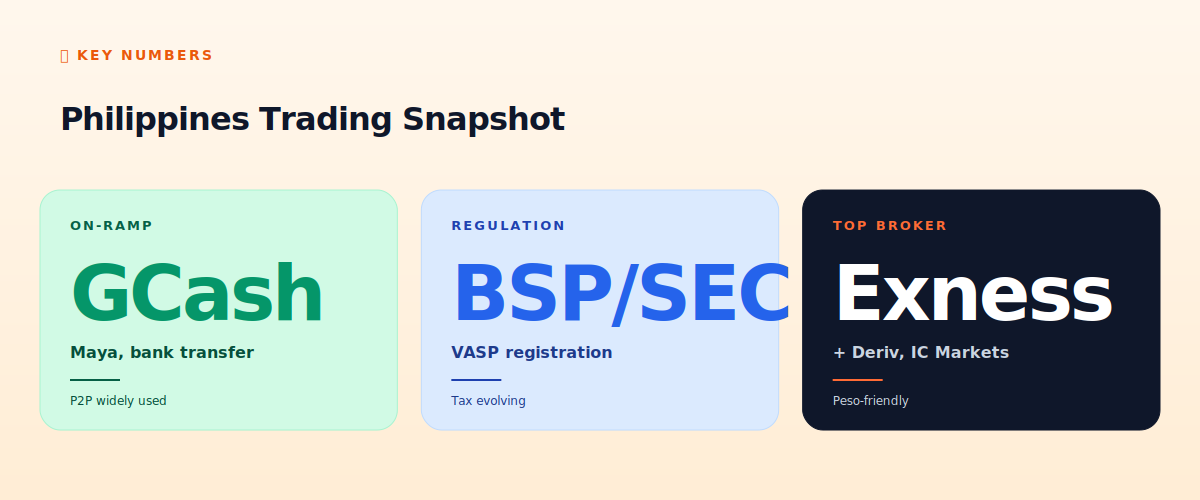
- On-ramp: GCash, Maya, bank transfer; P2P widely used and smooth.
- Regulation: BSP and SEC regulate; VASPs need registration. Tax evolving.
- Best brokers: Exness, Deriv, IC Markets — all peso-friendly.
- Latency: Singapore datacenters reasonably close (~50-70ms). DigitalOcean SG.
- Advantage: English-speaking, strong e-wallet ecosystem, high adoption.
- Watch out for: 'trading mentor' scams are common on local social media.
Philippines trading snapshot
Funding your account — the e-wallet advantage
The Philippines has one of the smoothest funding environments in our audience thanks to its mature e-wallet ecosystem. GCash and Maya are ubiquitous, and most crypto P2P marketplaces (Binance, OKX) support them directly. You can buy USDT via P2P paying with GCash in minutes, then fund forex brokers or trade crypto. Bank transfers also work for those with traditional accounts. The friction is low compared to markets with banking restrictions.
The regulatory picture
Crypto activities in the Philippines are regulated by the BSP (Bangko Sentral ng Pilipinas, the central bank) and the SEC. Virtual asset service providers (VASPs) need registration. Trading is legal. Tax treatment is evolving — gains are increasingly within scope, so track your transactions. See our regional regulation guide. Not legal advice; the tax situation in particular is developing, so consult a local professional.
Best brokers for Filipino traders
Filipino traders have good options. Exness offers peso-friendly funding and instant withdrawals (review). Deriv is popular for synthetic indices and low minimums (review). IC Markets suits serious algo traders wanting tight ECN spreads (review). For crypto, the usual venues (Binance, OKX, Bybit) all work.
Running an OpenClaw bot from the Philippines
Singapore datacenters are reasonably close (~50-70ms from Manila), making DigitalOcean Singapore a solid choice for hosting your bot. The English-speaking environment is a genuine advantage for working with OpenClaw's documentation and the broader (mostly English) community. Follow our install guide and VPS comparison.
The honest reality for Filipino traders
The Philippines' accessibility — easy funding, English fluency, high adoption — is a real advantage, but it also makes it a heavy target for 'trading mentor' and 'AI bot' scams on local Facebook and TikTok. The promises of guaranteed income from forex or crypto bots are the same hype we debunk in AI Trading Hype vs Reality — 70-84% of retail loses, and no mentor's signal service changes that. Use OpenClaw seriously, ignore the gurus, start small, and protect your capital.
📧 Get every new tutorial in your inbox
One email per week. Tutorials, CVE disclosures, broker updates. Unsubscribe in one click.
(Connect FluentCRM / ConvertKit / Beehiiv form here)
Frequently asked questions
How do I fund a trading account in the Philippines?
GCash and Maya are the easiest — most P2P marketplaces support them. Buy USDT via P2P, then fund brokers or trade crypto. Bank transfer also works.
Is crypto trading legal in the Philippines?
Yes, regulated by the BSP and SEC. VASPs need registration. Tax treatment is evolving — consult a local professional.
Which broker is best for Filipinos?
Exness (peso-friendly), Deriv (synthetics, low minimums), or IC Markets (serious algo trading). All work well.
Can I run an OpenClaw bot from the Philippines?
Yes. DigitalOcean Singapore (~50-70ms latency) is a good host. The English-speaking environment helps with documentation and community.
Are trading mentors on Filipino social media legit?
Mostly not. 'Guaranteed income' and 'AI bot' promises are the same hype that produces the 70-84% retail loss rate. Be very skeptical.
What to read next
Sources cited: The Hacker News (CVE-2026-25253 disclosure, Feb 2026); Conscia 2026 OpenClaw Security Crisis advisory; Snyk ToxicSkills study; Cyber Press ClawHavoc reporting; Wall Street Journal Polymarket profitability analysis (May 2026); Andrey Sergeenkov via The Defiant (April 2026); Akey, Grégoire, Harvie & Martineau, SSRN paper (March 2026); openclaw.ai official advisories; Peter Steinberger public statements on X. BSP and Philippine SEC publications; P2P marketplace data; not current legal authority.