Not legal or tax advice. Regulations and tax rules vary and change frequently. Consult a qualified local professional before acting. Risk disclosure: Independent research finds 70–84% of Polymarket traders lose money (Sergeenkov, April 2026; Akey et al., SSRN, March 2026). Forex CFDs: 70–85% retail loss rate. Binary options: 80%+ in most jurisdictions. AI agents don't change these baselines. Full disclaimer. Affiliate disclosure: Links to brokers (Exness, Deriv, Binance, Bybit, OKX, IQ Option, Pocket Option, Quotex) may earn us a referral commission. Your costs don't change. Our ratings don't either.
Indonesia is one of Southeast Asia's largest crypto markets, with a clear regulatory framework (crypto as a regulated commodity under Bappebti) and growing interest in AI trading tools. This hub covers what Indonesian traders specifically need: funding via local banks and e-wallets, the brokers and exchanges that work well with rupiah, the regulatory and tax picture, and the practical realities of running OpenClaw from Jakarta, Surabaya, or anywhere in the archipelago.
Indonesia's advantage for our audience: it's geographically close to the Singapore datacenters that minimize latency to Polymarket and crypto exchanges — a real edge for certain bot strategies.
TL;DR — The 30-second answer
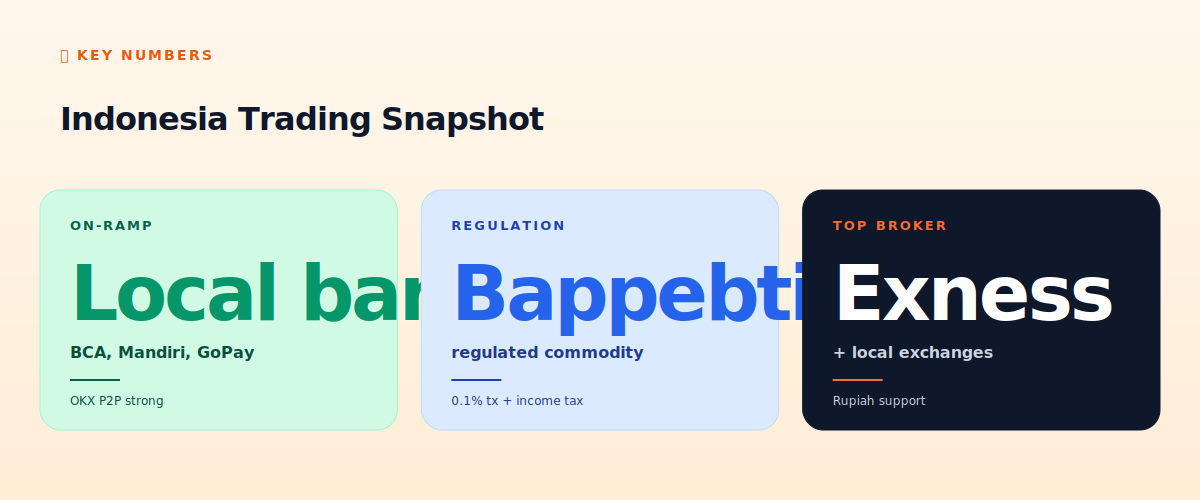
- On-ramp: local bank transfer (BCA, Mandiri, BRI), GoPay, OVO; OKX P2P strong.
- Regulation: crypto is a regulated commodity under Bappebti. Clear framework.
- Tax: ~0.1% transaction tax plus income tax on gains.
- Best brokers: Exness (rupiah support), local licensed crypto exchanges.
- Latency advantage: Singapore datacenters are close (~30-50ms). Use DigitalOcean SG.
- Watch out for: use licensed exchanges for cleaner tax compliance.
Indonesia trading snapshot
Funding your account
Indonesia has relatively smooth on-ramps compared to some regions. You can fund through local bank transfers (BCA, Mandiri, BRI are widely supported) and popular e-wallets (GoPay, OVO, DANA). For crypto, OKX's P2P marketplace has strong rupiah liquidity, and Indonesia's own licensed exchanges (regulated by Bappebti) provide direct rupiah on-ramps. The licensed-exchange route is cleaner for tax purposes since transactions are documented domestically.
The regulatory picture — one of SEA's clearer frameworks
Indonesia regulates crypto as a commodity under Bappebti (the Commodity Futures Trading Regulatory Agency), not as a currency or security. Trading is legal on licensed exchanges. The tax structure includes a small transaction tax (around 0.1%) plus income tax on gains. This is one of the clearer regulatory environments in Southeast Asia — the rules are defined, which reduces uncertainty for serious traders. See our regional regulation guide for context. Not legal advice; verify your situation locally.
Best brokers and exchanges
Exness works well for Indonesian forex traders with rupiah-friendly funding and instant withdrawals (review). For crypto, you have a choice: international venues (OKX, Binance — see our comparison) for maximum liquidity and bot support, or Indonesia's licensed domestic exchanges for cleaner regulatory standing. Many traders use both — domestic for the fiat on-ramp, international for bot trading.
The latency advantage
Indonesia's geographic position is a genuine asset for bot traders. The Singapore datacenters (DigitalOcean, AWS, others) are very close — latency from Jakarta to Singapore is roughly 30-50ms. For Polymarket bots (where Polygon RPC latency matters) and crypto strategies, running your OpenClaw bot on a DigitalOcean Singapore droplet gives you some of the best latency available in our entire audience. See our Hetzner vs DigitalOcean comparison — for Indonesia, DigitalOcean Singapore is the clear pick.
The honest reality for Indonesian traders
Indonesia's clear regulation, smooth on-ramps, and latency advantage make it one of the better-positioned markets in our audience for serious bot trading. But the universal caution holds: most retail traders lose, AI doesn't confer a magic edge (state of AI agents), and Indonesian social media has its share of 'trading guru' hype selling courses. Treat OpenClaw as a serious tool, use the latency advantage for legitimate strategies, comply with Bappebti's framework, and keep expectations realistic.
📧 Get every new tutorial in your inbox
One email per week. Tutorials, CVE disclosures, broker updates. Unsubscribe in one click.
(Connect FluentCRM / ConvertKit / Beehiiv form here)
Frequently asked questions
Is crypto legal in Indonesia?
Yes — regulated as a commodity under Bappebti. Trading on licensed exchanges is legal, subject to a transaction tax and income tax on gains.
How do I fund a trading account in Indonesia?
Local bank transfer (BCA, Mandiri, BRI), e-wallets (GoPay, OVO), or OKX P2P for crypto. Licensed domestic exchanges offer direct rupiah on-ramps.
What's the latency advantage for Indonesian traders?
Singapore datacenters are ~30-50ms from Jakarta. Running your bot on DigitalOcean Singapore gives excellent latency for Polymarket and crypto strategies.
What taxes apply to crypto trading in Indonesia?
A small transaction tax (~0.1%) plus income tax on gains. Use licensed exchanges and tax software for cleaner compliance.
Which broker is best for Indonesians?
Exness for forex (rupiah support). For crypto, international venues (OKX, Binance) for bots, or licensed domestic exchanges for cleaner tax standing.
What to read next
- Hetzner vs DigitalOcean
- OKX Review 2026
- Crypto Regulation 2026: SEA, Africa, LATAM
- OpenClaw Trading in the Philippines
Sources cited: The Hacker News (CVE-2026-25253 disclosure, Feb 2026); Conscia 2026 OpenClaw Security Crisis advisory; Snyk ToxicSkills study; Cyber Press ClawHavoc reporting; Wall Street Journal Polymarket profitability analysis (May 2026); Andrey Sergeenkov via The Defiant (April 2026); Akey, Grégoire, Harvie & Martineau, SSRN paper (March 2026); openclaw.ai official advisories; Peter Steinberger public statements on X. Bappebti regulatory framework; OKX P2P data; not current legal authority.