Not legal or tax advice. Regulations and tax rules vary and change frequently. Consult a qualified local professional before acting. Risk disclosure: Independent research finds 70–84% of Polymarket traders lose money (Sergeenkov, April 2026; Akey et al., SSRN, March 2026). Forex CFDs: 70–85% retail loss rate. Binary options: 80%+ in most jurisdictions. AI agents don't change these baselines. Full disclaimer. Affiliate disclosure: Links to brokers (Exness, Deriv, Binance, Bybit, OKX, IQ Option, Pocket Option, Quotex) may earn us a referral commission. Your costs don't change. Our ratings don't either.
South Africa has one of Africa's most developed financial markets and a clear crypto regulatory framework under the FSCA, which treats crypto as a financial product. Combined with strong banking infrastructure and high adoption, it's a well-positioned market for serious AI trading. This hub covers funding via EFT and local exchanges, the brokers that work with rand, the regulatory picture, and running OpenClaw from Johannesburg, Cape Town, or anywhere in the country.
South Africa's regulatory clarity and Pepperstone's local presence (CMA-adjacent African operations) make it one of the better-served markets in our audience.
TL;DR — The 30-second answer
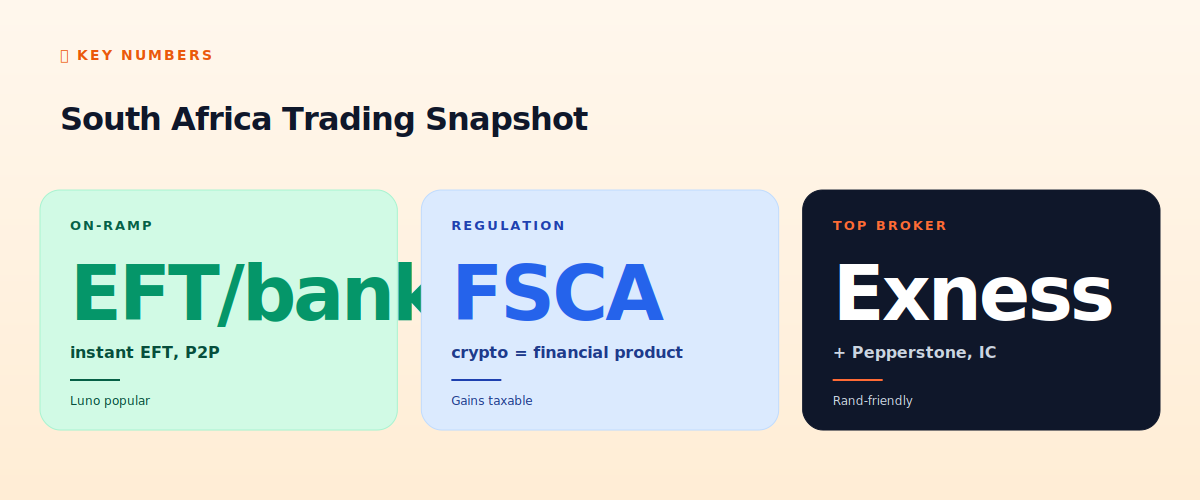
- On-ramp: instant EFT, local bank transfer; Luno popular for fiat.
- Regulation: FSCA treats crypto as a financial product. CASPs need licensing.
- Best brokers: Exness, Pepperstone, IC Markets — all rand-friendly.
- Latency: local/EU hosting; some SA datacenters available.
- Advantage: developed market, clear regulation, strong banking.
- Watch out for: gains are taxable — SARS is increasingly crypto-aware.
South Africa trading snapshot
Funding your account
South Africa's banking infrastructure is strong, so funding is relatively smooth. Instant EFT and local bank transfers work well. Luno is the popular local crypto exchange for fiat on-ramps (rand to crypto), and international P2P (Binance, OKX) provides additional liquidity. For forex brokers, rand-denominated funding is widely supported. The developed banking system means less of the friction seen in markets with crypto-banking restrictions.
The regulatory picture
South Africa's FSCA (Financial Sector Conduct Authority) regulates crypto as a financial product. Crypto asset service providers (CASPs) require licensing, and the framework is relatively developed. Gains are taxable — SARS (the revenue service) is increasingly crypto-aware and expects declaration. See our regional regulation guide. Not legal advice; consult a local professional, especially on the tax treatment, which SARS has been actively clarifying.
Best brokers for South African traders
South Africans are well-served. Exness has an FSCA-regulated entity and rand-friendly funding (review). Pepperstone has strong African operations and Tier-1 regulation (review). IC Markets suits serious algo traders (review). For crypto, Luno (local), plus Binance/OKX/Bybit for bot trading (comparison).
Running an OpenClaw bot from South Africa
South Africa has some local datacenter options, and EU hosting works well for forex (reasonable latency). For crypto and Polymarket, the venue's servers matter more than yours, so a stable EU or local VPS is fine. Follow our VPS comparison — Hetzner's value or DigitalOcean's coverage both work. The strong local internet infrastructure makes setup straightforward.
The honest reality for South African traders
South Africa's developed market, regulatory clarity, and broker access make it one of the best-positioned in our audience. But South Africa also has a notorious history of forex and crypto Ponzi schemes (the country has been hit hard by several large ones). The 'forex mentor' and 'guaranteed returns' culture is strong on local social media — and these are exactly the traps we cover in bucket shop recognition and hype vs reality. Use OpenClaw as a legitimate tool, trade on FSCA-regulated venues, declare to SARS, and be ruthlessly skeptical of anyone promising guaranteed returns.
📧 Get every new tutorial in your inbox
One email per week. Tutorials, CVE disclosures, broker updates. Unsubscribe in one click.
(Connect FluentCRM / ConvertKit / Beehiiv form here)
Frequently asked questions
Is crypto trading legal in South Africa?
Yes — the FSCA regulates crypto as a financial product. CASPs need licensing. Gains are taxable; SARS expects declaration.
How do I fund a trading account in South Africa?
Instant EFT and local bank transfer work smoothly. Luno is popular for fiat-to-crypto. International P2P (Binance, OKX) adds liquidity.
Which broker is best for South Africans?
Exness (FSCA entity), Pepperstone (strong African ops, Tier-1), or IC Markets (serious algo). All rand-friendly.
Do I pay tax on crypto gains in South Africa?
Yes — SARS is increasingly crypto-aware and expects declaration. Consult a local professional on treatment.
Why be cautious in the South African market?
South Africa has a notorious history of forex and crypto Ponzi schemes. 'Guaranteed returns' and 'forex mentor' pitches are usually traps. Be ruthlessly skeptical.
What to read next
- Pepperstone Review 2026
- How to Spot a Forex Bucket Shop
- Crypto Regulation 2026: SEA, Africa, LATAM
- OpenClaw Trading in Kenya
Sources cited: The Hacker News (CVE-2026-25253 disclosure, Feb 2026); Conscia 2026 OpenClaw Security Crisis advisory; Snyk ToxicSkills study; Cyber Press ClawHavoc reporting; Wall Street Journal Polymarket profitability analysis (May 2026); Andrey Sergeenkov via The Defiant (April 2026); Akey, Grégoire, Harvie & Martineau, SSRN paper (March 2026); openclaw.ai official advisories; Peter Steinberger public statements on X. FSCA regulatory framework; SARS crypto guidance; not current legal authority.