Not legal or tax advice. Regulations and tax rules vary and change frequently. Consult a qualified local professional before acting. Risk disclosure: Independent research finds 70–84% of Polymarket traders lose money (Sergeenkov, April 2026; Akey et al., SSRN, March 2026). Forex CFDs: 70–85% retail loss rate. Binary options: 80%+ in most jurisdictions. AI agents don't change these baselines. Full disclaimer. Affiliate disclosure: Links to brokers (Exness, Deriv, Binance, Bybit, OKX, IQ Option, Pocket Option, Quotex) may earn us a referral commission. Your costs don't change. Our ratings don't either.
Kenya is East Africa's fintech leader, home to M-Pesa — the mobile money system that revolutionized payments across the continent. For traders, M-Pesa is a genuine superpower: it makes funding crypto and broker accounts remarkably smooth. This hub covers M-Pesa on-ramps, the brokers that serve Kenya (including Pepperstone's CMA license), the evolving regulatory picture, and running OpenClaw from Nairobi, Mombasa, or anywhere in Kenya.
Kenya's M-Pesa advantage and Pepperstone's local CMA license make it surprisingly well-positioned for African traders, despite a still-evolving regulatory framework.
TL;DR — The 30-second answer
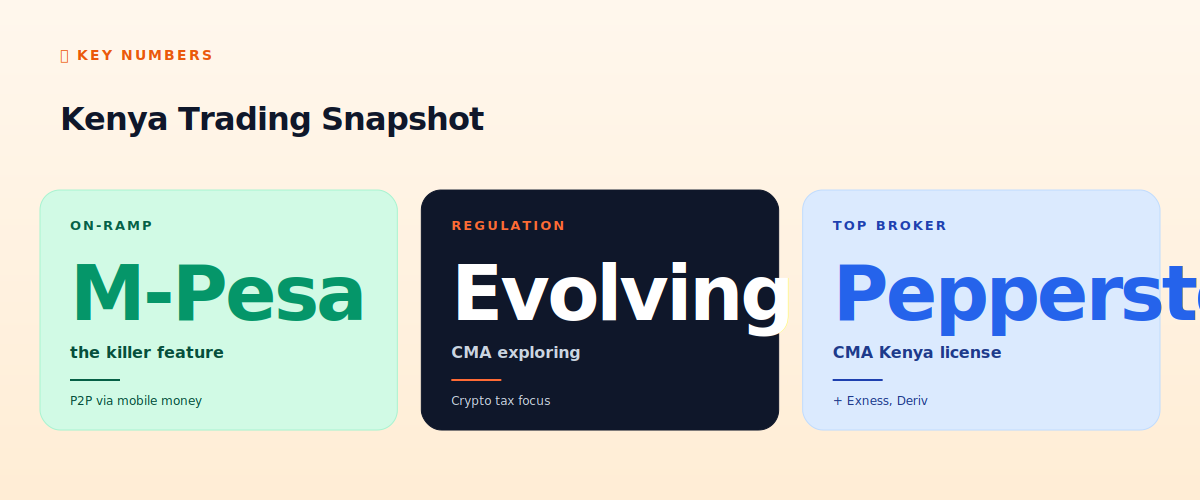
- On-ramp: M-Pesa — the killer feature. P2P via mobile money is seamless.
- Regulation: evolving; CMA exploring frameworks. Tax authorities crypto-focused.
- Best brokers: Pepperstone (CMA Kenya license!), Exness, Deriv.
- Latency: EU or SA hosting; local options limited.
- Advantage: M-Pesa makes funding uniquely smooth.
- Watch out for: regulatory framework still developing — verify current status.
Kenya trading snapshot
Funding your account — the M-Pesa superpower
M-Pesa is Kenya's defining financial advantage. The mobile money system is ubiquitous — nearly everyone has it — and crypto P2P marketplaces (Binance, OKX) support it directly. You buy USDT via P2P paying with M-Pesa in minutes, with no bank account needed. This is genuinely smoother than funding in many wealthier countries. Once you hold USDT, you fund forex brokers or trade crypto. For Kenyan traders, M-Pesa removes the funding friction that plagues other markets — it's a real, practical edge.
The regulatory picture — evolving
Kenya's crypto regulatory framework is still developing. The CMA (Capital Markets Authority) has explored regulation, and the tax authorities (KRA) have been increasingly focused on crypto gains — Kenya has discussed and moved toward taxing digital asset transactions. The framework is less settled than South Africa's or Thailand's, so verify the current status before committing significant capital. See our regional regulation guide. Not legal advice; given the evolving situation, a local professional is especially valuable here.
Best brokers for Kenyan traders
Kenya has a standout option: Pepperstone holds a CMA Kenya license, giving it a locally regulated presence uncommon among international brokers (review). This means local regulatory recourse and easier compliance. Exness is also widely used with M-Pesa-friendly funding (review), and Deriv is popular for synthetics (review). For crypto, Binance and OKX with M-Pesa P2P.
Running an OpenClaw bot from Kenya
Local VPS options are limited, so Kenyan operators typically use EU hosting (reasonable forex latency) or South African datacenters (closer regionally). For crypto and Polymarket, the venue's servers matter most, so a stable EU/SA VPS works fine. Follow our VPS comparison. As elsewhere in Africa, the key is a stable connection for setup — once on the VPS, your home internet doesn't affect the running bot.
The honest reality for Kenyan traders
Kenya's M-Pesa advantage and Pepperstone's local license make it genuinely well-positioned for African traders. But Kenya, like the rest of the region, faces heavy forex and crypto hype — 'forex training' schemes and signal sellers are common, and the same 70-84% loss rate applies regardless of M-Pesa convenience. The ease of funding is an advantage for legitimate trading, but it also makes it easy to lose money fast. Use OpenClaw seriously, leverage Pepperstone's local regulation, verify the tax situation with KRA guidance, and stay skeptical of the trading-guru ecosystem.
📧 Get every new tutorial in your inbox
One email per week. Tutorials, CVE disclosures, broker updates. Unsubscribe in one click.
(Connect FluentCRM / ConvertKit / Beehiiv form here)
Frequently asked questions
How do I fund a trading account in Kenya?
M-Pesa is the killer feature — buy USDT via P2P (Binance, OKX) paying with M-Pesa, no bank account needed. Genuinely smoother than many wealthier markets.
Is crypto trading legal in Kenya?
The framework is evolving — the CMA has explored regulation and the KRA is increasingly focused on crypto tax. Verify current status with a local professional.
Which broker is best for Kenyans?
Pepperstone stands out — it holds a CMA Kenya license, a locally regulated presence. Exness (M-Pesa-friendly) and Deriv are also popular.
Can I run an OpenClaw bot from Kenya?
Yes. Use EU or South African hosting (local options limited). For crypto/Polymarket, the venue's servers matter most.
Do I pay tax on crypto in Kenya?
Increasingly yes — the KRA has moved toward taxing digital asset transactions. The situation is evolving; consult a local professional.
What to read next
- Pepperstone Review 2026
- OpenClaw Trading in Nigeria
- OpenClaw Trading in South Africa
- Crypto Regulation 2026: SEA, Africa, LATAM
Sources cited: The Hacker News (CVE-2026-25253 disclosure, Feb 2026); Conscia 2026 OpenClaw Security Crisis advisory; Snyk ToxicSkills study; Cyber Press ClawHavoc reporting; Wall Street Journal Polymarket profitability analysis (May 2026); Andrey Sergeenkov via The Defiant (April 2026); Akey, Grégoire, Harvie & Martineau, SSRN paper (March 2026); openclaw.ai official advisories; Peter Steinberger public statements on X. CMA Kenya and KRA developments; M-Pesa P2P data; not current legal authority — framework evolving.