Risk disclosure: Independent research finds 70–84% of Polymarket traders lose money (Sergeenkov, April 2026; Akey et al., SSRN, March 2026). Forex CFDs: 70–85% retail loss rate. Binary options: 80%+ in most jurisdictions. AI agents don't change these baselines. Full disclaimer.
Our beginner glossary covered the basics — leverage, pips, order books, stops. This advanced glossary covers the next tier: the terms you'll encounter as you go deeper into derivatives and crypto trading. Perpetuals, basis, funding, open interest, and more — explained clearly, with how each connects to the strategies and concepts elsewhere on the site. It's a reference to return to as these terms come up.
These aren't beginner concepts, but understanding them unlocks the more sophisticated strategies (like funding arbitrage) and lets you read market commentary and exchange data fluently. We'll keep the explanations clear and grounded.
TL;DR — The 30-second answer
- Perpetual futures: futures with no expiry, kept anchored by funding rates.
- Basis: the spread between a futures price and the spot price.
- Funding rate: periodic payment between perp longs and shorts (basis of an arb).
- Open interest: total open derivative contracts — gauges market participation.
- Mark price, liquidation, margin: the mechanics of leveraged positions.
- A reference for the derivatives vocabulary beyond the beginner basics.
Advanced terms at a glance
Perpetual futures
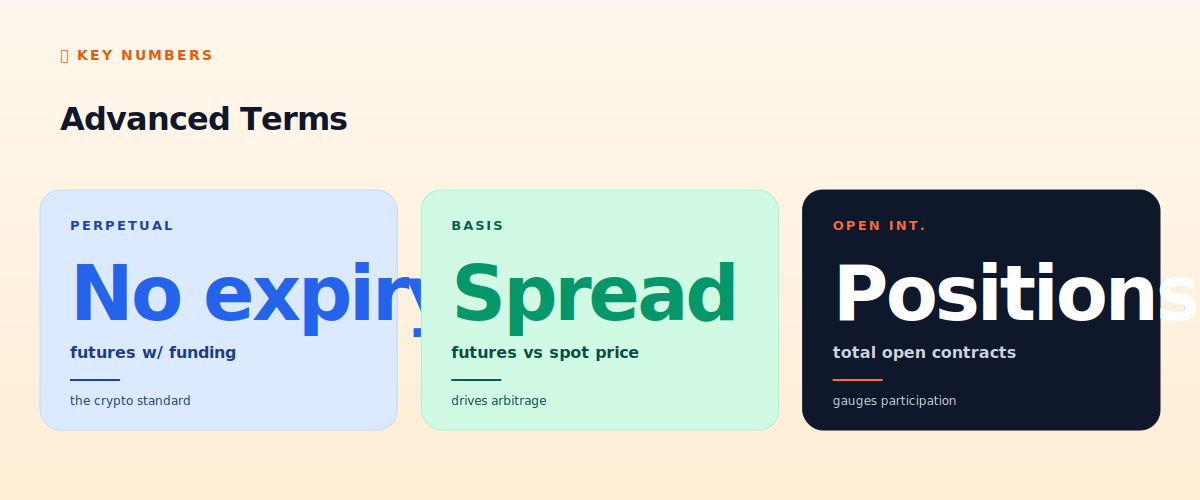
A perpetual future (or 'perp') is a futures contract with no expiry date — you can hold it indefinitely. Traditional futures expire on a set date; perpetuals don't, which is why they dominate crypto derivatives trading. To keep the perpetual's price anchored to the underlying spot price (since there's no expiry to force convergence), perpetuals use a funding rate mechanism. Perpetuals are the standard instrument for leveraged crypto trading and the basis of our funding rate arbitrage strategy. When crypto traders say 'perps,' this is what they mean.
Funding rate
The funding rate is the mechanism that keeps perpetual prices tethered to spot. Periodically (typically every 8 hours), a payment flows between long and short holders. When the perp trades above spot (more longs), longs pay shorts; when below (more shorts), shorts pay longs. This incentivizes traders to push the perp back toward spot. The funding rate is both a cost to consider (holding a leveraged position incurs or earns funding) and the entire basis of funding rate arbitrage — collecting funding while hedged. We cover it fully in the funding arbitrage guide and our fees guide.
Basis
Basis is the difference between a futures (or perpetual) price and the spot price. If BTC spot is $100,000 and the perpetual is $100,200, the basis is $200 (positive, or 'contango'). If the perp is below spot, the basis is negative ('backwardation'). Basis reflects market sentiment (positive basis often signals bullish leverage demand) and drives basis-trading and arbitrage strategies. A large positive basis often coincides with high funding rates — both signal heavy long demand. Watching basis helps you read whether the derivatives market is leaning bullish or bearish.
Open interest
Open interest (OI) is the total number of open derivative contracts (perpetuals, futures) at a given time — not trading volume, but the total outstanding positions. Rising OI means new money entering positions (more participation); falling OI means positions closing. OI is a useful gauge of market participation and conviction: a price move on rising OI suggests genuine new positioning behind it, while a move on falling OI suggests positions unwinding. Traders watch OI alongside price to gauge whether a move has real backing. Extreme OI can also signal crowded positioning vulnerable to liquidation cascades.
Mark price and liquidation
The mark price is the reference price exchanges use to value your position and trigger liquidations — usually based on an index of spot prices rather than the exchange's own last-traded price, to prevent manipulation. This matters because your liquidation (see our leverage guide) is triggered by the mark price, not the last trade. Understanding mark price prevents confusion when your position is liquidated at a level that seems different from the visible price — the exchange used the mark price to protect against wicks and manipulation.
Margin: initial, maintenance, isolated, cross
- Initial margin: the collateral required to open a leveraged position.
- Maintenance margin: the minimum collateral to keep it open. Fall below, and you're liquidated.
- Isolated margin: a position's risk is limited to its allocated margin (safer — one bad trade can't wipe the account).
- Cross margin: your whole account backs positions (riskier — a single bad position can liquidate everything).
We cover the practical implications in our leverage guide — for most traders, isolated margin is the safer choice.
A few more
- Slippage: the gap between expected and actual fill price (see our slippage guide).
- Spread: the bid-ask gap (see our order book guide).
- Maker/taker: fee tiers based on adding vs removing liquidity (see fees guide).
- Long/short: betting on rises vs falls (see long vs short guide).
- Delta-neutral: a position hedged against price direction (the core of funding arbitrage).
- Liquidation cascade: when liquidations trigger more liquidations, accelerating a price move.
The honest verdict
This advanced vocabulary — perpetuals, funding, basis, open interest, mark price, margin types — is the language of derivatives and leveraged crypto trading. Understanding it unlocks the more sophisticated strategies (especially funding arbitrage) and lets you read exchange data and market commentary fluently. None of these terms are beginner concepts, but none are mysterious once explained. Use this as a reference, return to it as the terms come up, and follow the links to the deeper guides where each concept connects to practice. Fluency in this vocabulary is a real step from beginner to capable — not because the words are magic, but because understanding the mechanics they describe lets you trade derivatives knowingly rather than blindly.
📧 Get every new tutorial in your inbox
One email per week. Tutorials, CVE disclosures, broker updates. Unsubscribe in one click.
(Connect FluentCRM / ConvertKit / Beehiiv form here)
Frequently asked questions
What is a perpetual future?
A futures contract with no expiry date — you can hold it indefinitely. Funding rates keep its price anchored to spot. Perpetuals dominate crypto derivatives and are the basis of funding rate arbitrage.
What is the funding rate?
A periodic payment (typically every 8 hours) between perpetual longs and shorts that keeps the perp price tethered to spot. It's both a holding cost/credit and the basis of funding arbitrage.
What is basis?
The difference between a futures/perpetual price and spot. Positive basis (perp above spot) signals bullish leverage demand; it often coincides with high funding rates. It drives arbitrage strategies.
What is open interest?
The total number of open derivative contracts — not volume, but outstanding positions. Rising OI means new money entering; it gauges market participation and conviction behind price moves.
What's the difference between mark price and last price?
Mark price is an index-based reference exchanges use to value positions and trigger liquidations, protecting against manipulation. Your liquidation is triggered by the mark price, not the last trade.
What to read next
- Funding Rate Arbitrage
- What Is Leverage?
- Spot vs Futures for Beginners
- DeFi Glossary: Pools, Oracles, Impermanent Loss
Sources cited: The Hacker News (CVE-2026-25253 disclosure, Feb 2026); Conscia 2026 OpenClaw Security Crisis advisory; Snyk ToxicSkills study; Cyber Press ClawHavoc reporting; Wall Street Journal Polymarket profitability analysis (May 2026); Andrey Sergeenkov via The Defiant (April 2026); Akey, Grégoire, Harvie & Martineau, SSRN paper (March 2026); openclaw.ai official advisories; Peter Steinberger public statements on X. derivatives and perpetual futures documentation; market microstructure literature.