Risk disclosure: Independent research finds 70–84% of Polymarket traders lose money (Sergeenkov, April 2026; Akey et al., SSRN, March 2026). Forex CFDs: 70–85% retail loss rate. Binary options: 80%+ in most jurisdictions. AI agents don't change these baselines. Full disclaimer. Security context: Three critical CVEs disclosed in OpenClaw in Q1 2026 (CVE-2026-25253, CVE-2026-32922) plus the ClawHavoc supply-chain attack (1,184 malicious skills). Always run v2026.4.12 or later. Full security assessment.
Decentralized finance (DeFi) has its own vocabulary, and if you venture beyond centralized exchanges into on-chain trading, liquidity provision, or DeFi protocols, you'll need it. This glossary covers the key DeFi terms: liquidity pools, AMMs, oracles, impermanent loss, gas, and more — explained clearly, with honest notes on the risks DeFi adds. Polymarket itself runs on-chain (Polygon), so some of this is relevant even if you stick to prediction markets.
DeFi opens possibilities but adds real risks — smart contract bugs, oracle exploits, impermanent loss — that don't exist on centralized exchanges. We'll explain the terms and flag the dangers honestly, because DeFi's 'be your own bank' freedom comes with 'be your own security team' responsibility.
TL;DR — The 30-second answer
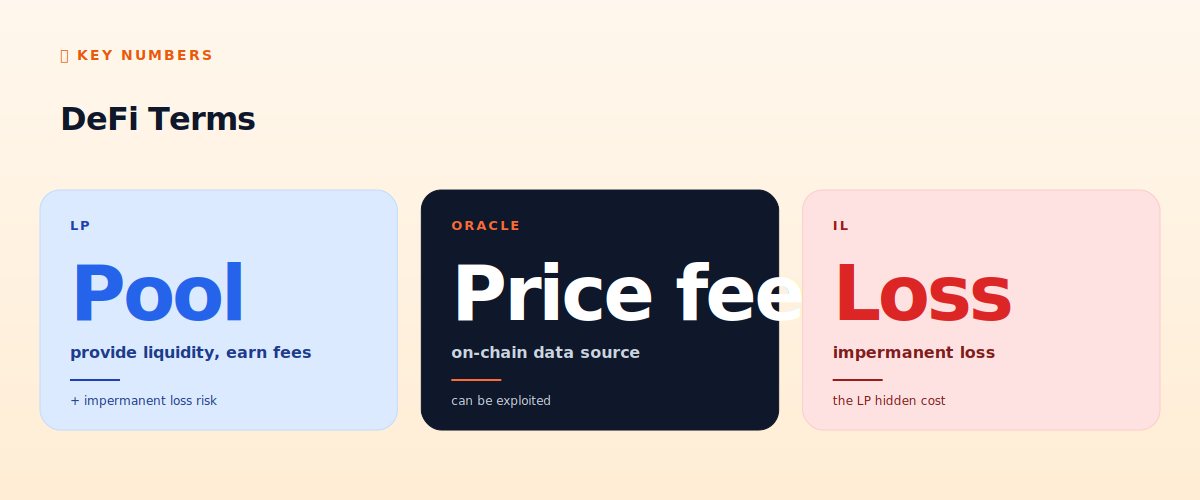
- Liquidity pool (LP): a pool of tokens enabling decentralized trading; LPs earn fees.
- AMM: automated market maker — the algorithm that prices pool trades.
- Oracle: a service feeding real-world/price data on-chain (a known attack vector).
- Impermanent loss: the hidden cost of providing liquidity when prices diverge.
- Gas: the transaction fee paid to the blockchain network.
- DeFi adds risks — smart contract bugs, exploits — absent on CEXs.
DeFi terms at a glance
Liquidity pools and AMMs
On centralized exchanges, an order book matches buyers and sellers. DeFi mostly uses a different model: liquidity pools and automated market makers (AMMs). A liquidity pool is a smart contract holding a pair of tokens (say ETH and USDC). Traders swap against the pool rather than against other traders. An AMM is the algorithm (famously the constant-product formula x * y = k) that determines prices based on the pool's token ratio. Liquidity providers (LPs) deposit tokens into the pool and earn a share of trading fees in return. This is how decentralized exchanges like Uniswap work — no order book, just pools and a pricing algorithm.
Impermanent loss (the LP trap)
This is the most important — and most under-understood — DeFi concept for anyone considering providing liquidity. Impermanent loss (IL) is the loss an LP suffers when the prices of the pooled tokens diverge from when they were deposited. Because the AMM rebalances the pool as prices move, an LP can end up with less value than if they'd simply held the tokens. The 'impermanent' name is misleading — if you withdraw while prices have diverged, the loss becomes permanent. Many LPs are surprised to find their fee earnings didn't compensate for IL, leaving them worse off than just holding. IL is the hidden cost of liquidity provision, and anyone considering it must understand it. The marketing for 'earn yield by providing liquidity' often glosses over IL entirely — don't let it.
Oracles
Smart contracts can't natively access off-chain data (like real-world prices). Oracles bridge this — services that feed external data (prices, event outcomes) onto the blockchain for contracts to use. Polymarket, for instance, relies on oracles to resolve market outcomes. The critical risk: oracles are a known attack vector. If an oracle can be manipulated or provides wrong data, the contracts relying on it can be exploited — many DeFi hacks have involved oracle manipulation (feeding a false price to trigger profitable liquidations or trades). When evaluating any DeFi protocol, the oracle is a key security consideration. A protocol is only as trustworthy as its price feeds.
Gas
Gas is the fee paid to the blockchain network to process a transaction — compensating the validators who run the network. Gas costs vary with network congestion: on Ethereum mainnet, gas can be expensive during busy periods; on layer-2s and chains like Polygon (where Polymarket operates), gas is much cheaper. For traders, gas matters because every on-chain action (a swap, providing liquidity, placing a Polymarket bet) costs gas. High gas can make small transactions uneconomical — a key reason Polymarket uses Polygon rather than Ethereum mainnet. Factor gas into the cost of any on-chain strategy.
More DeFi terms
- Smart contract: self-executing code on the blockchain. DeFi runs on these — and bugs in them cause hacks.
- TVL (Total Value Locked): the total assets deposited in a protocol — a rough gauge of its size/adoption.
- Yield farming: moving capital between protocols to chase the highest yields (often high-risk).
- Staking: locking tokens to support a network (or protocol) in exchange for rewards.
- Slippage tolerance: the max price movement you'll accept on a swap before it cancels (see our slippage guide).
- Rug pull: a scam where developers drain a project's liquidity and disappear. A pervasive DeFi risk.
- Wallet/private keys: in DeFi you self-custody (see our wallets guide) — full control, full responsibility.
The risks DeFi adds
DeFi's appeal is decentralization and self-custody, but it adds real risks absent on centralized exchanges:
- Smart contract risk: bugs in the code can be exploited, draining funds. Even audited contracts have been hacked.
- Oracle risk: manipulated price feeds (above).
- Impermanent loss: for liquidity providers (above).
- Rug pulls and scams: anyone can deploy a contract; many are malicious.
- No recourse: if you're hacked or make a mistake, there's no support line, no chargeback. Self-custody means self-responsibility.
This connects to our security philosophy throughout the site (e.g. the wallet hygiene guide): DeFi's freedom comes with the full weight of security responsibility on you.
The honest verdict
DeFi vocabulary — liquidity pools, AMMs, oracles, impermanent loss, gas — is the language of on-chain finance, relevant even for Polymarket traders since it runs on Polygon. Understanding these terms lets you navigate DeFi knowingly, but the more important takeaway is the risks: smart contract bugs, oracle exploits, impermanent loss, and rug pulls are real and have cost people enormous sums. DeFi offers genuine innovation and self-sovereignty, but 'be your own bank' means 'be your own security team,' with no safety net for mistakes. Learn the vocabulary, respect the risks doubly, and approach DeFi with even more caution than centralized trading — because the failure modes are unforgiving and the scams are abundant. The terms unlock the space; the caution keeps you safe in it.
📧 Get every new tutorial in your inbox
One email per week. Tutorials, CVE disclosures, broker updates. Unsubscribe in one click.
(Connect FluentCRM / ConvertKit / Beehiiv form here)
Frequently asked questions
What is a liquidity pool?
A smart contract holding a pair of tokens that traders swap against (instead of an order book). Liquidity providers deposit tokens and earn a share of trading fees. It's how decentralized exchanges like Uniswap work.
What is impermanent loss?
The loss a liquidity provider suffers when pooled token prices diverge — you can end up with less value than just holding. It's 'impermanent' until you withdraw, then permanent. The hidden cost of liquidity provision that marketing often hides.
What is an oracle and why is it risky?
A service feeding off-chain data (like prices) onto the blockchain for smart contracts. It's a known attack vector — manipulated or wrong oracle data has caused many DeFi hacks. A protocol is only as trustworthy as its price feeds.
What is gas?
The fee paid to the blockchain network to process a transaction. It varies with congestion — expensive on Ethereum mainnet, cheap on Polygon (where Polymarket runs). Factor it into any on-chain strategy.
What risks does DeFi add vs centralized exchanges?
Smart contract bugs, oracle exploits, impermanent loss, rug pulls, and — critically — no recourse. Self-custody means self-responsibility with no support line or chargeback. Approach with extra caution.
What to read next
- Crypto Wallets Explained
- What Is Slippage?
- Hot Wallet Hygiene for Bots
- Advanced Glossary: Perpetuals, Basis, Funding
Sources cited: The Hacker News (CVE-2026-25253 disclosure, Feb 2026); Conscia 2026 OpenClaw Security Crisis advisory; Snyk ToxicSkills study; Cyber Press ClawHavoc reporting; Wall Street Journal Polymarket profitability analysis (May 2026); Andrey Sergeenkov via The Defiant (April 2026); Akey, Grégoire, Harvie & Martineau, SSRN paper (March 2026); openclaw.ai official advisories; Peter Steinberger public statements on X. DeFi protocol documentation; smart contract security literature; AMM mechanics.