Not legal or tax advice. Regulations and tax rules vary and change frequently. Consult a qualified local professional before acting. Risk disclosure: Independent research finds 70–84% of Polymarket traders lose money (Sergeenkov, April 2026; Akey et al., SSRN, March 2026). Forex CFDs: 70–85% retail loss rate. Binary options: 80%+ in most jurisdictions. AI agents don't change these baselines. Full disclaimer. Affiliate disclosure: Links to brokers (Exness, Deriv, Binance, Bybit, OKX, IQ Option, Pocket Option, Quotex) may earn us a referral commission. Your costs don't change. Our ratings don't either.
Uganda is an East African market with strong mobile money adoption (MTN and Airtel money) and growing crypto interest, though the regulatory framework is still developing and authorities have issued caution. This hub covers funding via mobile money, the brokers Ugandans use, the evolving regulatory picture, and running OpenClaw from Kampala or anywhere in Uganda.
Uganda fits the East African pattern alongside Kenya and Tanzania: mobile money as the on-ramp advantage, an evolving regulatory framework, and growing grassroots interest tempered by official caution. The mobile-money infrastructure is the practical bright spot.
TL;DR — The 30-second answer
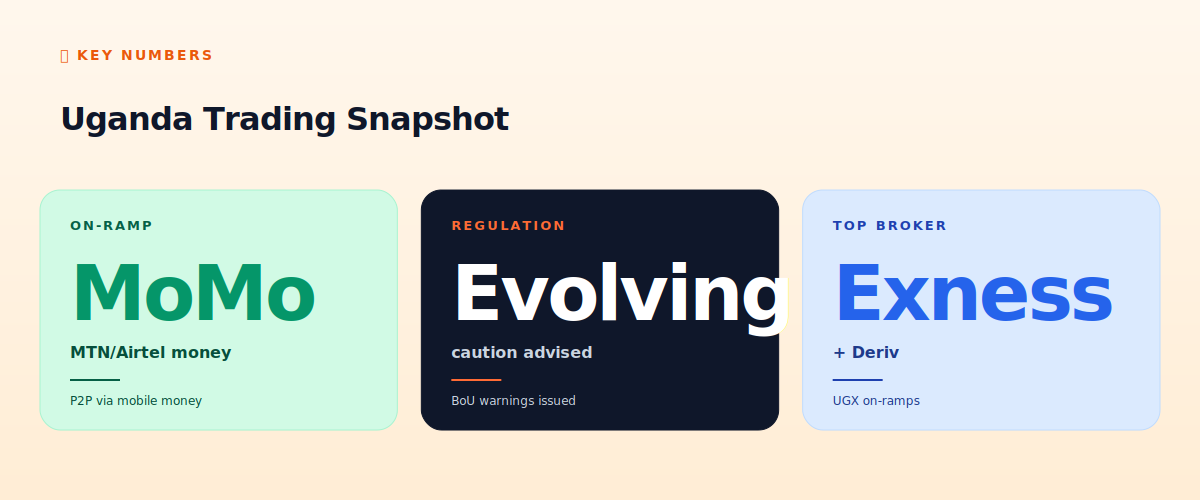
- On-ramp: MTN and Airtel mobile money — smooth P2P funding.
- Regulation: evolving; Bank of Uganda has issued caution. Verify current status.
- Best brokers: Exness, Deriv (synthetics popular in the region).
- Latency: EU or South African hosting; local options limited.
- Advantage: strong mobile money makes funding smooth.
- Watch out: evolving regulation and official caution — verify, stay informed.
Uganda trading snapshot
Funding your account — the mobile money advantage
Uganda has strong mobile money adoption through MTN Mobile Money and Airtel Money, which integrate with crypto P2P marketplaces. Like Kenya's M-Pesa and Ghana's MoMo, this lets Ugandans buy USDT via P2P (Binance, OKX) paying directly from mobile money — no traditional bank account required. The on-ramp is genuinely smooth, a real practical advantage shared across much of East Africa. Once you hold USDT, you can fund forex brokers or trade crypto.
The regulatory picture
Uganda's crypto regulatory framework is still developing. The Bank of Uganda has issued warnings and cautionary statements about cryptocurrency, reflecting a wary stance, even as usage grows. The framework is unsettled rather than clearly permissive or prohibitive. As with other evolving jurisdictions, verify the current status before committing significant capital, and be aware that official caution signals the authorities are watching the space. See our regional regulation guide. Not legal advice; consult a local professional, particularly given the cautionary official stance.
Best brokers for Ugandan traders
Exness is widely used across East Africa with mobile-money-friendly on-ramps and instant withdrawals (review), and Deriv is popular for synthetic indices, which have a following in the region (review). For crypto, Binance and OKX via mobile money P2P. The broker landscape mirrors Kenya and Tanzania — Exness and Deriv dominate East African retail.
Running an OpenClaw bot from Uganda
Local VPS options are limited, so Ugandan operators typically use EU hosting (reasonable forex latency) or South African datacenters (closer regionally) — the same approach as Kenya (VPS comparison). For crypto and Polymarket, the venue's servers matter most, so a stable EU/SA VPS works fine. A stable connection for setup is the main local requirement.
The honest reality for Ugandan traders
Uganda's mobile money advantage gives it accessible on-ramps, fitting the broader East African pattern. But the evolving regulation with official caution means Ugandan traders should verify the legal status and stay informed, and the universal trading-hype problem applies — Deriv 'strategies' and 'forex mentorship' schemes are promoted regionally and are usually the traps in our scam recognition guide. The smooth mobile-money on-ramp is an advantage for legitimate trading but also makes losing money easy. The sensible path: use the mobile-money convenience, verify the developing regulation, favor Exness/Deriv with realistic expectations, be skeptical of local hype, start small, and never risk money you can't lose.
📧 Get every new tutorial in your inbox
One email per week. Tutorials, CVE disclosures, broker updates. Unsubscribe in one click.
(Connect FluentCRM / ConvertKit / Beehiiv form here)
Frequently asked questions
How do I fund a trading account in Uganda?
MTN Mobile Money and Airtel Money — buy USDT via P2P (Binance, OKX) paying directly from mobile money, no bank account needed. Smooth, like Kenya's M-Pesa and Ghana's MoMo.
Is crypto trading legal in Uganda?
The framework is evolving and the Bank of Uganda has issued caution about crypto. It's unsettled rather than clearly permissive. Verify the current status with a local professional.
Which broker is best for Ugandans?
Exness (mobile-money-friendly, widely used in East Africa) and Deriv (synthetic indices, popular regionally). For crypto, Binance/OKX via mobile money P2P.
Can I run an OpenClaw bot from Uganda?
Yes — use EU or South African hosting (local options limited). For crypto/Polymarket, the venue's servers matter most. A stable connection for setup is the main need.
What should Ugandan traders watch out for?
Evolving regulation with official caution (verify and stay informed), and the regional trading hype — Deriv 'strategies' and 'mentorship' schemes are usually traps. The easy on-ramp makes losing fast easy.
What to read next
- OpenClaw Trading in Kenya
- OpenClaw Trading in Tanzania
- Deriv Review 2026
- Crypto Regulation 2026: SEA, Africa, LATAM
Sources cited: The Hacker News (CVE-2026-25253 disclosure, Feb 2026); Conscia 2026 OpenClaw Security Crisis advisory; Snyk ToxicSkills study; Cyber Press ClawHavoc reporting; Wall Street Journal Polymarket profitability analysis (May 2026); Andrey Sergeenkov via The Defiant (April 2026); Akey, Grégoire, Harvie & Martineau, SSRN paper (March 2026); openclaw.ai official advisories; Peter Steinberger public statements on X. Bank of Uganda statements; mobile money P2P data; not current legal authority — framework evolving.