Not legal or tax advice. Regulations and tax rules vary and change frequently. Consult a qualified local professional before acting. Risk disclosure: Independent research finds 70–84% of Polymarket traders lose money (Sergeenkov, April 2026; Akey et al., SSRN, March 2026). Forex CFDs: 70–85% retail loss rate. Binary options: 80%+ in most jurisdictions. AI agents don't change these baselines. Full disclaimer. Affiliate disclosure: Links to brokers (Exness, Deriv, Binance, Bybit, OKX, IQ Option, Pocket Option, Quotex) may earn us a referral commission. Your costs don't change. Our ratings don't either.
India is one of the world's largest and fastest-growing crypto markets, with enormous retail interest and a young, tech-savvy population — but also one of the heaviest tax regimes on crypto anywhere. This hub covers what Indian traders specifically need: funding via UPI and local exchanges, the significant tax implications (30% on gains plus 1% TDS), the brokers that work, and running OpenClaw from anywhere in India.
India's combination of huge adoption, excellent payment infrastructure (UPI), and punishing taxes makes it a unique market — the on-ramps are great, but the tax math reshapes what strategies make sense.
TL;DR — The 30-second answer
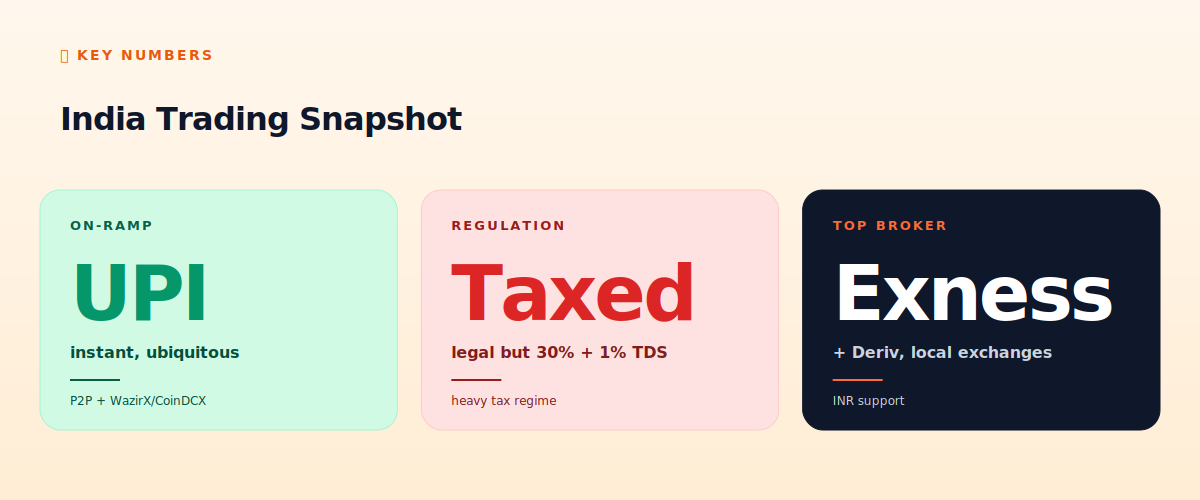
- On-ramp: UPI — instant and ubiquitous; plus WazirX, CoinDCX, P2P.
- Tax: heavy — 30% on crypto gains plus 1% TDS on every transaction.
- The TDS problem: 1% per transaction makes high-frequency strategies brutal.
- Best brokers: Exness, Deriv for forex; local exchanges for crypto on-ramp.
- Latency: reasonable to Singapore/EU datacenters. DigitalOcean SG.
- Watch out: the 1% TDS reshapes strategy — favor low-frequency approaches.
India trading snapshot
Funding your account — UPI is excellent
India's UPI (Unified Payments Interface) is one of the best instant-payment systems in the world — ubiquitous, instant, and free. Funding crypto via UPI is smooth: local exchanges (WazirX, CoinDCX, others) accept UPI directly, and P2P marketplaces (Binance, OKX) support it. For forex brokers, INR-friendly funding is widely available. The on-ramp experience for Indian traders is genuinely excellent — comparable to Brazil's PIX as among the smoothest in our audience.
The tax reality — this changes everything
India imposes one of the heaviest crypto tax regimes globally, and it fundamentally shapes what strategies make sense:
- 30% flat tax on crypto gains, with no deduction for losses against other income and no offsetting losses against gains in many cases.
- 1% TDS (Tax Deducted at Source) on every transaction above a small threshold. This is the killer for active trading.
The 1% TDS is the critical issue for bot traders. A high-frequency strategy that trades many times incurs the 1% deduction on each transaction — which compounds into a massive drag. A strategy making hundreds of trades could see its capital steadily eroded by TDS regardless of profitability. This effectively rules out high-frequency strategies (grid trading, scalping) for Indian traders and strongly favors low-frequency, longer-hold approaches (DCA, swing trades, funding arbitrage with infrequent rebalancing). The tax regime doesn't just cost money — it reshapes which strategies are viable. See our regional regulation guide, and consult a local tax professional, because the specifics matter enormously here.
Best brokers and exchanges for Indian traders
For forex, Exness and Deriv are widely used by Indian traders (Exness review, Deriv review), though note that the regulatory status of forex trading for Indian residents has its own complexities — verify the current rules. For crypto, local exchanges (WazirX, CoinDCX) offer the smoothest INR on-ramp and handle TDS compliance domestically, which simplifies your tax situation versus international venues. Many Indian traders use local exchanges specifically for the built-in tax handling.
Running an OpenClaw bot from India
Latency from India to Singapore datacenters is reasonable (~50-80ms), making DigitalOcean Singapore a solid host; EU datacenters also work for forex (VPS comparison). India's strong tech infrastructure and large developer community make setup straightforward. But the strategy you run should account for the tax regime — an OpenClaw bot for an Indian trader should favor low-frequency approaches that minimize the TDS drag, not the high-frequency strategies that work elsewhere.
The honest reality for Indian traders
India's massive adoption and excellent UPI on-ramps are matched by a tax regime that genuinely reshapes the game. The 1% TDS makes active, high-frequency trading punishing — a structural disadvantage that favors patient, low-frequency strategies. Combined with the universal 70-84% retail loss rate and India's enormous 'trading guru' ecosystem on YouTube and Telegram (much of it the hype we debunk in hype vs reality), Indian traders face real headwinds. The sensible path: use the great on-ramps, favor low-frequency strategies that minimize TDS, comply carefully with the heavy tax rules, ignore the gurus, and keep expectations realistic. The infrastructure is excellent; the tax math demands patience.
📧 Get every new tutorial in your inbox
One email per week. Tutorials, CVE disclosures, broker updates. Unsubscribe in one click.
(Connect FluentCRM / ConvertKit / Beehiiv form here)
Frequently asked questions
How do I fund a trading account in India?
UPI is excellent — instant, ubiquitous, free. Local exchanges (WazirX, CoinDCX) accept it directly; P2P marketplaces support it too. Among the smoothest on-ramps anywhere.
What taxes apply to crypto in India?
Heavy: 30% flat tax on gains (no loss offset in many cases) plus 1% TDS on every transaction. The TDS especially reshapes which strategies are viable. Consult a local professional.
Why does the 1% TDS matter so much?
It's deducted on every transaction, so high-frequency strategies (grid, scalping) accrue massive drag. It strongly favors low-frequency approaches like DCA and swing trades.
Which broker is best for Indians?
Exness and Deriv for forex (verify current forex rules for residents). For crypto, local exchanges (WazirX, CoinDCX) offer the smoothest INR on-ramp with built-in TDS handling.
Can I run an OpenClaw bot from India?
Yes — DigitalOcean Singapore (~50-80ms) is a good host. But favor low-frequency strategies to minimize the TDS drag, not the high-frequency ones that work elsewhere.
What to read next
- Crypto Regulation 2026: SEA, Africa, LATAM
- DCA Bots: Automating Dollar-Cost Averaging
- Exness Review 2026
- OpenClaw Trading in Pakistan
Sources cited: The Hacker News (CVE-2026-25253 disclosure, Feb 2026); Conscia 2026 OpenClaw Security Crisis advisory; Snyk ToxicSkills study; Cyber Press ClawHavoc reporting; Wall Street Journal Polymarket profitability analysis (May 2026); Andrey Sergeenkov via The Defiant (April 2026); Akey, Grégoire, Harvie & Martineau, SSRN paper (March 2026); openclaw.ai official advisories; Peter Steinberger public statements on X. Indian crypto tax framework (30% + 1% TDS); UPI and local exchange data; not current legal authority.