Risk disclosure: Independent research finds 70–84% of Polymarket traders lose money (Sergeenkov, April 2026; Akey et al., SSRN, March 2026). Forex CFDs: 70–85% retail loss rate. Binary options: 80%+ in most jurisdictions. AI agents don't change these baselines. Full disclaimer. Prediction markets: 84.1% of Polymarket wallets are in the red (Sergeenkov, April 2026). Affiliate disclosure: Links to brokers (Exness, Deriv, Binance, Bybit, OKX, IQ Option, Pocket Option, Quotex) may earn us a referral commission. Your costs don't change. Our ratings don't either.
Polymarket is the largest prediction market in the world, with $3.1 billion in monthly volume and markets on everything from elections to crypto prices to the weather. It's also the venue behind the viral profit stories (the $437K trader, the weather bots) and the sobering aggregate data (84.1% of wallets in the red). For non-US traders, it's the default prediction market — with significant caveats.
We've covered Polymarket extensively across the site. This review consolidates the assessment: liquidity, regulation, markets, bot support, and the verdict. Overall: 3.9/5 — the biggest and most capable, dragged down by regulatory exposure and the grim aggregate trader data.
TL;DR — The 30-second answer
- Rating: 3.9/5. The biggest prediction market, with the biggest caveats.
- Regulation: offshore, US-blocked (CFTC settlement 2022). Operates as DeFi.
- Standout: $3.1B volume, broadest markets, best bot API in the category.
- Watch out for: US-blocked; 84.1% of wallets lose; you track your own taxes.
- OpenClaw fit: good — CLOB API + polyclaw skill, active community.
- Best for: non-US traders wanting maximum liquidity and market variety.
Scorecard
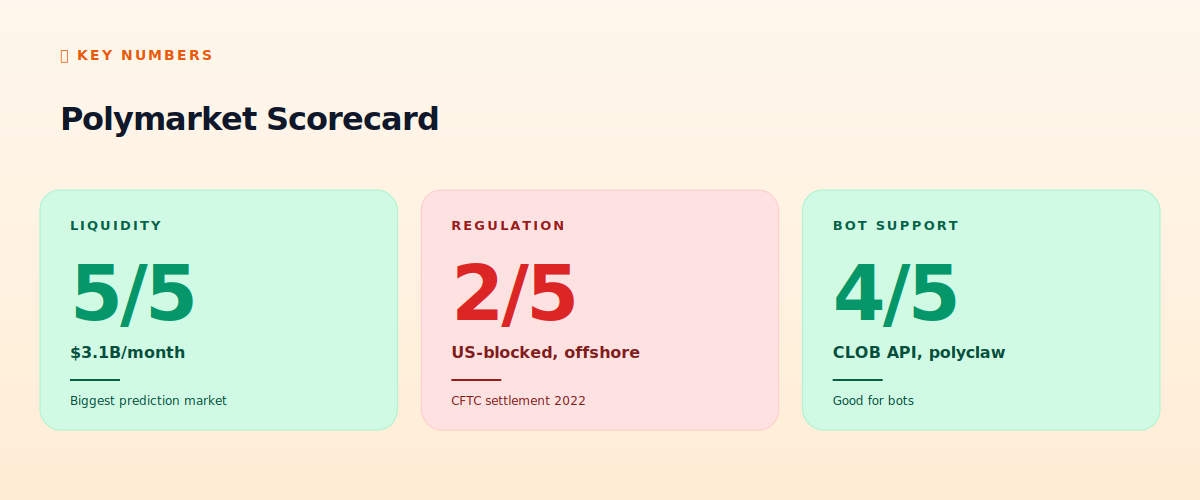
Liquidity — the category leader
Polymarket's $3.1B monthly volume is roughly 7x Kalshi's and dwarfs every other prediction market. This depth means tighter spreads on popular markets, the ability to size up without moving prices, and active trading across thousands of markets. For bots, liquidity is the most important property, and Polymarket has the most of it in the category.
The liquidity concentrates in high-profile markets (elections, major crypto events) while long-tail markets can be thin. But the depth on the markets that matter is the best available in prediction trading.
Markets — the broadest selection
Anyone can propose a Polymarket market, so the selection is vast: politics, crypto prices, sports, weather, pop culture, geopolitics, and endless custom long-tail. This breadth is a strength (something for every strategy) and a weakness (illiquid niche markets, occasional ambiguous resolution criteria). The weather markets in particular have become a profitable niche for bots — see our weather bots guide.
Regulation — the weak point
Polymarket settled with the CFTC in 2022 ($1.4M) and geo-blocks US residents. It operates offshore, classifying itself as a DeFi protocol. For US persons, this means Polymarket is off-limits — using a VPN violates the Terms of Service and may carry legal risk (we don't recommend it). For non-US traders in our core audience, Polymarket generally operates, though local crypto regulations apply. We cover the jurisdiction details in our tax and legal guide.
The regulatory exposure creates tail risk: future enforcement actions in your jurisdiction could restrict access. And because settlement is on-chain (USDC on Polygon), you're responsible for your own tax tracking — no 1099 forms, unlike Kalshi.
The aggregate trader data
The honest context for any Polymarket review: 84.1% of wallets are in the red (Sergeenkov, April 2026, analyzing 2.5M wallets), and the top 0.1% capture 67% of all profits (WSJ, May 2026). The viral success stories are real but wildly unrepresentative. We cover this fully in Polymarket Explained. This isn't a knock on the platform — it's the nature of speculative trading — but it's essential context.
API and OpenClaw compatibility
Polymarket's CLOB API (REST + WebSocket) is the best in the prediction-market category for bots. There's an active developer community, the maintained polyclaw OpenClaw skill, and good documentation. Our complete bot guide walks through the setup. Bot support is genuinely strong — more developed than Kalshi's.
The main friction is the blockchain layer: you need a Polygon wallet, USDC, and you pay gas per transaction. For high-frequency strategies, gas costs add up. But for most OpenClaw bots, the API experience is the best in prediction markets.
Pros and cons
Pros: largest liquidity in the category ($3.1B/mo); broadest market selection; best bot API and most active developer community; profitable niches (weather, latency arb) genuinely exist.
Cons: US-blocked (CFTC settlement); regulatory tail risk; you track your own taxes (no 1099); 84.1% of wallets lose; gas costs on high-frequency strategies; occasional oracle-resolution disputes.
The verdict
Polymarket earns 3.9/5 as the most capable prediction market, held back by regulatory exposure and the grim aggregate trader data (which applies to the activity, not the platform's quality). For non-US traders in our core audience, it's the default choice — the liquidity, market variety, and bot support are unmatched. Just go in with realistic expectations: most lose, you track your own taxes, and US persons should use Kalshi instead.
Use Polymarket if: you're non-US and want maximum liquidity and bot support. Use Kalshi if: you're a US resident who needs legal, tax-clean prediction trading.
📧 Get every new tutorial in your inbox
One email per week. Tutorials, CVE disclosures, broker updates. Unsubscribe in one click.
(Connect FluentCRM / ConvertKit / Beehiiv form here)
Frequently asked questions
Can US residents use Polymarket?
No. Polymarket geo-blocks US residents after a 2022 CFTC settlement. VPN use violates the ToS and may carry legal risk. US traders should use Kalshi.
Do most Polymarket traders profit?
No. 84.1% of wallets are in the red; the top 0.1% capture 67% of profits. The viral winners are real but unrepresentative.
Is Polymarket good for bots?
Yes — the best bot API in the prediction-market category, with an active developer community and the polyclaw OpenClaw skill.
Does Polymarket report taxes?
No. Settlement is on-chain (USDC on Polygon); you track your own taxes. Crypto tax software can import via your Polygon address.
What about oracle disputes?
Polymarket uses UMA, which resolves 99%+ of markets without dispute. The disputed minority makes headlines but isn't the norm.
What to read next
Sources cited: The Hacker News (CVE-2026-25253 disclosure, Feb 2026); Conscia 2026 OpenClaw Security Crisis advisory; Snyk ToxicSkills study; Cyber Press ClawHavoc reporting; Wall Street Journal Polymarket profitability analysis (May 2026); Andrey Sergeenkov via The Defiant (April 2026); Akey, Grégoire, Harvie & Martineau, SSRN paper (March 2026); openclaw.ai official advisories; Peter Steinberger public statements on X. CFTC 2022 settlement; Polymarket CLOB docs; Sergeenkov/The Defiant (April 2026); WSJ (May 2026); our bot testing.