Risk disclosure: Independent research finds 70–84% of Polymarket traders lose money (Sergeenkov, April 2026; Akey et al., SSRN, March 2026). Forex CFDs: 70–85% retail loss rate. Binary options: 80%+ in most jurisdictions. AI agents don't change these baselines. Full disclaimer. Prediction markets: 84.1% of Polymarket wallets are in the red (Sergeenkov, April 2026). Affiliate disclosure: Links to brokers (Exness, Deriv, Binance, Bybit, OKX, IQ Option, Pocket Option, Quotex) may earn us a referral commission. Your costs don't change. Our ratings don't either.
Kalshi is the only CFTC-regulated prediction market in the United States — which makes it the legal, tax-clean choice for US traders who want to bet on real-world events. Compared to Polymarket, Kalshi has smaller liquidity and narrower markets, but it makes up for it with regulatory legitimacy, automatic tax reporting, and the ability to operate without VPNs or legal gray areas.
We tested Kalshi's API and trading experience. This review covers regulation, liquidity, markets, fees, bot support, and the verdict. Overall: 4.0/5 — the compliant choice, with the trade-offs that compliance brings.
TL;DR — The 30-second answer
- Rating: 4.0/5. The CFTC-regulated, US-legal prediction market.
- Regulation: fully CFTC-regulated. The cleanest in the category.
- Standout: US-legal, automatic 1099 tax reporting, no VPN needed.
- Watch out for: smaller liquidity ($420M/mo) and narrower markets than Polymarket.
- OpenClaw fit: moderate — REST API, but KYC-gated and conservatively rate-limited.
- Best for: US traders who want compliant, tax-clean prediction trading.
Scorecard
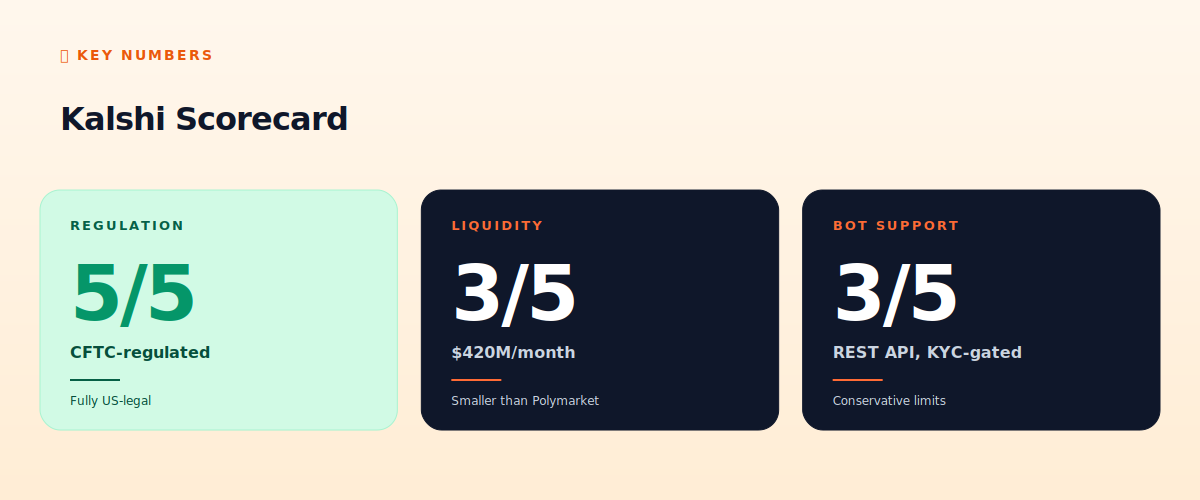
Regulation — the whole point
Kalshi is a CFTC-regulated Designated Contract Market (DCM). This is unique among prediction markets and is Kalshi's entire value proposition: it's fully legal for US residents, operates with regulatory oversight, segregates customer funds, and reports to the IRS automatically. Where Polymarket is geo-blocked in the US and operates offshore, Kalshi is the regulated, onshore alternative.
For US traders specifically, this matters enormously. You don't need a VPN, you're not violating any terms of service, and your tax situation is clean. We cover the comparison in detail in Polymarket vs Kalshi.
Liquidity and markets
Kalshi's 30-day volume is around $420M — roughly one-seventh of Polymarket's $3.1B. This means wider spreads on smaller markets and less depth for large positions. For most retail-sized trades, liquidity is adequate; for large bot operations, it can be constraining.
Markets are CFTC-approved and curated: economic indicators (CPI, Fed decisions, jobs reports), elections (with regulatory caveats), weather, and increasingly sports. No memes, no celebrity outcomes, no obscure long-tail markets. The trade-off: every Kalshi market has a clearly-defined, dispute-resistant resolution source. You won't get the oracle-dispute surprises that occasionally hit Polymarket.
Fees
Kalshi charges a settlement fee (roughly $0.50 per $100 of contract value, varying by market) but no spread markup on its central order book. Free ACH deposits and withdrawals for verified US accounts. No gas fees (it's not blockchain-based). Total cost per trade is generally lower than Polymarket's gas-plus-spread once you account for Polygon network costs.
API and OpenClaw compatibility
Kalshi offers a REST API, but it's KYC-gated (you need a verified account and must request API access) and conservatively rate-limited — designed for low-frequency strategies, not high-frequency trading. There's a maintained kalshi-py client. For OpenClaw bots running at LLM speed, the rate limits are fine; for aggressive multi-strategy operations, they can constrain.
The bot experience is less developed than Polymarket's — fewer community skills, less documentation, smaller developer community. You're more on your own. But the API is clean and reliable for what it does.
Pros and cons
Pros: CFTC-regulated and US-legal; automatic tax reporting (1099); no VPN needed; dispute-resistant market resolution; free ACH; no gas fees; segregated customer funds.
Cons: smaller liquidity than Polymarket; narrower market selection; KYC-gated, conservatively rate-limited API; less developed bot ecosystem; US-focused (non-US users typically can't access).
The verdict
Kalshi earns 4.0/5 as the compliant prediction market. For US traders, it's the clear choice — legal, tax-clean, regulated. The trade-offs (smaller liquidity, narrower markets, less bot flexibility) are the price of legitimacy. For non-US traders in our core audience, Kalshi typically isn't accessible (it requires a US bank account), so Polymarket remains the practical option.
Use Kalshi if: you're a US resident who wants legal, tax-clean prediction trading. Use Polymarket if: you're non-US and want maximum liquidity and market variety.
📧 Get every new tutorial in your inbox
One email per week. Tutorials, CVE disclosures, broker updates. Unsubscribe in one click.
(Connect FluentCRM / ConvertKit / Beehiiv form here)
Frequently asked questions
Is Kalshi legal in the US?
Yes. It's a CFTC-regulated Designated Contract Market — fully legal for US residents, no VPN or workaround needed.
How is Kalshi different from Polymarket?
Kalshi is US-regulated, USD-settled, tax-reported, with narrower markets and smaller liquidity. Polymarket is offshore, crypto-settled, US-blocked, with broader markets and 7x the volume.
Does Kalshi report to the IRS?
Yes, automatically (1099 forms). This is a major advantage over Polymarket, where you track your own taxes.
Can non-US residents use Kalshi?
Generally no — it requires a US bank account. Non-US traders typically use Polymarket instead.
Is Kalshi good for bots?
Moderately. REST API is clean but KYC-gated and conservatively rate-limited. Fine for LLM-speed OpenClaw bots, less so for high-frequency operations.
What to read next
Sources cited: The Hacker News (CVE-2026-25253 disclosure, Feb 2026); Conscia 2026 OpenClaw Security Crisis advisory; Snyk ToxicSkills study; Cyber Press ClawHavoc reporting; Wall Street Journal Polymarket profitability analysis (May 2026); Andrey Sergeenkov via The Defiant (April 2026); Akey, Grégoire, Harvie & Martineau, SSRN paper (March 2026); openclaw.ai official advisories; Peter Steinberger public statements on X. Kalshi CFTC DCM designation; Kalshi public metrics and API docs; our API testing.