Not legal or tax advice. Regulations and tax rules vary and change frequently. Consult a qualified local professional before acting. Risk disclosure: Independent research finds 70–84% of Polymarket traders lose money (Sergeenkov, April 2026; Akey et al., SSRN, March 2026). Forex CFDs: 70–85% retail loss rate. Binary options: 80%+ in most jurisdictions. AI agents don't change these baselines. Full disclaimer. Affiliate disclosure: Links to brokers (Exness, Deriv, Binance, Bybit, OKX, IQ Option, Pocket Option, Quotex) may earn us a referral commission. Your costs don't change. Our ratings don't either.
Turkey has one of the world's highest rates of crypto adoption, driven substantially by persistent lira inflation that pushes Turks toward crypto as a store of value — much like Argentina. Crypto trading is legal and regulated, though using crypto for payments is banned. This hub covers funding, the regulatory picture, the inflation-hedge context, and running OpenClaw from Istanbul, Ankara, or anywhere in Turkey.
Turkey is the Argentina of our second country round — crypto adoption driven by currency instability, deep liquidity, and a pragmatic 'preserve value' mindset alongside speculative trading. That context shapes everything.
TL;DR — The 30-second answer
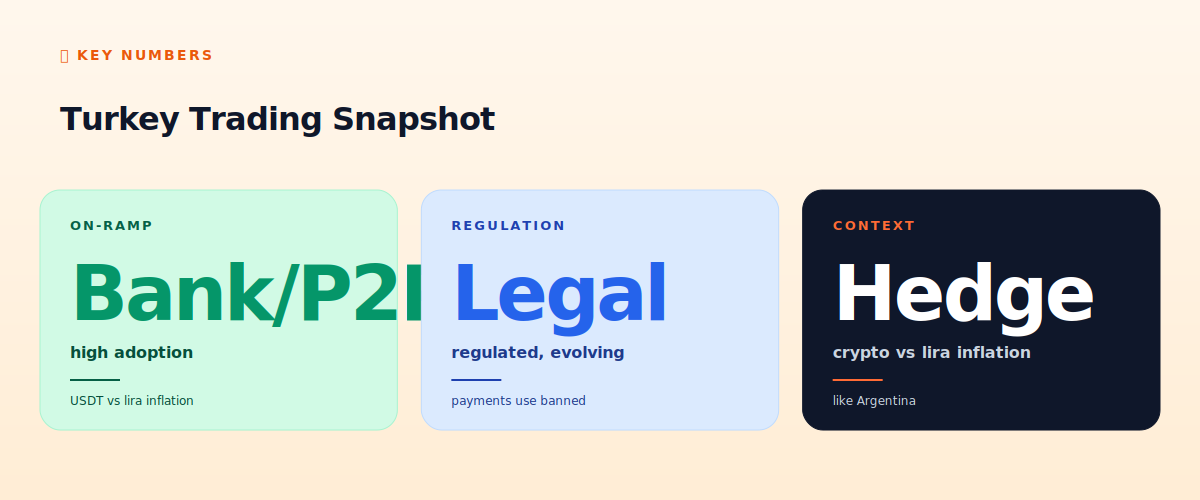
- On-ramp: bank transfer and P2P; very high adoption, deep liquidity.
- Regulation: trading legal and regulated; using crypto for payments is banned.
- Context: crypto as a hedge against lira inflation — like Argentina.
- Best venues: Binance (strong Turkey presence), local exchanges.
- Latency: EU datacenters close. Hetzner/DigitalOcean EU.
- Watch out: the payments ban; trading is fine but payment use isn't.
Turkey trading snapshot
Funding your account — deep liquidity
Turkey's very high crypto adoption creates deep P2P and exchange liquidity. Funding is typically via bank transfer to exchanges (Binance has a strong Turkish presence, and local exchanges operate) or P2P. The volume of Turkish crypto activity means good liquidity and competitive rates for the lira (TRY). Once you hold USDT or crypto, you can fund forex brokers or trade. The high adoption makes the on-ramp experience robust.
The inflation-hedge context
Like Argentina (see our Argentina hub), much of Turkey's crypto demand is driven by necessity rather than speculation. Persistent high inflation has eroded the lira's value, and many Turks hold USDT and crypto as a dollar-equivalent store of value to preserve purchasing power. This creates the deep liquidity and high adoption, and it shapes the trader mindset — crypto here is often about defense against inflation first, trading second. As with Argentina, there's a useful distinction: holding USDT to preserve value against inflation is sensible; expecting an AI bot to generate consistent trading profits faces the same 70-84% loss rate as everywhere. Know which game you're playing.
The regulatory picture — legal to trade, banned to pay
Turkey's regulatory stance has a specific feature to understand: crypto trading and holding are legal and regulated, but using crypto for payments is banned (the central bank prohibited crypto as a means of payment). So you can lawfully buy, hold, and trade crypto, but you can't use it to pay for goods and services. For traders, this distinction matters less — trading is the activity, and that's permitted — but it's important to understand the line. The framework has been developing toward clearer regulation. See our regional regulation guide. Not legal advice; verify the current rules and tax treatment with a local professional.
Best venues for Turkish traders
Binance has a strong Turkey presence and is the default for crypto bot trading with deep TRY liquidity (review). Local Turkish exchanges also operate and provide lira on-ramps. For forex, the usual international brokers (Exness and others) are used, with the standard caveat to verify the regulatory treatment of forex for Turkish residents. Given the inflation context, the crypto/USDT focus tends to dominate.
Running an OpenClaw bot from Turkey
Turkey's position gives reasonable latency to EU datacenters, making Hetzner or DigitalOcean EU sensible hosts (VPS comparison). The setup is straightforward with Turkey's solid connectivity. For crypto and Polymarket, the venue's servers matter most, so a stable EU VPS works well.
The honest reality for Turkish traders
Turkey's combination of high adoption, deep liquidity, legal trading status, and inflation-hedge motivation makes it a substantial crypto market. The pragmatic 'preserve value against inflation' foundation is healthier than pure speculation, but the trading-specific cautions still apply fully: bot trading for profit faces the 70-84% loss rate, and Turkey has its share of trading hype. Use the deep liquidity for legitimate purposes, understand the payments ban (it doesn't affect trading, but know the line), be clear whether you're hedging or speculating, comply with the regulations, and keep realistic expectations. The inflation context is real and understandable; it doesn't change the math of active trading.
📧 Get every new tutorial in your inbox
One email per week. Tutorials, CVE disclosures, broker updates. Unsubscribe in one click.
(Connect FluentCRM / ConvertKit / Beehiiv form here)
Frequently asked questions
Is crypto trading legal in Turkey?
Yes — trading and holding crypto are legal and regulated. However, using crypto for payments is banned by the central bank. For traders this is fine; trading is the permitted activity.
Why is crypto adoption so high in Turkey?
Persistent lira inflation drives Turks to hold USDT and crypto as a store of value, much like Argentina. Adoption is driven substantially by currency-hedging necessity, not just speculation.
How do I fund a trading account in Turkey?
Bank transfer to exchanges (Binance has a strong Turkish presence) or P2P. Very high adoption means deep liquidity and competitive lira rates.
What's the payments ban about?
Turkey's central bank prohibited using crypto as a means of payment for goods/services. You can lawfully buy, hold, and trade crypto — just not pay with it. The distinction matters less for traders.
Should I hedge or trade with crypto in Turkey?
Distinguish them: holding USDT against inflation is sensible; expecting bot trading profits faces the same 70-84% loss rate. Know which game you're playing.
What to read next
- OpenClaw Trading in Argentina
- Binance Review 2026
- Crypto Regulation 2026: SEA, Africa, LATAM
- OpenClaw Trading in Egypt
Sources cited: The Hacker News (CVE-2026-25253 disclosure, Feb 2026); Conscia 2026 OpenClaw Security Crisis advisory; Snyk ToxicSkills study; Cyber Press ClawHavoc reporting; Wall Street Journal Polymarket profitability analysis (May 2026); Andrey Sergeenkov via The Defiant (April 2026); Akey, Grégoire, Harvie & Martineau, SSRN paper (March 2026); openclaw.ai official advisories; Peter Steinberger public statements on X. Turkish regulatory framework (trading legal, payments banned); inflation and adoption context; not current legal authority.