Not legal or tax advice. Regulations and tax rules vary and change frequently. Consult a qualified local professional before acting. Risk disclosure: Independent research finds 70–84% of Polymarket traders lose money (Sergeenkov, April 2026; Akey et al., SSRN, March 2026). Forex CFDs: 70–85% retail loss rate. Binary options: 80%+ in most jurisdictions. AI agents don't change these baselines. Full disclaimer. Affiliate disclosure: Links to brokers (Exness, Deriv, Binance, Bybit, OKX, IQ Option, Pocket Option, Quotex) may earn us a referral commission. Your costs don't change. Our ratings don't either.
Argentina has one of the world's highest rates of crypto adoption, driven by a practical need: persistent inflation has made Argentines turn to USDT and crypto as a store of value. For traders, this means deep P2P liquidity and a population fluent in crypto — but also a regulatory and economic environment in flux. This hub covers funding via P2P, the exchanges and brokers that work with the peso (ARS), the evolving regulatory picture, and running OpenClaw from Buenos Aires or anywhere in Argentina.
Argentina is unique in our audience: crypto here is less about speculation and more about survival against inflation. That shapes everything — the deep USDT demand, the P2P liquidity, and the trader mindset.
TL;DR — The 30-second answer
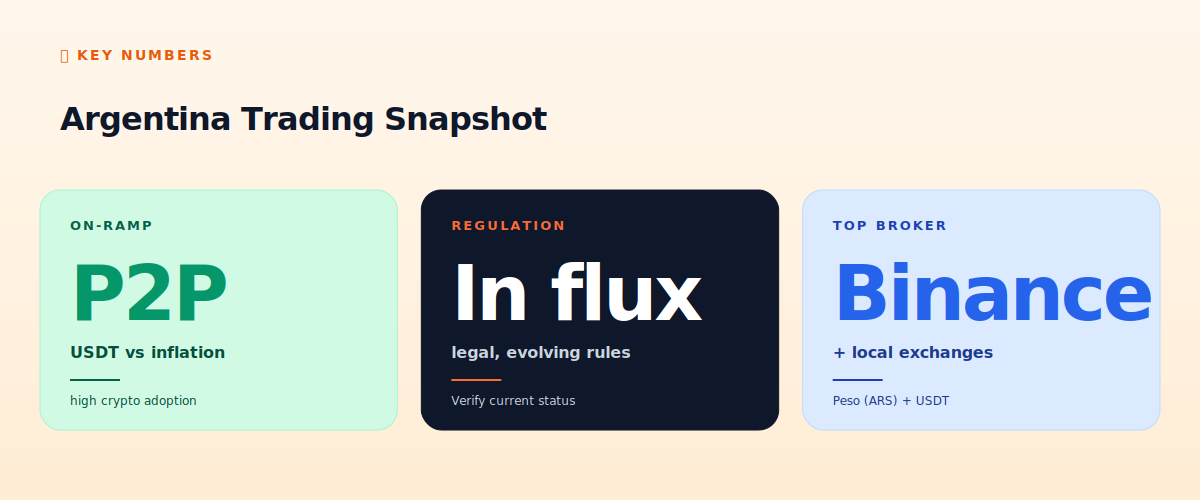
- On-ramp: P2P dominant — USDT as inflation hedge drives huge volume.
- Regulation: legal but in flux amid economic changes. Verify current status.
- Best venues: Binance, local exchanges (Lemon, Bel, Ripio); P2P liquidity deep.
- Latency: US or local hosting. DigitalOcean US datacenters reasonable.
- Context: crypto is an inflation hedge first, speculation second.
- Watch out for: rules and capital controls shift — stay informed.
Argentina trading snapshot
Funding your account — P2P and the inflation context
Argentina's crypto scene is unlike anywhere else in our audience because it's driven by necessity. With persistent high inflation eroding the peso, millions of Argentines hold USDT as a dollar-equivalent store of value. This creates enormous P2P liquidity — buying and selling USDT for pesos is a daily activity for a huge population. You fund through P2P (Binance, local exchanges) paying in pesos, and the deep liquidity means good rates and fast settlement. Local exchanges like Lemon, Bel, Buenbit, and Ripio are widely used and integrate with the local banking system.
The regulatory picture — in flux
Argentina's crypto situation is legal but unsettled, and it's been changing amid broader economic reforms. The country has gone through significant economic policy shifts, and crypto's regulatory and tax treatment has evolved alongside — including questions around capital controls, currency restrictions, and how crypto holdings are treated. This is one of the more fluid situations in our audience. Verify the current status before making decisions. See our regional regulation guide. Not legal advice — and given Argentina's flux, professional local guidance is especially worthwhile.
Best venues for Argentine traders
For crypto bot trading, Binance offers the deepest liquidity and best API, funded via peso P2P (review). Local exchanges (Lemon, Bel, Ripio, Buenbit) are excellent for the fiat on-ramp and are deeply integrated with Argentine banking — many traders use a local exchange to convert pesos to USDT, then move to Binance for bot trading. For forex, options exist but the crypto/USDT focus dominates given the inflation context. The practical pattern: local exchange for on-ramp, Binance for bots.
Running an OpenClaw bot from Argentina
US datacenters offer reasonable latency from Argentina, and there are some local hosting options. For Polymarket and international crypto, DigitalOcean's US datacenters work well (VPS comparison). The main consideration is a stable connection and payment method for the VPS itself — given currency controls, paying for international hosting sometimes requires using crypto or a card that works internationally.
The honest reality for Argentine traders
Argentina's relationship with crypto is the most pragmatic in our audience — it's a tool against inflation first. That practical foundation is healthier than pure speculation, but the trading-specific cautions still apply: bot trading for profit (as opposed to holding USDT against inflation) faces the same 70-84% loss rate, and Argentina has its share of crypto-trading hype. There's a useful distinction here: using USDT to preserve value against inflation is sensible; expecting an AI bot to generate consistent trading profits is the same hope that produces the loss statistics. Use OpenClaw with clear eyes about which game you're playing, verify the shifting regulatory situation, and stay informed about capital controls that can affect moving money.
📧 Get every new tutorial in your inbox
One email per week. Tutorials, CVE disclosures, broker updates. Unsubscribe in one click.
(Connect FluentCRM / ConvertKit / Beehiiv form here)
Frequently asked questions
Why is crypto adoption so high in Argentina?
Persistent inflation drives Argentines to hold USDT as a dollar-equivalent store of value. Crypto here is an inflation hedge first, speculation second — creating deep P2P liquidity.
How do I fund a trading account in Argentina?
P2P dominates — buy USDT for pesos via Binance or local exchanges (Lemon, Bel, Ripio). Deep liquidity means good rates and fast settlement.
Is crypto trading legal in Argentina?
Legal but in flux amid economic reforms. Treatment of holdings, capital controls, and tax have been changing. Verify current status with a local professional.
Which venue is best for Argentines?
Local exchanges (Lemon, Bel, Ripio) for the fiat on-ramp, Binance for bot trading (best liquidity/API). The common pattern is local for on-ramp, Binance for bots.
Should I use crypto for trading or saving in Argentina?
Distinguish the two: holding USDT against inflation is sensible; expecting an AI bot to generate consistent profits faces the same 70-84% loss rate. Know which game you're playing.
What to read next
Sources cited: The Hacker News (CVE-2026-25253 disclosure, Feb 2026); Conscia 2026 OpenClaw Security Crisis advisory; Snyk ToxicSkills study; Cyber Press ClawHavoc reporting; Wall Street Journal Polymarket profitability analysis (May 2026); Andrey Sergeenkov via The Defiant (April 2026); Akey, Grégoire, Harvie & Martineau, SSRN paper (March 2026); openclaw.ai official advisories; Peter Steinberger public statements on X. Argentine economic and crypto policy developments; local exchange and P2P data; not current legal authority — situation fluid.