Not legal or tax advice. Regulations and tax rules vary and change frequently. Consult a qualified local professional before acting. Risk disclosure: Independent research finds 70–84% of Polymarket traders lose money (Sergeenkov, April 2026; Akey et al., SSRN, March 2026). Forex CFDs: 70–85% retail loss rate. Binary options: 80%+ in most jurisdictions. AI agents don't change these baselines. Full disclaimer. Affiliate disclosure: Links to brokers (Exness, Deriv, Binance, Bybit, OKX, IQ Option, Pocket Option, Quotex) may earn us a referral commission. Your costs don't change. Our ratings don't either.
Mexico is Latin America's second-largest crypto market, with a fintech-friendly legal framework and strong local exchanges like Bitso. For traders, Mexico offers solid on-ramps via SPEI (the bank transfer system) and Bitso, a defined legal status for crypto, and growing AI trading interest. This hub covers funding, the brokers and exchanges that work with the peso, the regulatory picture, and running OpenClaw from Mexico City, Guadalajara, or anywhere in Mexico.
Mexico's proximity to US datacenters and Bitso's strong local presence make it well-positioned for LATAM traders, with reasonable regulatory clarity under the Fintech Law.
TL;DR — The 30-second answer
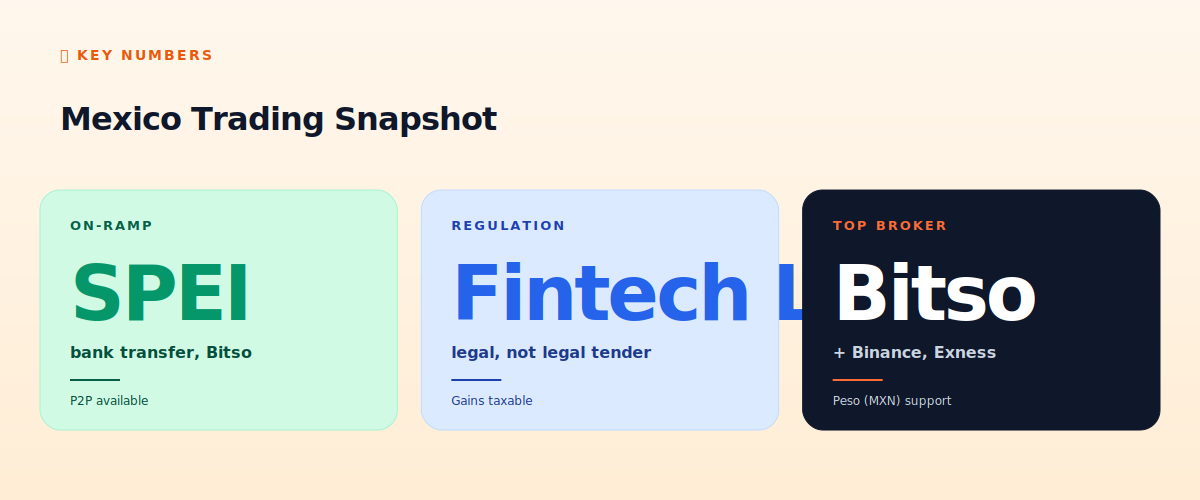
- On-ramp: SPEI bank transfer, Bitso (strong local exchange); P2P available.
- Regulation: Fintech Law framework. Crypto legal, not legal tender.
- Tax: gains taxable; treatment defined under existing rules.
- Best brokers: Bitso (local crypto), Binance, Exness (forex).
- Latency: US datacenters very close. DigitalOcean US, or local.
- Advantage: Bitso's local presence + US datacenter proximity.
Mexico trading snapshot
Funding your account
Mexico has solid on-ramps. SPEI (the interbank electronic payment system) enables fast bank transfers, and Bitso — the leading Mexican crypto exchange — integrates SPEI directly for smooth peso-to-crypto funding. Bitso is genuinely good and widely trusted locally. International P2P (Binance, OKX) provides additional liquidity. The combination of SPEI and Bitso makes funding straightforward for Mexican traders.
The regulatory picture
Mexico's Fintech Law (Ley Fintech) provides a framework that addresses crypto, though crypto is legal as an asset rather than legal tender. The regulatory environment is relatively permissive, with Bitso and others operating within the framework. Gains are taxable under existing tax rules. See our regional regulation guide. The specifics continue to evolve, so — not legal advice — consult a local professional, particularly on tax treatment of trading gains.
Best brokers and exchanges for Mexican traders
Bitso is the standout local option — a trusted Mexican exchange with SPEI integration, good for fiat on-ramps and spot crypto. For bot trading with maximum liquidity and API support, Binance remains the choice (review), often funded via Bitso or P2P. For forex, Exness supports Mexican traders with peso-friendly funding (review). Many traders use Bitso for the on-ramp and Binance for bots.
Running an OpenClaw bot from Mexico
Mexico's proximity to US datacenters is a real advantage — latency from Mexico City to US-East or US-Central datacenters is low. For Polymarket (US-East RPC) and US-accessible crypto, US hosting gives excellent latency. DigitalOcean's US datacenters or a local Mexican VPS both work well. Follow our VPS comparison — for Mexico, DigitalOcean's US datacenters are a strong pick.
The honest reality for Mexican traders
Mexico's Bitso ecosystem, US datacenter proximity, and reasonable regulatory clarity make it well-positioned for LATAM bot traders. But Mexico, like Brazil, has a large trading-influencer culture promoting forex and crypto 'opportunities,' much of it the hype we cover in hype vs reality. The 70-84% retail loss rate applies regardless of how good Bitso is. Use the genuine advantages for disciplined, legitimate trading, leverage the US latency for appropriate strategies, declare your gains, and ignore the guru promises.
📧 Get every new tutorial in your inbox
One email per week. Tutorials, CVE disclosures, broker updates. Unsubscribe in one click.
(Connect FluentCRM / ConvertKit / Beehiiv form here)
Frequently asked questions
How do I fund a trading account in Mexico?
SPEI bank transfer and Bitso (the leading local exchange with SPEI integration) for smooth peso-to-crypto. International P2P adds liquidity.
Is crypto trading legal in Mexico?
Yes — legal as an asset (not legal tender) under the Fintech Law framework. Relatively permissive. Gains are taxable.
Which exchange is best for Mexicans?
Bitso is the trusted local option for fiat on-ramps and spot. Binance for bot trading (best liquidity/API). Many use both.
Can I run an OpenClaw bot from Mexico?
Yes, and well — US datacenter proximity gives excellent latency for Polymarket and US-accessible crypto. DigitalOcean US datacenters are a strong pick.
Do I pay tax on crypto gains in Mexico?
Yes — gains are taxable under existing rules. Specifics evolve; consult a local professional on treatment.
What to read next
- Binance Review 2026
- OpenClaw Trading in Brazil
- OpenClaw Trading in Argentina
- Crypto Regulation 2026: SEA, Africa, LATAM
Sources cited: The Hacker News (CVE-2026-25253 disclosure, Feb 2026); Conscia 2026 OpenClaw Security Crisis advisory; Snyk ToxicSkills study; Cyber Press ClawHavoc reporting; Wall Street Journal Polymarket profitability analysis (May 2026); Andrey Sergeenkov via The Defiant (April 2026); Akey, Grégoire, Harvie & Martineau, SSRN paper (March 2026); openclaw.ai official advisories; Peter Steinberger public statements on X. Mexican Fintech Law; Bitso and SPEI data; not current legal authority.