Important: crypto and/or forex trading carries significant legal and regulatory risk in this jurisdiction. This is not legal advice — verify the current law and consult a qualified local professional before doing anything. Risk disclosure: Independent research finds 70–84% of Polymarket traders lose money (Sergeenkov, April 2026; Akey et al., SSRN, March 2026). Forex CFDs: 70–85% retail loss rate. Binary options: 80%+ in most jurisdictions. AI agents don't change these baselines. Full disclaimer. Affiliate disclosure: Links to brokers (Exness, Deriv, Binance, Bybit, OKX, IQ Option, Pocket Option, Quotex) may earn us a referral commission. Your costs don't change. Our ratings don't either.
Egypt has a large population, a young demographic, and growing interest in crypto as a hedge against currency pressures — but also a cautious regulatory stance with restrictions that traders must understand. This hub covers funding via P2P, the brokers used, the evolving and partly-restrictive regulatory picture, and running OpenClaw from Egypt, with appropriate emphasis on the legal caveats.
Like several markets in this round, Egypt requires careful attention to the legal layer. The interest is real and the on-ramps function, but the regulatory environment carries caveats that we'll be direct about.
TL;DR — The 30-second answer
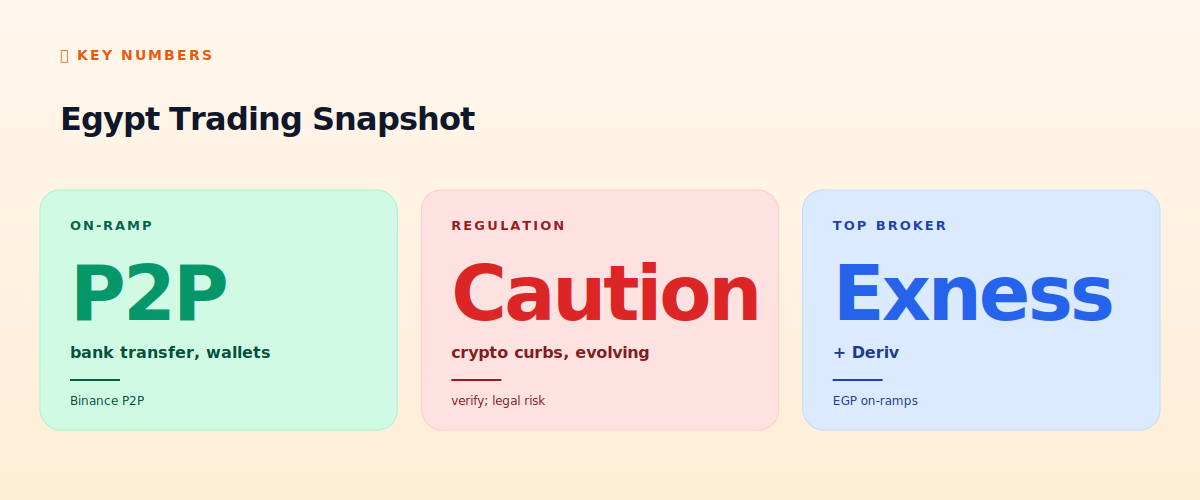
- On-ramp: P2P via bank transfer and wallets; Binance P2P used.
- Regulation: cautious/restrictive and evolving — real legal caveats. Verify.
- Context: interest partly driven by hedging against currency pressure.
- Best brokers: Exness, Deriv for forex.
- Latency: reasonable to EU datacenters.
- Watch out: the regulatory stance has restrictions — understand the law first.
Egypt trading snapshot
The regulatory picture — understand it first
Egypt's authorities, including the central bank, have taken a cautious stance toward cryptocurrency, with restrictions and warnings rather than a permissive framework. The regulatory environment has carried real caveats — crypto trading is not as clearly settled as in markets like Brazil or South Africa. As with other restrictive jurisdictions in this round, the most important step for an Egyptian trader is to understand the current legal position before acting, via a qualified local professional. The framework may evolve, but you need to know where it stands now. See our regional regulation guide. This is not legal advice, and the caveat carries real weight here.
The currency-hedging context
Part of Egypt's crypto interest, as in Argentina and Turkey, stems from currency pressure — the Egyptian pound has faced significant devaluation, and some Egyptians look to crypto (particularly USDT) as a way to preserve value against a weakening local currency. This is a recurring theme in emerging markets with currency instability: crypto adoption driven by practical hedging rather than pure speculation. It's an understandable motivation, though it sits alongside the regulatory caveats — the desire to hedge doesn't change the legal situation, which must be understood independently.
Funding and brokers
Where lawful and where it functions, funding is typically via P2P (Binance, OKX) using bank transfer or local wallets. For forex, Exness and Deriv are used by Egyptian traders (Exness review, Deriv review), with the usual caveat to verify the regulatory treatment of forex for Egyptian residents. As always in restrictive environments, the legal question of whether and how you can lawfully use these venues precedes the mechanical question of how to fund them.
Running an OpenClaw bot from Egypt
Latency from Egypt to EU datacenters is reasonable, making EU hosting (Hetzner, DigitalOcean) a sensible choice (VPS comparison). The technical setup is straightforward; as elsewhere in this round, the legal consideration dominates. Understand your legal position before running a live trading bot, and let that determine whether and how you proceed.
The honest reality for Egyptian traders
Egypt combines genuine grassroots interest (large young population, currency-hedging motivation) with a cautious, partly-restrictive regulatory stance that demands careful attention to the law. The hedging instinct is understandable, but it doesn't resolve the legal caveats — those must be understood independently and professionally. On top of the regulatory layer, the universal cautions apply: most retail traders lose, the hype is pervasive, and no AI bot or signal service changes the odds. For Egyptian readers, the sensible path is to understand the legal position fully first, proceed only if there's a lawful route, start small, be skeptical of the hype, and never risk money you can't afford to lose.
📧 Get every new tutorial in your inbox
One email per week. Tutorials, CVE disclosures, broker updates. Unsubscribe in one click.
(Connect FluentCRM / ConvertKit / Beehiiv form here)
Frequently asked questions
Is crypto trading legal in Egypt?
Egypt's authorities have taken a cautious-to-restrictive stance with warnings and restrictions, not a permissive framework. It carries real legal caveats — understand the current position via a local professional before acting.
Why is there crypto interest in Egypt despite restrictions?
Partly currency hedging — the pound has faced devaluation, so some look to crypto (USDT) to preserve value, as in Argentina and Turkey. But the hedging motivation doesn't change the legal situation.
How do I fund a trading account in Egypt?
Where lawful and functioning, P2P via Binance/OKX using bank transfer or local wallets. But the legal question of whether you can lawfully use these venues comes first.
Which broker is best for Egyptians?
Exness and Deriv for forex, with the caveat to verify the regulatory treatment of forex for Egyptian residents.
What should an Egyptian trader do first?
Understand the current legal position via a qualified local professional. The regulatory consideration dominates; let it determine whether and how you proceed.
What to read next
- Crypto Regulation 2026: SEA, Africa, LATAM
- OpenClaw Trading in Argentina
- Exness Review 2026
- OpenClaw Trading in Ghana
Sources cited: The Hacker News (CVE-2026-25253 disclosure, Feb 2026); Conscia 2026 OpenClaw Security Crisis advisory; Snyk ToxicSkills study; Cyber Press ClawHavoc reporting; Wall Street Journal Polymarket profitability analysis (May 2026); Andrey Sergeenkov via The Defiant (April 2026); Akey, Grégoire, Harvie & Martineau, SSRN paper (March 2026); openclaw.ai official advisories; Peter Steinberger public statements on X. Egyptian regulatory stance; currency and P2P context; not current legal authority.