Important: crypto and/or forex trading carries significant legal and regulatory risk in this jurisdiction. This is not legal advice — verify the current law and consult a qualified local professional before doing anything. Risk disclosure: Independent research finds 70–84% of Polymarket traders lose money (Sergeenkov, April 2026; Akey et al., SSRN, March 2026). Forex CFDs: 70–85% retail loss rate. Binary options: 80%+ in most jurisdictions. AI agents don't change these baselines. Full disclaimer. Affiliate disclosure: Links to brokers (Exness, Deriv, Binance, Bybit, OKX, IQ Option, Pocket Option, Quotex) may earn us a referral commission. Your costs don't change. Our ratings don't either.
Morocco presents a notable case: despite an official ban on cryptocurrency, it has one of the higher rates of crypto usage in North Africa, with significant grey-area P2P activity. This creates a genuinely complicated situation that Moroccan traders must understand clearly. This hub leads with the legal reality — the ban — because for Morocco, that has to come first, and we won't pretend otherwise.
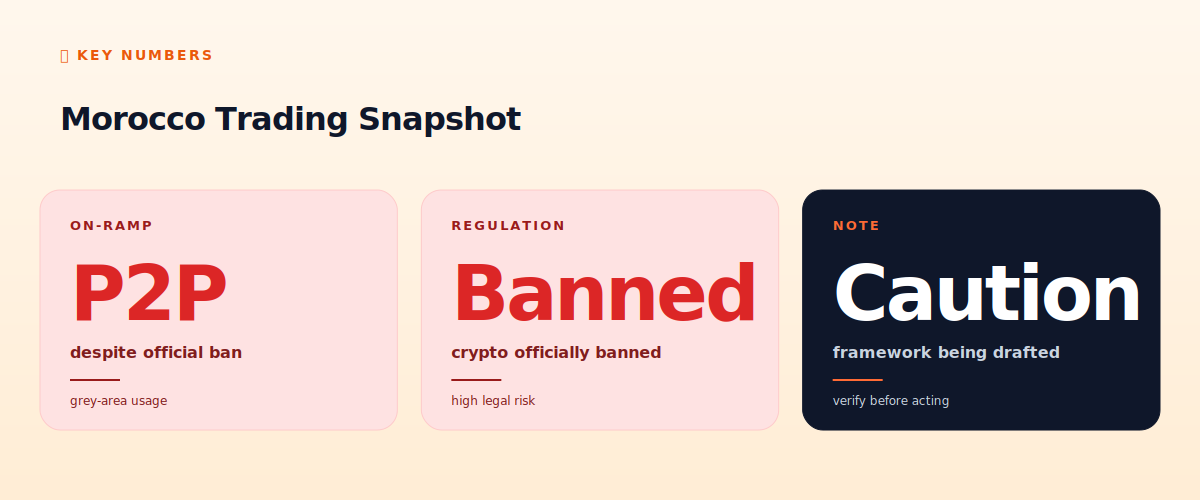
We're going to be direct: crypto is officially banned in Morocco, even though usage persists. That contradiction defines the Moroccan situation, and the legal risk is real. This guide prioritizes making sure you understand that before anything else.
TL;DR — The 30-second answer
- Crucial caveat: crypto is officially banned in Morocco — high legal risk.
- The contradiction: usage persists in a grey area despite the ban.
- This guide leads with the law because the ban must come first.
- A framework is reportedly being drafted — the situation may change. Verify.
- The honest advice: understand the legal position fully before considering anything.
- Not legal advice — consult a qualified local professional; the risk is genuine.
Morocco trading snapshot
The ban — why this comes first
Morocco officially banned cryptocurrency transactions, and that prohibition has been the legal baseline. Unlike jurisdictions where crypto is merely unregulated or ambiguous, Morocco's stance has been an explicit ban. This is the single most important fact for a Moroccan reader: crypto trading exists in a prohibited legal space, and engaging in it carries real legal risk. We lead with this because it would be irresponsible to walk through on-ramps and broker setups as if the activity were lawful when it officially isn't. The legal question dominates everything else here.
The contradiction: usage despite the ban
Despite the official ban, Morocco has seen significant crypto usage — one of the higher rates in North Africa — through grey-area P2P channels. This is the contradiction that defines the Moroccan situation: a prohibition that hasn't eliminated grassroots usage. But persistent usage does not make it legal, and the existence of grey-area activity does not reduce the legal risk to any individual. People using crypto despite the ban are operating in prohibited territory, whatever the practical prevalence. We note the usage to be accurate about the situation, not to suggest it's safe or advisable.
A changing situation
There have been reports that Morocco's authorities are working on a regulatory framework that could eventually legalize and regulate crypto under defined rules — potentially moving from outright ban to regulated activity. If that materializes, the situation would change significantly. But until and unless a new framework is actually in force, the ban is the operative legal reality. This makes verifying the current status especially important for Moroccan readers — the law may be in transition, and you need to know exactly where it stands now, for you, before considering anything. See our regional regulation guide. This is not legal advice; a qualified local professional is essential here.
What this means practically
Given the official ban, our honest guidance for Moroccan readers mirrors what we said for other restrictive jurisdictions, but more strongly: understand your legal position fully before considering any crypto trading activity. The technical details — P2P methods, brokers, VPS, OpenClaw setup — are entirely secondary to the legal question of whether you can lawfully trade at all, and the current answer has been 'no' for crypto. We're not going to provide a funding walkthrough that presumes lawfulness. If Morocco's reported framework comes into force and legalizes regulated crypto activity, the general principles elsewhere on the site would apply — but that's conditional on the law actually changing, which you must verify.
The honest reality for Moroccan traders
Morocco's situation is defined by the contradiction between an official ban and persistent grey-area usage, with a possible regulatory framework in the works. For a Moroccan reader, the responsible takeaway is unambiguous: the legal status (officially banned, possibly changing) is the dominant consideration, and you must understand it — via a qualified local professional — before anything else. The grassroots usage doesn't make it safe or legal. If and when Morocco regulates crypto, the landscape will shift; until then, proceed only with full awareness of the legal reality. And the universal cautions still apply on top: most retail traders lose, the hype is pervasive, and no scheme changes those odds — legal risk aside.
📧 Get every new tutorial in your inbox
One email per week. Tutorials, CVE disclosures, broker updates. Unsubscribe in one click.
(Connect FluentCRM / ConvertKit / Beehiiv form here)
Frequently asked questions
Is crypto legal in Morocco?
No — Morocco officially banned cryptocurrency transactions, and that prohibition has been the legal baseline. Crypto trading exists in a prohibited space carrying real legal risk. Verify the current status with a local professional.
But people use crypto in Morocco anyway?
Yes, in grey-area P2P channels — one of the higher usage rates in North Africa despite the ban. But persistent usage doesn't make it legal or reduce the legal risk to any individual.
Is the ban changing?
There have been reports of a regulatory framework being drafted that could eventually legalize regulated crypto. If it comes into force, the situation changes. Until then, the ban is operative — verify the current status.
What should a Moroccan trader do first?
Understand your legal position fully via a qualified local professional. The legal question (officially banned, possibly changing) dominates all the technical details.
Why doesn't this guide give a funding walkthrough?
Because it would be irresponsible to presume lawfulness when crypto is officially banned. The legal question comes first; technical details are secondary and conditional on the law.
What to read next
- Crypto Regulation 2026: SEA, Africa, LATAM
- OpenClaw Trading in Egypt
- AI Trading Hype vs Reality
- OpenClaw Trading in Ghana
Sources cited: The Hacker News (CVE-2026-25253 disclosure, Feb 2026); Conscia 2026 OpenClaw Security Crisis advisory; Snyk ToxicSkills study; Cyber Press ClawHavoc reporting; Wall Street Journal Polymarket profitability analysis (May 2026); Andrey Sergeenkov via The Defiant (April 2026); Akey, Grégoire, Harvie & Martineau, SSRN paper (March 2026); openclaw.ai official advisories; Peter Steinberger public statements on X. Moroccan crypto ban and reported framework developments; not current legal authority — crypto officially banned.