Important: crypto and/or forex trading carries significant legal and regulatory risk in this jurisdiction. This is not legal advice — verify the current law and consult a qualified local professional before doing anything. Risk disclosure: Independent research finds 70–84% of Polymarket traders lose money (Sergeenkov, April 2026; Akey et al., SSRN, March 2026). Forex CFDs: 70–85% retail loss rate. Binary options: 80%+ in most jurisdictions. AI agents don't change these baselines. Full disclaimer. Affiliate disclosure: Links to brokers (Exness, Deriv, Binance, Bybit, OKX, IQ Option, Pocket Option, Quotex) may earn us a referral commission. Your costs don't change. Our ratings don't either.
Bangladesh has a large population and growing fintech adoption (notably bKash), but it also has some of the more restrictive policies toward crypto and forex trading in our audience. This hub is unusually focused on the legal picture, because for Bangladeshi traders, understanding the law comes before anything else. We'll cover the restrictions honestly, what they mean practically, and why caution is paramount here.
This guide leads with a serious caveat: crypto and forex trading face real restrictions in Bangladesh, and the legal risk is significant. We're not going to gloss over that. If you're a Bangladeshi reader, the most valuable thing this guide can do is make sure you understand the legal reality before anything else.
TL;DR — The 30-second answer
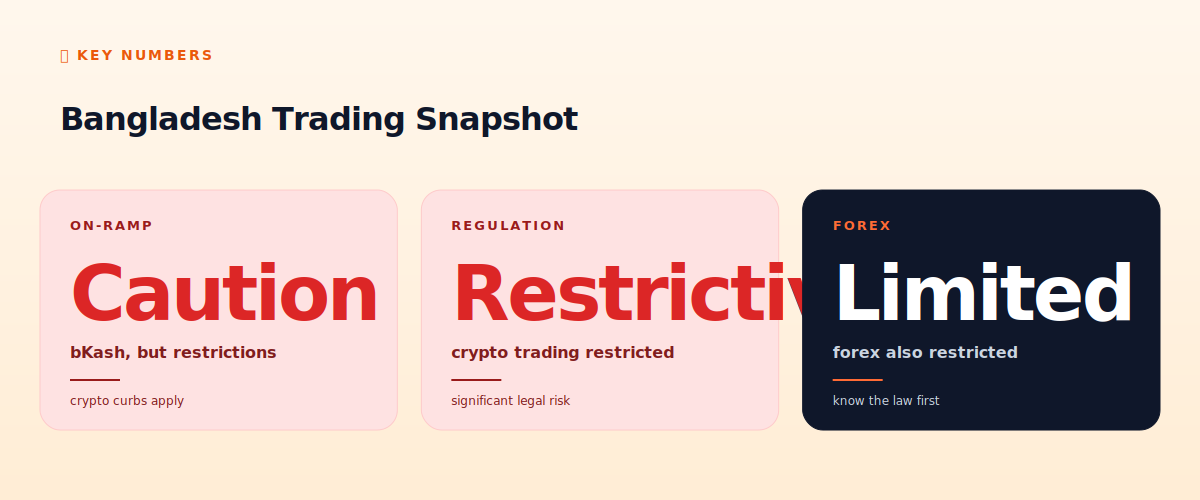
- Crucial caveat: crypto trading is restricted in Bangladesh — significant legal risk.
- Forex too: retail forex faces restrictions; foreign-broker trading is legally fraught.
- This guide leads with the law because it must — understand it first.
- On-ramps: bKash exists but crypto restrictions complicate everything.
- The honest advice: understand the legal position fully before considering anything.
- Not legal advice — consult a qualified local professional; the risk is real.
Bangladesh trading snapshot
Why this guide leads with the law
For most countries in our audience, we cover on-ramps first and regulation second. For Bangladesh, we reverse that deliberately, because the legal situation is restrictive enough that it must come first. Crypto trading has faced significant restrictions in Bangladesh, with the central bank and authorities taking a notably cautious-to-prohibitive stance. Retail forex trading through foreign brokers also faces legal complications. This isn't a jurisdiction where you can assume trading is fine and just figure out the payment method — the legal layer is the dominant consideration, and getting it wrong carries real risk.
The crypto restrictions
Bangladesh's authorities have historically treated cryptocurrency with significant caution, including warnings and restrictions on its use. The legal status has been restrictive rather than permissive. This means crypto trading in Bangladesh carries genuine legal risk — it's not a settled, clearly-legal activity the way it is in, say, Brazil or Thailand. We strongly emphasize: verify the current legal status with a qualified local professional before doing anything. The situation may evolve (many countries are developing clearer frameworks over time), but you must know where it stands now, for you, before acting. See our regional regulation guide for broader context — but Bangladesh sits at the restrictive end.
The forex picture
Retail forex trading through international brokers also faces legal complications in Bangladesh, related to foreign-exchange controls and the regulatory framework. This is another area where the legal reality is more restrictive than in many neighboring markets, and where Bangladeshi traders need to understand their actual legal position rather than assuming international forex brokers are freely accessible. Again: this is not legal advice, and the specifics require a local professional.
What this means practically
Given the restrictive environment, the honest practical guidance for Bangladeshi readers is unusual for this series: understand your legal position fully before considering any trading activity. The technical aspects — on-ramps, brokers, VPS hosting, OpenClaw setup — are secondary to the legal question of whether and how you can lawfully trade at all. We're not going to walk through funding methods and broker setups as if the legal situation were settled, because it isn't, and doing so would be irresponsible. The bKash mobile-money system exists and is widely used for legitimate payments, but the crypto restrictions complicate its use for trading purposes.
The honest reality for Bangladeshi traders
We'll be straight: Bangladesh is one of the more legally restrictive environments in our audience for crypto and forex trading, and that fact dominates everything else. The grassroots interest is real — large population, growing fintech — but the legal framework has been restrictive, and the risk of running afoul of it is genuine. Our honest advice for Bangladeshi readers is to prioritize understanding the law (via a qualified local professional) above all the technical details this site otherwise focuses on. If, after proper legal guidance, you find a lawful path, then the general principles elsewhere on the site apply — but the legal question comes first, and we won't pretend otherwise. On top of all this, the universal cautions hold: 70-84% of retail loses, the hype is everywhere, and no signal seller changes that.
📧 Get every new tutorial in your inbox
One email per week. Tutorials, CVE disclosures, broker updates. Unsubscribe in one click.
(Connect FluentCRM / ConvertKit / Beehiiv form here)
Frequently asked questions
Is crypto trading legal in Bangladesh?
Crypto has faced significant restrictions in Bangladesh, with a cautious-to-prohibitive official stance. It carries genuine legal risk — it's not a settled, clearly-legal activity. Verify the current status with a local professional before anything.
Can I trade forex in Bangladesh?
Retail forex through international brokers faces legal complications related to foreign-exchange controls. The legal reality is more restrictive than in many neighboring markets. Verify your actual position.
Why does this guide focus so much on the law?
Because for Bangladesh, the legal situation is restrictive enough that it must come before on-ramps, brokers, or setup. Getting the legal question wrong carries real risk.
What should a Bangladeshi trader do first?
Understand your legal position fully via a qualified local professional, before considering any trading activity. The technical details are secondary to whether and how you can lawfully trade.
Could the rules change?
Possibly — many countries are developing clearer frameworks over time. But you must know where the law stands now, for you, before acting. Don't assume future liberalization.
What to read next
- Crypto Regulation 2026: SEA, Africa, LATAM
- AI Trading Hype vs Reality
- OpenClaw Trading in India
- OpenClaw Trading in Pakistan
Sources cited: The Hacker News (CVE-2026-25253 disclosure, Feb 2026); Conscia 2026 OpenClaw Security Crisis advisory; Snyk ToxicSkills study; Cyber Press ClawHavoc reporting; Wall Street Journal Polymarket profitability analysis (May 2026); Andrey Sergeenkov via The Defiant (April 2026); Akey, Grégoire, Harvie & Martineau, SSRN paper (March 2026); openclaw.ai official advisories; Peter Steinberger public statements on X. Bangladeshi regulatory stance on crypto and forex; not current legal authority — environment is restrictive.